

100% Pass Guaranteed Accurate HPE7-A07 Answers 365 Days Free Updates
HPE7-A07 DUMPS Q&As with Explanations Verified & Correct Answers
HP HPE7-A07 Exam Syllabus Topics:
| Topic | Details |
|---|---|
| Topic 1 |
|
| Topic 2 |
|
| Topic 3 |
|
| Topic 4 |
|
| Topic 5 |
|
| Topic 6 |
|
| Topic 7 |
|
NEW QUESTION # 39
You configured a WPA3-SAE with the following MAC Authentication Role Mapping inCloud Authentication and Policy: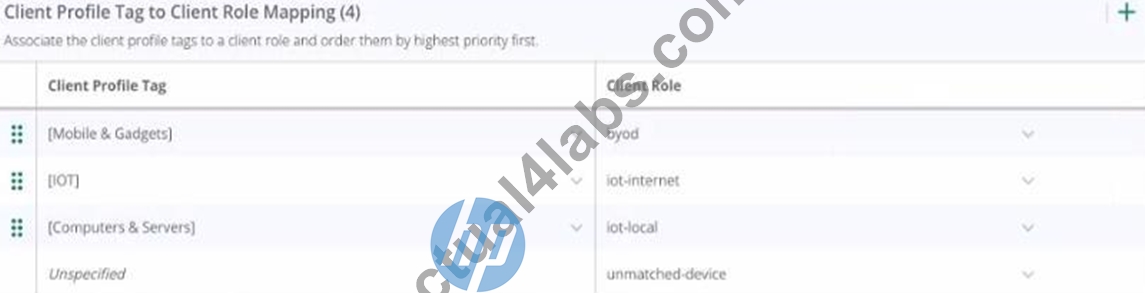
With further default settings assume a new Android phone is connected to the network. Which role will the client be assigned after connecting forthe first time?
- A. lot-local
- B. byod
- C. unmatched-device
- D. client will be rejected network access
Answer: C
Explanation:
The configuration shown in the third exhibit details a client role mapping that associates different client profile tags with specific client roles. When a new device, such as an Android phone, connects to the network, it will be profiled and assigned a role based on the mappings defined. If the device does not match any predefined profiles, it would be assigned the "unmatched-device" role. This is under the assumption that default settings are in place and the client does not match the criteria for any of the specific roles like "byod", "iot-internet", or
"iot-local". Therefore, an Android phone connecting for the first time and not matching any specific profile tag would be assigned to the "unmatched-device" role.
NEW QUESTION # 40
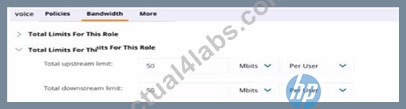
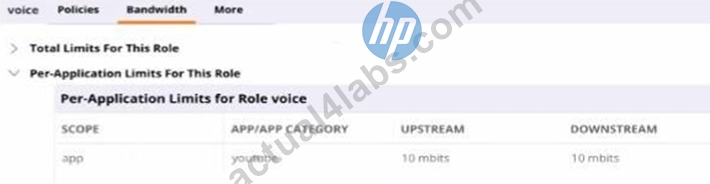
Anetworkadministrator accesses HPE Aruba Networking Central and notices that visitors consume too much internet bandwidth starving employee traffic when accessing an external service.Therefore,the administrator wants to limitwireless bandwidth to 60 Mops in both directions among all users in the voice rote and no more than 10 Mops in both directions for YouTube traffic. Deep packet inspection, web contentclassification, andfirewall visibility are enabled.
Which configurations are required to accomplish this task? (Select two.)
- A.
- B.

- C.

- D.
Answer: C,D
Explanation:
To achieve the bandwidth limits set by the network administrator, both per-application and total limits need to be configured. Option B shows the configuration for setting a per-application bandwidth limit, which can restrict YouTube traffic to 10 Mbps in both directions. Option D shows the configuration for setting a total bandwidth limit for all users within the voice role to 50000 Kbps (or 50 Mbps), satisfying the requirement to restrict total wireless bandwidth. By applying these configurations in HPE Aruba Networking Central, the administrator will successfully implement the necessary controls to ensure that visitor traffic does not impede the network performance for employee traffic, aligning with the capabilities of Aruba solutions to manage and prioritize network resources effectively.
NEW QUESTION # 41
An ACME company employee complained about a recent poor-quality VoIP call while moving aroundtheir office environment HPE Aruba Networking Central reported a fair UCC score for this callwhile your VoIP engineer reported that their systems reported a MOS of 2,3. The VoIP devices are operatingover the 5GHz frequency band.
What are the possible contributing factors? (Select two.)
- A. The client roamed into an area that continuously operates Zigbee.
- B. There was localized interference at the caller's location
- C. Coverage AP deployment plans generally don't support enough cell overlap for VoIP.
- D. 802.tr is enabled in the WLAN Security settings.
- E. 802.1K is disabled in the WLAN Security settings
Answer: A,C
Explanation:
VoIP quality can be negatively impacted by insufficient cell overlap in AP deployment plans, which can cause poor handoffs between APs as a user moves around. This results in a degraded VoIP experience. Additionally, roaming into an area with continuous Zigbee operation can cause interference with the 5GHz frequency band, further contributing to poor VoIP call quality. The Zigbee communication protocol operates on the same frequency band as Wi-Fi and can introduce noise and interference, which leads to a reduced MOS score, as reported by the VoIP engineer.
NEW QUESTION # 42
A customer would like to allow their IT Helpdesk to configure loT devices to connect lo a single SSID using a unique PSK that other devices cannot use. Which solution would you recommend?
- A. MPSK AES with MAC Auth
- B. MPSK Local
- C. MPSK AES with Cloud Auth
- D. MPSK AES with ClearPass
Answer: D
Explanation:
Multi-Pre-Shared Key (MPSK) with ClearPass is the recommended solution for a scenario where the IT Helpdesk needs to configure IoT devices to connect to a single SSID using unique PSKs. MPSK allows for the use of different PSKs on the same SSID, and ClearPass enables the management of these unique keys efficiently.
NEW QUESTION # 43
Refer to the CLI output below:
What statement about the output above is correct?
- A. The port-access role was configured with gateway-role visitor
- B. The client authenticated using dot1x.
- C. The secondary tunnel endpoint IP is 10.10-10.151.
- D. The UBT zone was configured to use a user-defined VRF
Answer: C
Explanation:
The CLI output indicates a tunnel creation process, where "SW hw tun created" refers to the switch hardware tunnel being created. The line mentioning "BYP-10.10.10.101 -> SW hw tun created to 10.10.10.151 tunnel
15." implies that a tunnel was established to the secondary tunnel endpoint with the IP address 10.10.10.151.
This is a common configuration for User-Based Tunneling (UBT) setups where traffic is tunneled to a specific endpoint.
NEW QUESTION # 44
A university owns a campus with several buildings segmented into east and west wings, which are L3 separated. The east wing has 1600 APs. and the west wing has 1200 Aps. Each wing has a single gateway cluster managed by HPE Aruba Networking Central. Each cluster contains one 7210 mobility gateway The gateways are configured with DHCP relay and route all client VLANs. A new business-critical facultyreal-time application requires users to roam within wings but not across wings without disconnections or delay increments.
Which changes must the network administrator make lo successfully meet the requirement without performance degradation matching best practices? (Select two.)
- A. Add a single 7210 mobility gateway to each cluster.
- B. Replace me 7210 mobility gateway in the east wing with a pair or 9012 mobility gateways
- C. Remove the DHCP relay from the gateways and enable the DHCP server instead
- D. Replace the 7210 mobility gateway in the west wing with a pair of 7030 mobility gateways.
- E. Run L2 for all SSIDs and permit the users' VLANs in the gateway's uplinks.
Answer: A,E
Explanation:
To support a business-critical faculty real-time application that requires seamless roaming within wings without cross-wing roaming, it's essential to ensure high availability and sufficient capacity. Adding an additional 7210 mobility gateway to each cluster would provide the required redundancy and capacity.
Running L2 for all SSIDs and permitting user VLANs on gateway uplinks would facilitate the necessary traffic flow without L3 segmentation issues, thus supporting seamless roaming within each wing.
NEW QUESTION # 45
Which data transmission method provides the most efficient use of airtime for VoIP traffic?
- A. OFDM
- B. TWT
- C. MU-MIMO
- D. FDMA
Answer: C
Explanation:
MU-MIMO (Multi-User, Multiple Input, Multiple Output) provides the most efficient use of airtime for VoIP traffic among the options listed. MU-MIMO allows multiple users to receive multiple data streams simultaneously, improving the overall efficiency of the network, especially in dense environments where VoIP applications need consistent and reliable connectivity.
NEW QUESTION # 46
A customer has deployed an AOS 10 mobility gateway cluster consisting of three controllers at a single site The WLAN is configured to tunnel wireless device traffic to the AOS 10 mobility cluster The clients are authenticated by ClearPass using WPA3-Enterprise (opmode wpa3-aes-ccm-128). The security team has requested the ability to force a wireless device to reauthenticate using ClearPass.
Which steps are required to ensure ClearPass can consistently initiate a change of authorization against an AOS 10 mobility cluster, including during gateway failover scenarios? (Select two)
- A. modify NAS IPv4 address under Security - Advanced - RADIUS Client
- B. modify WLAN - SSID - VLAN - Mode Configuration
- C. enable manual cluster configuration under High Availability - Cluster Configuration
- D. set cluster mode to Auto Site under High Availability - Cluster configuration
- E. enable Dynamic Authorization CoA under High Availability - Cluster Configuration
Answer: A,E
Explanation:
To ensure that ClearPass can initiate a Change of Authorization (CoA) consistently, it's important to enable dynamic authorization to allow RADIUS CoA messages to be processed. This setting typically falls under the high-availability cluster configuration to ensure that it persists across gateway failovers. Additionally, the NAS IP address must be configured under RADIUS client settings to ensure that the correct IP address is used for RADIUS communications, which is necessary for CoA to function correctly.
NEW QUESTION # 47
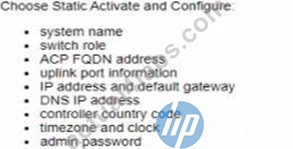
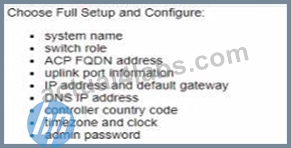
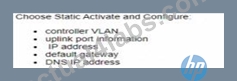
You are deploying a new AOS 10 mobility gateway cluster. Due to customer requirements, the gateways must be configured with static IP addresses and are restricted from communicating using port 443 to any URLs except tor "central arubanetworks.com How would you onboard these gateways successfully into HPE Aruba Networking Central?
- A.
- B.
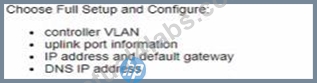
- C.
- D.
Answer: C
Explanation:
Option A includes all necessary steps for a full setup of an AOS 10 mobility gateway cluster, including setting the system name, switch role, ACP FQDN address, uplink port information, IP address and default gateway, DNS IP address, controller country code, timezone and clock, andadmin password. Since the gateways must have static IP addresses and can only communicate on port 443 for a specific URL, this configuration would need to allow for static IP configuration and restrict communication to the required URL.
NEW QUESTION # 48
What directly affects the MCS used by wireless stations? (Select two.)
- A. frequency band
- B. retry rate
- C. SNR
- D. channel utilization
- E. number of connected clients
Answer: A,C
Explanation:
The Modulation and Coding Scheme (MCS) used by wireless stations is directly affected by the signal-to-noise ratio (SNR) and the frequency band. Higher SNR can lead to higher MCS values, which means better data rates. The frequency band can affect MCS due to different channel characteristics, such as the presence of interference and propagation properties, which are factors in determining data rates.
NEW QUESTION # 49
Exhibit.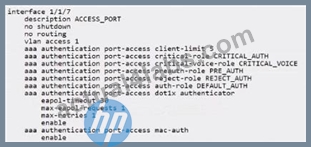
Which user role will be assigned when a voice client tries to connect for the first time, but the RADIUS server is unavailable?
- A. DEFAULT_AUTH
- B. CRIT1CAL_V0ICE
- C. PRE_AUTH
- D. CRITICAl_AUTH
Answer: B
Explanation:
In the provided configuration for interface 1/1/7, there are roles specified for different scenarios concerning authentication. When a voice client attempts to connect and the RADIUS server is unreachable, the role that is assigned is the one specified as the "critical-voice-role". In this case, the "CRITICAL_VOICE" role is configured to be assigned under such circumstances, ensuring that voice clients receive appropriate network access permissions even when the RADIUS server is not available to authenticate them.
NEW QUESTION # 50
A BGP routing tablecontains multiple routes to the same destination prefix.
Referring to the table below whichroutewould be marked with a ">" symbol?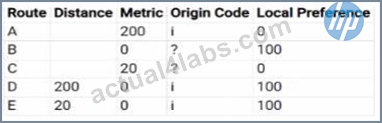
- A. Option A
- B. Option B
- C. Option D
- D. Option E
- E. Option C
Answer: D
Explanation:
In BGP, the route marked with a ">" symbol is the best route that is chosen based on BGP attributes in the following order: highest weight (Cisco-specific), highest local preference, originated by BGP running on the local router, shortest AS path, lowest origin type, lowest MED, eBGP over iBGP, closest IGP neighbor, and lowest BGP router ID. Based on the table provided, Option E would be marked with a ">" symbol as it has the highest local preference of 100 which is a decisive factor in the BGP best path selection process.
NEW QUESTION # 51
A customer wan a gateway connected to a device on gigabitethernet0/0/3 configures an Asset ID TLVon the device for inventory management.
Exhibit.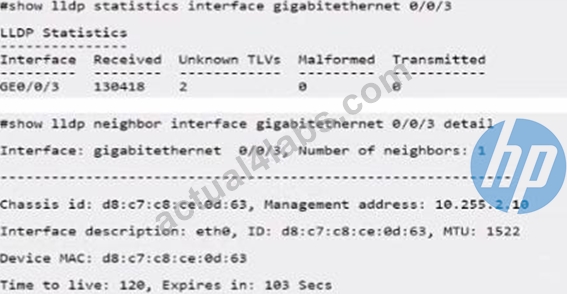
The customer mentions me Asset ID is not shown What is causing the issue?
- A. LLDP TX is not enabled.
- B. LLPD-MED needs to be enabled.
- C. Unknown TLVs cannot be displayed.
- D. MTU size is too small.
Answer: C
Explanation:
The issue is that unknown TLVs (Type Length Values) cannot be displayed. LLDP (Link Layer Discovery Protocol) is used to share device information with network neighbors, but if a TLV is not recognized by the LLDP implementation on the gateway, it won't be displayed or processed. Hence, the Asset ID TLV set on the device for inventory management is not showing up because it is unrecognized or unsupported by the gateway's LLDP.
NEW QUESTION # 52
Exhibit.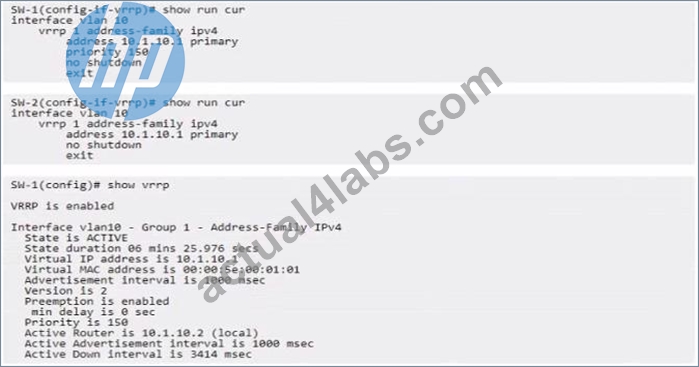
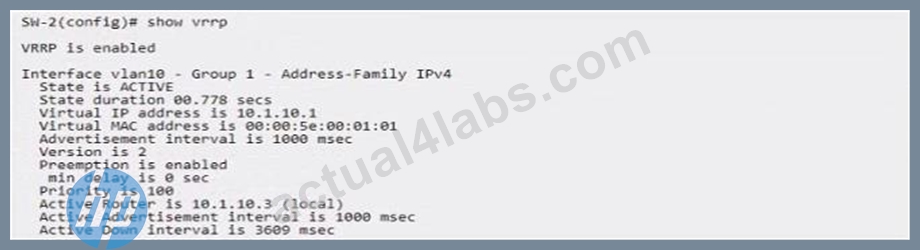
After configuring VRRP between sw-1 and SW-2. you notice that both switches are showing as active. What could be the reason for this issue?
- A. SW-1 cam reach SW-2 on VLAN 10.
- B. SW-2 has no priority configurations for VRRP 1.
- C. Both switches are configured as VRRP 'primary.'
- D. VRRP preemptive mode is disabled.
Answer: C
Explanation:
In VRRP (Virtual Router Redundancy Protocol), only one switch should be the primary (master) for a given virtual IP address, with the other switches being backups. If both switches are showing as active, it suggests a misconfiguration where both are set to act as the primary for the same VRRP group. The exhibits provided indicate that both switches believe they are the active or primary for the VRRP group, which is an incorrect configuration.
NEW QUESTION # 53
Exhibit.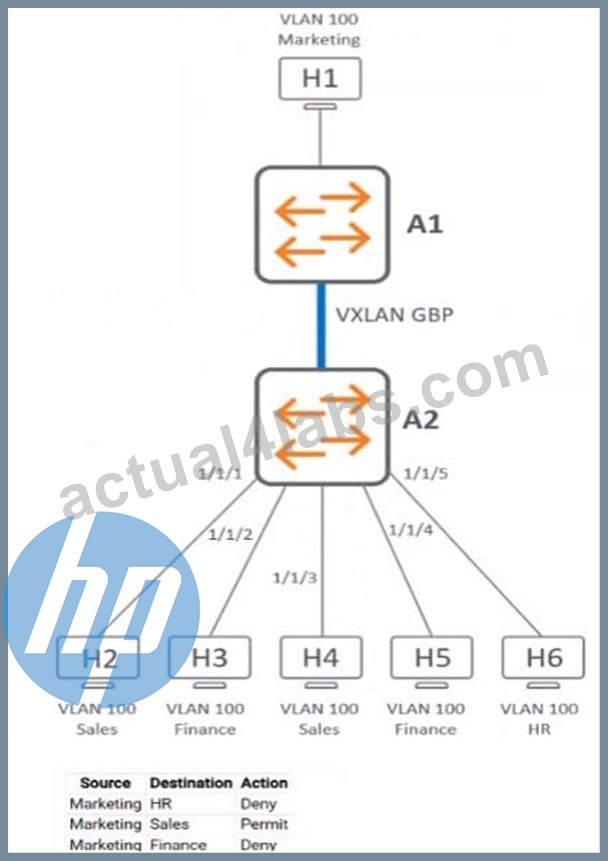
What is me expected behavior for ARP traffic sent from H1?
- A. A2 will drop the ARP traffic.
- B. A2 willflood the ARP traffic out of all interfaces.
- C. A2 will send the ARP traffic out of ports 1/1/1-1/1/4.
- D. A2 willsend the ARP traffic out of ports 1/1/1 and 1/1/3.
Answer: B
Explanation:
In a VXLAN environment, unknown unicast traffic, such as ARP requests from H1, which does not have a specific destination MAC address learned by the switch A2, will be flooded out of all interfaces. This flooding behavior is necessary because A2 needs to ensure that the ARP requestreaches its intended destination, which might be on any of the interfaces. It's a part of the standard behavior of switches to handle ARP traffic when the destination hardware address is unknown.
NEW QUESTION # 54
......
HPE7-A07 dumps Exam Material with 70 Questions: https://www.actual4labs.com/HP/HPE7-A07-actual-exam-dumps.html
HPE7-A07 Questions and Answers Guarantee you Oass the Test Easily: https://drive.google.com/open?id=1ZTeca6l0o1XjyLmQwFDVk1mVjm5nAynH