

2025 Updated HashiCorp HCVA0-003 Certification Study Guide Pass HCVA0-003 Fast
HCVA0-003 Dumps PDF 2025 Program Your Preparation EXAM SUCCESS
HashiCorp HCVA0-003 Exam Syllabus Topics:
| Topic | Details |
|---|---|
| Topic 1 |
|
| Topic 2 |
|
| Topic 3 |
|
| Topic 4 |
|
| Topic 5 |
|
NEW QUESTION # 25
According to the screenshot below, what auth method did this client use to log in to Vault?
(Screenshot shows a lease path: auth/userpass/login/student01)
- A. Child token
- B. Userpass
- C. Root token
- D. Auth
Answer: B
Explanation:
Comprehensive and Detailed in Depth Explanation:
The screenshot provides a lease path: auth/userpass/login/student01, which reveals the authentication method used to generate the token tied to this lease. Vault's auth methods create tokens at specific paths, and the path structure indicates the method.
* Option A: UserpassThe path auth/userpass/login/student01 explicitly includes userpass, matching the userpass auth method. This method authenticates users with a username (e.g., student01) and password, typically via vault login -method=userpass username=student01. The /login endpoint confirms a login operation, and the lease ties to the resulting token. This is the clear, correct answer based on the path.
Correct.Vault Docs Insight:"The userpass auth method allows users to authenticate with a username and password... mounted at auth/userpass by default." (Matches the path.)
* Option B: Auth"Auth" isn't an auth method-it's the namespace prefix (auth/) for all auth methods in Vault (e.g., auth/token, auth/userpass). The screenshot specifies userpass within auth/, not a generic
"auth" method. This option is a misnomer and incorrect.Vault Docs Insight:"All auth methods are mounted under auth/... 'auth' itself is not a method." (Clarifies structure.)
* Option C: Root tokenA root token is a privileged token type, not an auth method. It's created during Vault initialization or via auth/token/create with root privileges, not through a login path like auth
/userpass/login. The screenshot's path indicates a userpass login, not a root token usage. Incorrect.
Vault Docs Insight:"Root tokens are created at initialization... not tied to a specific auth method login path." (Distinct from userpass.)
* Option D: Child tokenA child token is a token created by a parent token (e.g., via vault token create), not an auth method. The path auth/userpass/login/student01 shows a login event, not a token creation event (which would be auth/token/create). This option confuses token hierarchy with authentication.
Incorrect.Vault Docs Insight:"Child tokens are created by parent tokens... not directly via login endpoints." (Different mechanism.) Detailed Mechanics:
When a user logs in with vault login -method=userpass -path=userpass username=student01, Vault hits the endpoint POST /v1/auth/userpass/login/student01 with a password payload. Success generates a token, and a lease is created at auth/userpass/login/student01 with a TTL. The screenshot's lease path directly reflects this process, pinpointing userpass as the method.
Real-World Example:
Enable userpass: vault auth enable userpass. Add user: vault write auth/userpass/users/student01 password=secret. Login: vault login -method=userpass username=student01. The token's lease appears as auth
/userpass/login/student01.
Overall Explanation from Vault Docs:
"The lease shown lives at auth/userpass/login/<username> and indicates the userpass auth method was used to obtain a token... The userpass method authenticates via username/password at its mount path." The path structure is a definitive indicator.
Reference:https://developer.hashicorp.com/vault/docs/auth/userpass
NEW QUESTION # 26
After setting up a new HashiCorp Vault server with the default configurations, which method can be used to unseal Vault?
- A. Log on to each Vault node and provide the root token
- B. Running vault operator init to regenerate unseal keys and automatically unseal the Vault
- C. Restart the Vault service, which will automatically unseal it
- D. Submit a threshold of unseal keys to reconstruct the root key
Answer: D
Explanation:
Comprehensive and Detailed In-Depth Explanation:
Unsealing a new Vault:
* C. Correct: "When a Vault server is started, it starts in a sealed state. Unsealing is the process of obtaining the plaintext root key necessary to read the decryption key to decrypt the data."
* Incorrect Options:
* A, B, D: Misrepresent unsealing process.
Reference:https://developer.hashicorp.com/vault/docs/concepts/seal
NEW QUESTION # 27
Vault operators can create two types of groups in Vault. What are the two types?
- A. External groups
- B. Internal groups
- C. Security groups
- D. Policy groups
Answer: A,B
Explanation:
Comprehensive and Detailed In-Depth Explanation:
In HashiCorp Vault, operators can create two distinct types of groups within the Identity secrets engine:
external groupsandinternal groups. These groups are used to manage and organize users and policies, facilitating access control and permissions management.
* External Groups: These groups are designed to integrate with external identity providers or systems, such as LDAP or OIDC (OpenID Connect). External groups allow Vault to map groups from these external systems to Vault policies, enabling seamless access control for users authenticated via external auth methods. They can be created manually or automatically mapped (e.g., from LDAP group memberships to Vault policies). This is particularly useful when managing users who exist outside of Vault's internal identity store but need access to Vault resources. The documentation states: "External groups are usually associated with an auth method, such as LDAP or OIDC."
* Internal Groups: These are created and managed directly within Vault's identity store. Internal groups are used to organize Vault entities (representing users or machines) and assign policies to them manually. They are ideal for scenarios where user management is entirely within Vault's ecosystem, without reliance on external identity providers. The documentation explains: "Internal groups are created in the identity store and map to other groups or entities."
* Incorrect Options:
* Security Groups: This term is not used in Vault's context for group types. While security is a core concern, "security groups" do not represent a specific category of groups in Vault.
* Policy Groups: Policies in Vault define permissions, but there is no concept of "policy groups" as a distinct group type. Policies are attached to groups, not grouped themselves in this manner.
The distinction between external and internal groups enhances flexibility in managing authentication and authorization, aligning with Vault's design to support both internal and federated identity systems.
Reference:https://developer.hashicorp.com/vault/docs/secrets/identity#external-vs-internal-groups
NEW QUESTION # 28
During a service outage, you must ensure all current tokens and leases are copied to another Vault cluster for failover so applications don't need to authenticate. How can you accomplish this?
- A. Replicate to another cluster using Performance Replication and promote the secondary cluster during an outage
- B. Have Vault write all the tokens and leases to a file so you have a second copy of them
- C. Configure all applications to use the auto-auth feature of the Vault Agent
- D. Configure Disaster Recovery replication and promote the secondary cluster during an outage
Answer: D
Explanation:
Comprehensive and Detailed in Depth Explanation:
* A:Insecure and manual; not a Vault feature. Incorrect.
* B:Auto-auth doesn't replicate tokens/leases. Incorrect.
* C:DR replication mirrors tokens and leases; promotion enables failover. Correct.
* D:Performance replication doesn't replicate tokens fully. Incorrect.
Overall Explanation from Vault Docs:
"Disaster Recovery replication mirrors tokens and leases... Promote the secondary during an outage." Reference:https://developer.hashicorp.com/vault/docs/enterprise/replication#replicated-data
NEW QUESTION # 29
Your organization recently suffered a security breach on a specific application, and the security response team believes that MySQL database credentials were likely obtained during the event. The application generated the credentials using the database secrets engine in Vault mounted at the path database/. How can you quickly revoke all of the secrets generated by this secrets engine?
- A. vault lease revoke -prefix database/
- B. vault token revoke database/*
- C. vault lease renew database/creds/mysql
- D. vault secrets disable mysql
Answer: A
Explanation:
Comprehensive and Detailed In-Depth Explanation:
To revoke all secrets from the database/ engine, use vault lease revoke -prefix. The Vault documentation states:
"If you need to revoke many leases, you can use vault lease revoke -prefix <prefix> and Vault will revoke all leases associated with the specified path. For example, you can revoke all leases associated with an entire database secrets engine by using vault lease revoke -prefix database/."
-Vault Commands: lease revoke
* D: Correct. Revokes all leases under database/:
"Using the command vault lease revoke -prefix database/ will revoke all the leases that have a prefix matching the specified path database/."
-Vault Commands: lease revoke
* A: Revokes tokens, not leases.
* B: Disables the engine, not existing secrets.
* C: Renews a specific lease, not revokes all.
References:
Vault Commands: lease revoke
Vault Secrets: Databases
NEW QUESTION # 30
You are performing a high number of authentications in a short amount of time. You're experiencing slow throughput for token generation. How would you solve this problem?
- A. Implement batch tokens
- B. Reduce the number of policies attached to the tokens
- C. Increase the time-to-live on service tokens
- D. Establish a rate limit quota
Answer: A
Explanation:
Batch tokens are a type of tokens that are not persisted in Vault's storage backend, but are encrypted blobs that carry enough information to perform Vault actions. Batch tokens are extremely lightweight and scalable, and can improve the throughput for token generation. Batch tokens are suitable for high-volume and ephemeral workloads, such as containers or serverless functions, that require short-lived and non-renewable tokens. Batch tokens canbe created by using the -type=batch flag in the vault token create command, or by configuring the token_type parameter in the auth method's role or mount options. Batch tokens have some limitations compared to service tokens, such as the lack of renewal, revocation, listing, accessor, and cubbyhole features. Therefore, batch tokens should be used with caution and only when the trade-offs are acceptable. References: https://developer.hashicorp.com/vault/tutorials/tokens/batch-tokens1,
https://developer.hashicorp.com/vault/docs/commands/token/create2, https://developer.hashicorp.com/vault
/docs/concepts/tokens#token-types3
NEW QUESTION # 31
True or False? Performing a rekey operation using the vault operator rekey command creates new unseal
/recovery keys as well as a new root key?
- A. False
- B. True
Answer: A
Explanation:
Comprehensive and Detailed In-Depth Explanation:
False. The vault operator rekey command updates unseal/recovery keys, not the master key (often confused with "root key"). The Vault documentation states:
"The operator rekey command generates a new set of unseal keys. This can optionally change thetotal number of key shares or the required threshold of those key shares to reconstruct the master key. This operation is zero downtime, but it requires that Vault is unsealed and a quorum of existing unseal keys are provided."
-Vault Commands: operator rekey
* B: Correct. Only unseal keys are recreated:
"When performing a rekey operation using the vault operator rekey command, new unseal/recovery keys are generated, but the root key remains the same."
-Vault Commands: operator rekey
* A: Incorrect; the master key persists.
References:
Vault Commands: operator rekey
NEW QUESTION # 32
You are working on a new project and need to retrieve a secret from Vault. You log into the Vault UI and browse to the path where the secret is stored. Based on the screenshot below, what is true about the secrets stored in this path? (Select four)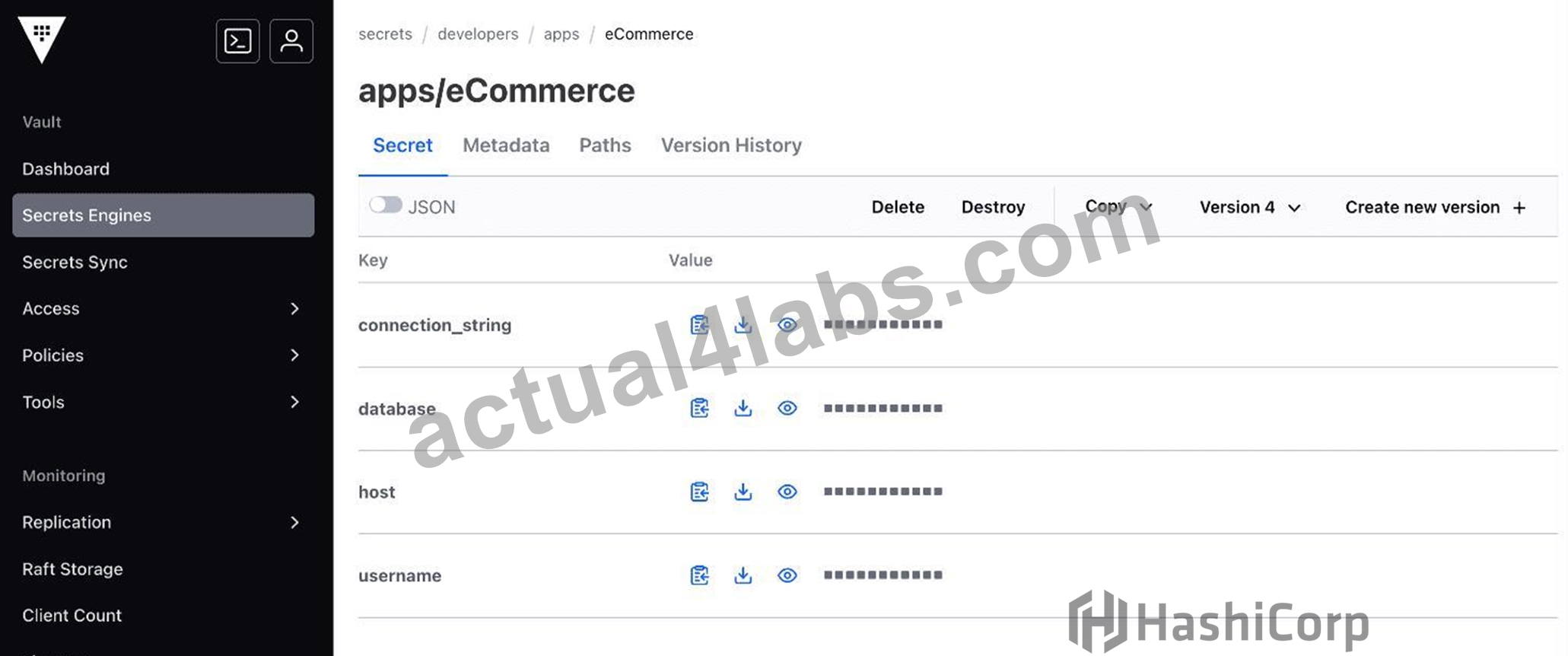
- A. The secrets are stored in a KV v1 secrets engine
- B. There are four previous versions of the secret
- C. The user has additional permissions on the path beyond just list and read
- D. The secrets engine is mounted at the path developers/
- E. The user does not have permission to delete the secret
- F. The secrets are stored in a KV v2 secrets engine
Answer: B,C,D,F
Explanation:
Comprehensive and Detailed In-Depth Explanation:
Assuming the screenshot shows a KV secrets engine at developers/ with version 5 of a secret and options for delete/create:
* C: KV v2 is indicated by versioning (version 5 and four previous versions). KV v1 doesn't support versioning, per the KV v2 documentation.
* D: The path developers/ is the mount point, as secrets are accessed under this path, consistent with Vault's mount structure.
* E: Four previous versions (v1-v4) exist if v5 is current, a feature of KV v2's versioning.
* F: Delete and create options in the UI imply permissions beyond list and read, such as delete and create or update, per Vault's UI behavior reflecting policy capabilities.
* A: KV v1 lacks versioning, so this is incorrect.
* B: The delete option's presence suggests permission exists, though UI visibility isn't a definitive policy check-still, it's typically indicative.
References:
KV Secrets Engine v2 Docs
Vault UI Tutorial
NEW QUESTION # 33
Select the two default policies created in Vault. (Select two)
- A. vault
- B. root
- C. base
- D. user
- E. admin
- F. default
Answer: B,F
Explanation:
Comprehensive and Detailed in Depth Explanation:
Vault creates two default policies upon initialization:rootanddefault. The HashiCorp Vault documentation states: "Vault creates two default policies, root and default. The root policy cannot be deleted or modified.
The default policy is attached to all tokens, by default, however, this action can be modified if needed." The rootpolicy grants unrestricted access for administrative tasks, while thedefaultpolicy provides basic permissions for all tokens unless overridden.
Policies likeuser,admin,base, andvaultare not default; they must be explicitly created by users if needed.
Thus, A (root) and D (default) are the correct selections.
Reference:
HashiCorp Vault Documentation - Policies: Built-in Policies
NEW QUESTION # 34
A new Vault administrator is writing a CURL command (shown below) to retrieve a secret stored in a KV v2 secrets engine at secret/audio/soundbooth but is receiving an error. What could be the cause of the error?
$ curl \
--header "X-Vault-Token: hvs.rffHw0iXqkRo19b2cjf93DM39WjpbN3J" \
https://vault.unlimited.com:8200/v1/secret/audio/soundbooth
- A. The request is being made on the incorrect endpoint and should be:
$ curl \
--header "X-Vault-Token: hvs.rffHw0iXqkRo19b2cjf93DM39WjpbN3J" \
https://vault.unlimited.com:8200/v1/secret/data/audio/soundbooth - B. The VAULT_ADDR environment variable wasn't set, so it should be configured: export VAULT_ADDR="https://vault.unlimited.com:8200"
- C. The endpoint should point to v2 since this is a KV v2 secrets engine:
$ curl \
--header "X-Vault-Token: hvs.rffHw0iXqkRo19b2cjf93DM39WjpbN3J" \
https://vault.unlimited.com:8200/v2/secret/audio/soundbooth - D. The user's token doesn't permit access to the Vault API, only the UI
Answer: A
Explanation:
Comprehensive and Detailed in Depth Explanation:
The error occurs because the CURL command uses the wrong endpoint for a KV v2 secrets engine. The HashiCorp Vault documentation states: "The KVv2 store uses a prefixed API, which is different from the version 1 API. Writing and reading versions are prefixed with the data/ path." For KV v2, the correct endpoint to retrieve a secret is /v1/secret/data/audio/soundbooth, not /v1/secret/audio/soundbooth, which applies to KV v1.
The docs explain: "In KV v2, the data/ prefix is required when accessing secrets via the API to distinguish data operations from metadata or versioning tasks." Option A (VAULT_ADDR) is irrelevant for API calls, as it's CLI-specific. Option C (token UI restriction) is incorrect-tokens apply universally. Option D misinterprets v1 as the API version, not the engine version. Thus, B is correct.
Reference:
HashiCorp Vault Documentation - KV v2: ACL Rules
NEW QUESTION # 35
Which of the following statements best describes the difference in cluster strategies between self-managed Vault and HashiCorp-managed Vault?
- A. Self-managed clusters require users to handle setup, maintenance, and scaling, whereas HCP Vault Dedicated is fully managed by HashiCorp and offloads most operational tasks
- B. Both self-managed clusters and HCP Vault Dedicated require manual patching and upgrades, but only self-managed clusters are hosted in the user's cloud
- C. In self-managed clusters, HashiCorp is responsible for scaling, upgrades, and patching, while HCP Vault Dedicated requires the user to handle all operational overhead
- D. Neither self-managed clusters nor HCP Vault Dedicated include enterprise security features such as replication or disaster recovery
Answer: A
Explanation:
Comprehensive and Detailed in Depth Explanation:
* A:Correctly contrasts self-managed (user responsibility) with HCP Vault (HashiCorp-managed).
Correct.
* B:Both support replication; false. Incorrect.
* C:HCP Vault doesn't require manual upgrades. Incorrect.
* D:Reverses responsibilities; false. Incorrect.
Overall Explanation from Vault Docs:
"HCP Vault Dedicated is operated by HashiCorp... Self-managed Vault requires users to handle setup, maintenance, and scaling." Reference:https://developer.hashicorp.com/hcp/docs/vault/what-is-hcp-vault
NEW QUESTION # 36
Based on the following output, what command can Steve use to determine if the KV store is configured for versioning?
text
CollapseWrapCopy
$ vault secrets list
Path Type Accessor Description
---- ---- -------- -----------
automation/ kv kv_56f991b9 Automation team for CI/CD
cloud/ kv kv_4426c541 Cloud team for static secrets
cubbyhole/ cubbyhole cubbyhole_9bd538e per-token priv secret storage
data_team/ kv kv_96d57692 Data warehouse KV for certs
identity/ identity identity_0042595e identity store
network/ kv kv_3e53aaab Network team secret storage
secret/ kv kv_d66e2adc key/value secret storage
sys/ system system_d6f218a9 system endpoints
- A. vault secrets list -all
- B. vault secrets list -detailed
- C. vault kv get automation
- D. vault kv list
Answer: B
Explanation:
Comprehensive and Detailed in Depth Explanation:
To determine if a KV store is configured for versioning (i.e., KV v1 or v2), Steve needs detailed information about the secrets engines. The HashiCorp Vault documentation states: "To list all enabled secrets engines with detailed output, use the command vault secrets list -detailed. This will provide additional information about each secrets engine, including the version of the KV secrets engines." The -detailed flag reveals configuration details, such as the options field indicating version=2 for KV v2, which supports versioning.
vault secrets list -allis not a valid command.vault kv get automationretrieves a specific secret, not engine configuration.vault kv listlists keys in a path, not engine details. Thus, C is correct.
Reference:
HashiCorp Vault Documentation - Secrets Engines(Note: Specific command details are from CLI help and tutorials)
NEW QUESTION # 37
When using Integrated Storage, which of the following should you do to recover from possible data loss?
- A. Use snapshot
- B. Use server logs
- C. Failover to a standby node
- D. Use audit logs
Answer: A
Explanation:
Integrated Storage is a Raft-based storage backend that allows Vault to store its data internally without relying on an external storage system. It also enables Vault to run in high availability mode with automatic leader election and failover. However, Integrated Storage is not immune to data loss or corruption due to hardware failures, network partitions, or human errors. Therefore, it is recommended to use the snapshot feature to backup and restore the Vault data periodically or on demand. A snapshot is a point-in-time capture of the entire Vault data, including the encrypted secrets, the configuration, and the metadata. Snapshots can be taken and restored using the vault operator raft snapshot command or the sys/storage/raft/snapshot API endpoint.
Snapshots are encrypted and can only be restored with a quorum of unseal keys or recovery keys. Snapshots are also portable and can be used to migrate data between different Vault clusters or storage backends. References: https://developer.hashicorp.com/vault/docs/concepts/integrated-storage1,
https://developer.hashicorp.com/vault/docs/commands/operator/raft/snapshot2, https://developer.hashicorp.
com/vault/api-docs/system/storage/raft/snapshot3
NEW QUESTION # 38
Before data is written to the storage backend, the data is encrypted by which Vault feature?
- A. Unseal keys
- B. Cryptographic barrier
- C. Transit secrets engine
- D. TLS certificate
Answer: B
Explanation:
Comprehensive and Detailed In-Depth Explanation:
Vault's architecture includes a cryptographic barrier that encrypts all data before it's written to the storage backend. This ensures that the backend (e.g., Consul, Filesystem) only stores encrypted data, enhancing security even if the backend is compromised. The barrier uses a master key (split into unseal keys via Shamir' s Secret Sharing) to encrypt a keyring, which in turn encrypts the data. TLS certificates secure network communication, not storage encryption. Unseal keys unlock the master key, not encrypt data directly. The Transit engine is for application-level encryption, not storage backend protection. The Vault architecture docs confirm the cryptographic barrier's role.
References:
Vault Architecture Overview
Data Encryption
NEW QUESTION # 39
You are using Azure Key Vault for the auto-unseal configuration on your cluster. After the Vault service restarts, what command must you run to unseal Vault?
- A. vault operator unseal
- B. vault operator init
- C. vault operator members
- D. You don't need to run a command when using auto-unseal
Answer: D
Explanation:
Comprehensive and Detailed in Depth Explanation:
When using Azure Key Vault for auto-unseal, no manual command is required to unseal Vault after a service restart. The HashiCorp Vault documentation states: "Vault supports opt-in automatic unsealing via cloud technologies: AliCloud KMS, AWS KMS, Azure Key Vault, Google Cloud KMS, and OCI KMS. This feature enables operators to delegate the unsealing process to trusted cloud providers to ease operations in the event of partial failure and to aid in the creation of new or ephemeral clusters." Specifically, for Azure Key Vault, "the auto-unseal feature automatically handles the unsealing process," eliminating the need for manual intervention.
The documentation further explains: "When configured with auto-unseal, Vault will automatically unseal itself upon startup using the configured key management service, provided the necessary permissions and credentials are in place." Options likevault operator unsealare for manual unsealing,vault operator memberslists cluster members, andvault operator initinitializes Vault-none apply to auto-unseal scenarios.
Thus, A is correct.
Reference:
HashiCorp Vault Documentation - Auto Unseal with Azure Key Vault
HashiCorp Vault Documentation - Seal Concepts: Auto Unseal
NEW QUESTION # 40
Which of the following features in Vault will replicate service tokens between clusters?
- A. Disaster Recovery Replication
- B. Integrated Storage
- C. Vault Agent
- D. Performance Replication
Answer: A
Explanation:
Comprehensive and Detailed In-Depth Explanation:
Vault Enterprise supports replication to synchronize data across clusters, with two main types:Disaster Recovery (DR) ReplicationandPerformance Replication. Only one replicates service tokens:
* A. Disaster Recovery Replication: This feature replicates critical data, including service tokens, between clusters for warm-standby failover. "DR clusters are essentially a warm-standby and do replicate tokens from the primary cluster," per the documentation. This ensures continuity in disaster scenarios.
* Incorrect Options:
* B. Performance Replication: Focuses on scaling read performance, not token replication.
"Performance clusters create and maintain their own tokens. These tokens are NOT replicated."
* C. Vault Agent: A client-side tool for token management, not cluster replication. "It does not specifically replicate service tokens between clusters."
* D. Integrated Storage: A storage backend, not a replication mechanism. "It does not directly replicate service tokens between clusters." DR Replication is designed for full data consistency, including tokens, across clusters.
Reference:https://developer.hashicorp.com/vault/docs/enterprise/replication
NEW QUESTION # 41
You are planning to deploy a new Vault cluster for your organization and notice that Vault supports a wide variety of storage backends. You need high availability since you will have multiple applications relying on the Vault service. When building your cluster, can you choose any of the available storage backends?
- A. Yes, because all backends provide similar functionality
- B. No, because not all storage backends provide similar functionality
Answer: B
Explanation:
Comprehensive and Detailed In-Depth Explanation:
Vault supports various storage backends (e.g., Consul, Raft, DynamoDB), but not all provide high availability (HA). HA ensures that Vault remains operational across multiple nodes, with automatic failover if a node fails-an essential feature for applications relying on Vault. The Vault documentation lists each backend's capabilities, noting that only certain ones (e.g., Consul, Raft Integrated Storage, etcd) support HA through features like leader election and data replication. Others, like Filesystem or MySQL, don't support HA natively, making them unsuitable for this requirement. Thus, you cannot choose any backend arbitrarily; the choice must align with HA needs, disproving option A and confirming option B.
References:
Storage Backends Overview
HA Considerations
NEW QUESTION # 42
After decrypting data using the Transit secrets engine, the plaintext output does not match the plaintext credit card number that you encrypted. Which of the following answers provides a solution?
$ vault write transit/decrypt/creditcard ciphertext="vault:v1:cZNHVx+sxdMEr......." Key: plaintext Value: Y3JlZGl0LWNhcmQtbnVtYmVyCg==
- A. The user doesn't have permission to decrypt the data, therefore Vault returns false data
- B. Vault is sealed, therefore the data cannot be decrypted. Unseal Vault to properly decrypt the data
- C. The data is corrupted. Execute the encryption command again using a different data key
- D. The resulting plaintext data is base64-encoded. To reveal the original plaintext, use the base64 --decode command
Answer: D
Explanation:
Comprehensive and Detailed in Depth Explanation:
* A:Sealing would prevent decryption, not return encoded data. Incorrect.
* B:Permission issues don't return encoded data. Incorrect.
* C:Transit returns base64-encoded plaintext; decoding Y3JlZGl0LWNhcmQtbnVtYmVyCg== yields
"credit-card-number". Correct.
* D:No evidence of corruption; it's a format issue. Incorrect.
Overall Explanation from Vault Docs:
"All plaintext data must be base64-encoded... Decode it to reveal the original value." Reference:https://developer.hashicorp.com/vault/docs/secrets/transit
NEW QUESTION # 43
......
Get Perfect Results with Premium HCVA0-003 Dumps Updated 287 Questions: https://www.actual4labs.com/HashiCorp/HCVA0-003-actual-exam-dumps.html
Free HCVA0-003 Exam Study Guide for the NEW Dumps Test Engine: https://drive.google.com/open?id=1kNn35rVmzM2l58aizSne27R6WocB1od5