

2026 New New-Jersey-Real-Estate-Salesperson Dumps - Real Real Estate Exam Questions
Dependable New-Jersey-Real-Estate-Salesperson Exam Dumps to Become Real Estate Certified
NEW QUESTION # 42
A seller sold a property for $375,000, with the closing on July 1st, in a jurisdiction where the buyer pays for the day of closing. The seller had a mortgage balance at the time of closing of $301,000, and had recently paid invoices of $400 for the second quarter's water and electricity, $1,200 for new appliances, and roofing repairs of $700. Based only on these items, how much will the seller receive at closing?
- A. $74,000
- B. $71,700
- C. $72,400
- D. $73,600
Answer: A
Explanation:
Sale price = $375,000
Mortgage payoff = $301,000
Seller prepaid invoices (utilities, appliances, roof) are already paid and not reimbursable through closing unless agreed. They do not affect the closing statement.
Buyer pays closing day (July 1), so no adjustment required for that day.
375
,
000
#
301
,
000
=
74
,
000
375,000#301,000=74,000
Thus, the seller's net proceeds = $74,000.
Reference: NJ Real Estate Salesperson Study Guide, Chapter on Closings and Settlement Statements.
NEW QUESTION # 43
Who may give a supportable opinion of market value to be used in seeking a federally-related loan to finance a real estate transaction?
- A. a certified appraiser
- B. a licensed real estate broker
- C. any real estate licensee, in each state in which the licensee is licensed
- D. a Certified Public Accountant
Answer: A
Explanation:
For federally-related transactions (most residential loans regulated by federal agencies), the Financial Institutions Reform, Recovery, and Enforcement Act (FIRREA, 1989) requires an appraisal by a state- licensed or certified appraiser.
Brokers and salespersons may prepare CMAs (Comparative Market Analyses) or BPOs, but these are not acceptable for federally-related loans.
Correct answer = A.
Reference: FIRREA (1989); NJ Real Estate Salesperson Study Guide, Chapter on Appraisal and Valuation.
NEW QUESTION # 44
A public utility company is installing power lines across several counties. Will the utility company be more likely to be granted an easement appurtenant or an easement in gross?
- A. easement appurtenant because it cannot run with the land
- B. easement in gross because it does not require ownership of real property adjacent to the property that is subject to the easement
- C. easement in gross because it allows the holder of the easement to eventually gain title to the encumbered property
- D. easement appurtenant because it cannot be extinguished by merger of the dominant and servient tenements
Answer: B
Explanation:
An easement in gross benefits a person or entity, rather than another parcel of land. Unlike an easement appurtenant, which requires a dominant and servient estate (two adjoining parcels), an easement in gross does not require ownership of adjacent property.
Utility companies (electric, gas, water, sewer, cable) typically hold easements in gross, allowing them to install and maintain lines across multiple properties. The easement is granted to the utility company, not to a neighboring landowner.
Therefore, the correct answer is C.
Reference: NJ Real Estate Salesperson Pre-Licensure Course Guide, Chapter on Interests in Real Estate (Easements); NJ Property Law principles on easements.
NEW QUESTION # 45
Which of the following statements in an advertisement would be an example of non-discriminatory language under HUD's Fair Housing Advertising Guidelines?
- A. apartment available. No pets or children allowed
- B. nice home ideal for any family with children
- C. located within walking distance to a great Catholic school
- D. female seeking female roommate
Answer: B
Explanation:
HUD Fair Housing Advertising Guidelines prohibit words that indicate preference or limitation based on protected classes (race, sex, religion, familial status, etc.).
"Female seeking female roommate" = gender preference # discriminatory.
"No pets or children allowed" = familial status discrimination.
"Catholic school" = religious preference.
"Ideal for any family with children" = permitted because it is descriptive and not exclusionary.
Correct answer = B.
Reference: HUD Fair Housing Advertising Guidelines; NJ Real Estate Salesperson Study Guide, Chapter on Fair Housing.
NEW QUESTION # 46
When buyers move into their new house, they see that the ceiling fan in the dining room is gone. The ceiling fan was not mentioned in the offer to purchase. Did the sellers have the right to take the ceiling fan?
- A. Yes, because it was not referenced in the contract.
- B. Yes, because it was the sellers' personal property.
- C. No, because it was a fixture in the house.
- D. No, because it was chattel.
Answer: C
Explanation:
A fixture is personal property that has become real property by being permanently attached (e.g., ceiling fans, light fixtures).
Fixtures are considered part of the real estate and transfer with the property unless specifically excluded in the contract.
Chattel refers to movable personal property, which a ceiling fan is not once installed.
Correct answer = C.
Reference: NJ Real Estate Salesperson Study Guide, Chapter on Property Ownership and Fixtures.
NEW QUESTION # 47
Last year, an apartment building had a net operating income of $174,000. If a potential buyer is looking for a capitalization rate of 8%, how much should the buyer be willing to pay for the building?
- A. $174,000
- B. $139,200
- C. $2,175,000
- D. $1,392,000
Answer: D
Explanation:
The Income Capitalization Approach formula is: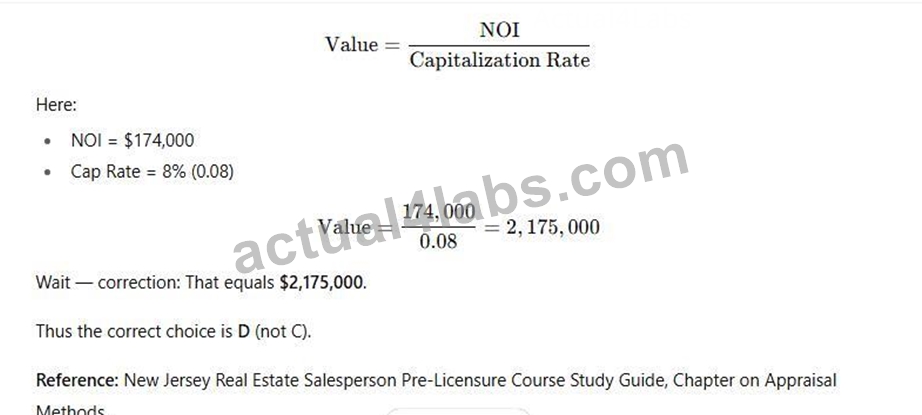
NEW QUESTION # 48
A licensed broker may establish a commission rate at a predetermined amount that reflects the broker's general office policy provided the broker:
- A. has the percentage or fixed amount printed on all listing agreement forms
- B. negotiates all commissions with sellers
- C. advises the New Jersey Consumer Affairs Division that the broker will not negotiate this commission rate
- D. advertises the commission rate at least once per month
Answer: B
Explanation:
Under New Jersey Real Estate Commission rules and antitrust law, commissions are always negotiable between the broker and the client. A broker may set a general office policy or customary rate, but legally the rate cannot be mandatory or fixed without negotiation. It must be negotiated in each listing agreement.
* Options A, B, and C would constitute unlawful practices or misleading advertising.
* Only D is correct: all commissions must be negotiated with sellers.
(Reference: NJ Real Estate Salesperson Pre-Licensure Course Study Guide, Commission Rates & Antitrust; NJAC 11:5 on advertising and business conduct.)
NEW QUESTION # 49
According to the New Jersey Law Against Discrimination, which of the following descriptions may be used in advertising properties in a townhome development?
- A. Senior housing
- B. Ethnic neighborhood
- C. Singles only
- D. Close to synagogues and churches
Answer: A
Explanation:
Under the New Jersey Law Against Discrimination (LAD) and HUD advertising guidelines:
Ads cannot reference religion, ethnicity, or familial status (e.g., "singles only" or "close to synagogues").
However, housing for older persons (senior housing) is a permitted exception under the Housing for Older Persons Act (HOPA).
Correct answer = D. Senior housing.
Reference: NJ Law Against Discrimination (N.J.S.A. 10:5-1 et seq.); HUD Fair Housing Advertising Guidelines.
NEW QUESTION # 50
If an owner wants to list a property for sale "as is," the listing agent should:
- A. question the seller as to any known defects.
- B. conclude that if the buyer later discovers defects that were not disclosed the listing agent is relieved of any responsibility.
- C. assume that the owner will accept a relatively low price for the property.
- D. assume that the house is a "fixer-upper."
Answer: A
Explanation:
"As is" does not relieve a seller or listing agent from disclosure obligations.
The licensee must still make reasonable inquiries about known defects.
All material facts must be disclosed, regardless of the "as is" designation.
"As is" simply means the seller will not make repairs or improvements.
Thus, the agent must ask the seller about known defects = C.
Reference: NJREC Rules and Regulations on Disclosure; NJ Real Estate Salesperson Study Guide, Chapter on Seller Disclosures and "As Is" Sales.
NEW QUESTION # 51
Which of the following is a permitted free offering?
- A. A coupon for discounted commission on listing services
- B. A complimentary home warranty with every listing
- C. Free use of a local moving van for all listings
- D. A free dinner for attendees at a homebuyers' evening seminar
Answer: D
Explanation:
According to NJREC rules on inducements (N.J.A.C. 11:5-6.4):
Free offers to the general public (e.g., a dinner seminar or educational event) are permissible because they are not conditioned upon listing or buying.
Inducements like "home warranty with every listing," "discounted commissions," or "moving vans for clients only" are contingent on brokerage activity and are prohibited.
Thus, the permitted free offering is C.
Reference: NJREC Rules and Regulations, N.J.A.C. 11:5-6.4; NJ Real Estate Salesperson Study Guide, Chapter on Advertising and Inducements.
NEW QUESTION # 52
A broker maintains a real estate agency and terminated two salespersons. In this situation, the broker is REQUIRED to take all the following actions with regard to these two salespersons EXCEPT:
- A. permit them to remove original sales or listing contracts from the broker's office.
- B. pay any undisputed compensation due within ten days of the broker's receipt of such funds.
- C. abide by the post-termination compensation clause contained in their employment agreements or provide a written explanation for not doing so.
- D. provide each with a written accounting of all monies due each salesperson.
Answer: A
Explanation:
According to NJREC Rules and Regulations (N.J.A.C. 11:5-4.1) and the Broker-Salesperson employment agreement requirements:
Brokers must provide a full written accounting of monies due.
Any undisputed commission due must be paid within 10 business days of the broker receiving the funds.
The broker must honor the compensation provisions of the terminated salesperson's written employment agreement.
However, salespersons are not permitted to remove original sales or listing contracts, which remain the property of the broker.
Therefore, the action the broker is NOT required to take is B.
Reference: NJREC Rules and Regulations, N.J.A.C. 11:5-4.1 (Employment Agreements and Compensation).
NEW QUESTION # 53
After announcing that a new city park will soon be developed, homes in the immediate area experience a rise in value. This is an example of which of the following principles of value?
- A. highest and best use
- B. contribution
- C. change
- D. anticipation
Answer: D
Explanation:
Principle of anticipation: Value is created by the expectation of future benefits (e.g., new park development).
Change: value is constantly influenced by natural and economic changes.
Contribution: value of an improvement is measured by its contribution to the property's value.
Highest and best use: most profitable legal use of the land.
Here, the increase is due to anticipated future benefits # C.
Reference: NJ Real Estate Salesperson Study Guide, Chapter on Appraisal Principles.
NEW QUESTION # 54
Under the New Jersey Real Estate Sales Full Disclosure Act, the Act does NOT apply to a development project:
- A. where the purchaser's total financial obligation is less than $5,000.
- B. consisting of 10 units.
- C. already approved by the Department of Commerce.
- D. extending over a 5 year period only.
Answer: A
Explanation:
The NJ Real Estate Sales Full Disclosure Act (RESFDA) regulates sales or leases of subdivided land and certain developments to protect consumers.
Exemptions exist for small-scale projects or when the total financial obligation to the purchaser is less than
$5,000.
Developments with 100+ lots typically require registration and a Public Offering Statement.
Thus, the Act does not apply where the financial obligation is under $5,000.
Reference: NJ Real Estate Sales Full Disclosure Act, N.J.S.A. 45:15-16.27; NJ Real Estate Salesperson Study Guide, Chapter on Land Sales.
NEW QUESTION # 55
A Seller's Property Disclosure form states that there are no known material defects with the property, but the listing licensee is aware of asbestos wrapped duct pipes in the basement. The licensee should:
- A. disclose the existence of asbestos to all potential buyers.
- B. ask the seller's permission to disclose and abide by the seller's wishes.
- C. suggest to the seller wrap the pipes to contain potential airborne contamination.
- D. suggest the buyers have a home inspection and leave discovery up to the inspector.
Answer: A
Explanation:
Under New Jersey Real Estate License Law and NJREC disclosure rules:
Licensees must disclose all known material facts about a property to potential buyers, regardless of what the seller states.
Asbestos is considered a material defect and a potential environmental hazard.
Licensees cannot withhold disclosure, nor leave it solely to inspectors.
Thus, the licensee must disclose the asbestos.
Reference: NJREC Rules and Regulations, N.J.A.C. 11:5-6.4; NJ Real Estate Salesperson Study Guide, Chapter on Disclosure of Material Defects.
NEW QUESTION # 56
A married couple is purchasing a home. They ask the salesperson to advise them regarding the best way to take title. The salesperson should
- A. decline to advise them and suggest that they consult an attorney.
- B. explain the possible types of joint ownership so they understand the options.
- C. advise them to take title as tenants by the entirety.
- D. ask a broker to make a recommendation.
Answer: A
Explanation:
According to the NJ Real Estate Commission regulations on licensee conduct and the Salesperson Study Guide (Agency & Professional Practice section), licensees may explain types of ownership but must not give legal advice or recommend a specific method of taking title. Advising how to take title (e.g., tenants by the entirety, joint tenancy, tenancy in common) constitutes the practice of law. The proper action is to refer the buyers to an attorney.
Therefore, the correct answer is C.
(Reference: NJ Real Estate Salesperson Pre-Licensure Course Study Guide, Professional Responsibilities & Avoiding Unauthorized Practice of Law.)
NEW QUESTION # 57
A broker who charges or collects an advance fee in excess of $25 for services to be rendered MUST:
- A. retain the difference between the amount of money collected and the amount spent
- B. furnish within ninety days of its collection an accounting of how the money was used
- C. deduct the amount collected from the commission or settlement
- D. give the principal receipts for all expenditures
Answer: B
Explanation:
According to N.J.A.C. 11:5-6.1(j), any broker who collects an advance fee greater than $25 for services to be rendered must provide the client with a written accounting within 90 days of the collection date. This accounting must detail how the money was used and what services were performed.
This rule prevents abuse of advance fees and ensures transparency between brokers and clients. Brokers cannot simply keep advance fees without providing an itemized report.
Therefore, the correct answer is C.
Reference: NJREC Rules and Regulations, N.J.A.C. 11:5-6.1(j); NJ Real Estate Salesperson Pre-Licensure Course Guide, Chapter on Brokerage Business Practices.
NEW QUESTION # 58
A buyer-broker locates a property that is listed with another broker. The buyer makes an offer through the buyer-broker and an agreement of sale results. In this situation, the buyer-broker is acting as a:
- A. referring broker with the listing broker
- B. representative of the buyer and owes no fiduciary obligations to the seller
- C. subagent of the listing broker
- D. representative of the seller and owes no fiduciary obligations to the buyer
Answer: B
Explanation:
In a buyer agency relationship, the buyer-broker owes fiduciary duties solely to the buyer.
The buyer-broker is not a subagent of the seller's broker unless that is specifically created (rare in NJ).
The buyer-broker represents the buyer, not the seller, and has no fiduciary duty to the seller.
Correct answer = C.
Reference: NJ Real Estate Salesperson Study Guide, Chapter on Buyer Agency and Fiduciary Duties.
NEW QUESTION # 59
Prospective buyers asked the licensee representing them if it would be a good idea to check the property they wish to purchase for radon. The licensee's best response would be to tell the buyers that:
- A. it is unlikely that radon would be a problem in that area.
- B. they should do so, because radon is now considered to be one of the causes of lung cancer.
- C. as long as they are non-smokers, it should not be an issue.
- D. they need not do so, because if radon were present, there would be an odor that would make it easy to detect.
Answer: B
Explanation:
Radon is a colorless, odorless, radioactive gas linked to lung cancer.
The EPA and NJDEP recommend testing homes for radon regardless of location.
Licensees should never minimize the risk or falsely suggest it is detectable by odor.
The best professional response is to recommend that buyers test for radon because it is a known health risk.
Correct answer = C.
Reference: NJDEP Radon Hazard Program; NJ Real Estate Salesperson Study Guide, Chapter on Environmental Issues.
NEW QUESTION # 60
......
Get Ready with New-Jersey-Real-Estate-Salesperson Exam Dumps (2026): https://www.actual4labs.com/Real-Estate/New-Jersey-Real-Estate-Salesperson-actual-exam-dumps.html
Realistic New-Jersey-Real-Estate-Salesperson Dumps are Available for Instant Access: https://drive.google.com/open?id=1sj0oXzDZjVnA_dn-Rs26z4_Czdz2W--w