

Enhance your career with 300-740 PDF Dumps - True Cisco Exam Questions
New (2026) Download free 300-740 PDF for Cisco Practice Tests
Cisco 300-740 Exam Syllabus Topics:
| Topic | Details |
|---|---|
| Topic 1 |
|
| Topic 2 |
|
| Topic 3 |
|
| Topic 4 |
|
| Topic 5 |
|
| Topic 6 |
|
| Topic 7 |
|
| Topic 8 |
|
NEW QUESTION # 45
The SAFE Key structure is designed to:
- A. Organize security measures within the network architecture
- B. Create a single sign-on experience for users
- C. Unlock encrypted data
- D. Guide the deployment of network devices
Answer: A
NEW QUESTION # 46
Which mitigation technique does a web application firewall use to protect a web server against DDoS attacks?
- A. Packet filtering
- B. Source-specific ACL
- C. Standard ACL
- D. Rate-based rules
Answer: D
Explanation:
Web Application Firewalls (WAFs) use rate-based rules as one of the primary mechanisms to detect and mitigate Distributed Denial of Service (DDoS) attacks. According to the SCAZT Study Guide, Section 3 (Network and Cloud Security, Pages 74-77), rate-based rules dynamically detect unusual spikes in traffic and can throttle or block connections exceeding predefined thresholds. This form of protection is more adaptive and intelligent than standard ACLs or static filtering, enabling protection against zero-day and volumetric attacks that may not follow known patterns.
Reference: Designing and Implementing Secure Cloud Access for Users and Endpoints (SCAZT), Section 3, Pages 74-77
NEW QUESTION # 47
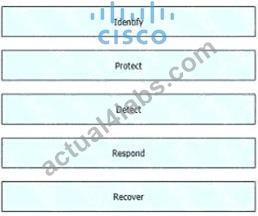
Drag and drop the five core functions from the left into the order defined by the NIST Cyber security Framework on the right.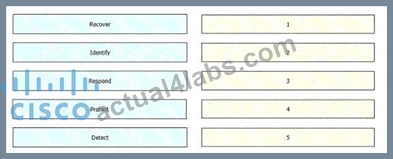
Answer:
Explanation: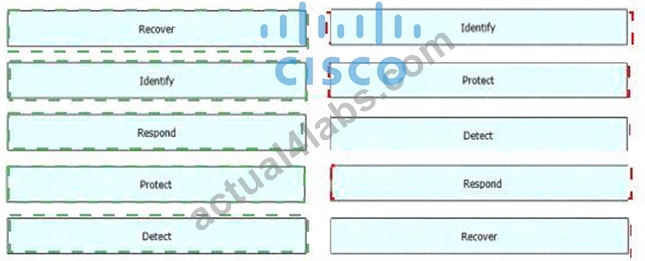
NEW QUESTION # 48
When an application is compromised, the first response action is typically to:
- A. Contain the breach to prevent further unauthorized access
- B. Immediately notify the public
- C. Amplify the breach
- D. Increase user privileges
Answer: A
NEW QUESTION # 49
When determining security policies for network security edge to enforce application policy, which of the following considerations are important?
- A. The ability to inspect encrypted traffic
- B. The integration of threat intelligence for real-time decision making
- C. The need to implement a simple, one-size-fits-all policy
- D. The use of static rules that do not adapt to changing threat landscapes
Answer: A,B
NEW QUESTION # 50
An administrator must deploy an endpoint posture policy for all users. The organization wants to have all endpoints checked against antimalware definitions and operating system updates and ensure that the correct Secure Client modules are installed properly. How must the administrator meet the requirements?
- A. Create the required posture policy within Cisco ISE, configure redirection on the NAD, and ensure that the client provisioning policy is correct.
- B. Identify the antimalware being used, create an endpoint script to ensure that it is updated, and send the update log to Cisco ISE for processing.
- C. Configure the WLC to provide local posture services, and configure Cisco ISE to receive the compliance verification from the WLC to be used in an authorization policy.
- D. Create an ASA Firewall posture policy, upload the Secure Client images to the NAD, and create a local client provisioning portal.
Answer: A
Explanation:
Cisco Identity Services Engine (ISE) is the central policy engine for posture assessments. As outlined in the SCAZT guide (Section 2: User and Device Security, Pages 39-44), to implement posture assessment and client provisioning correctly, an administrator must create posture policies within Cisco ISE and configure the Network Access Device (NAD)-such as a switch, WLC, or firewall-for redirection. This redirection sends the user to the posture portal, where ISE verifies the Secure Client modules (such as AnyConnect) and enforces compliance with antivirus signatures and OS updates.
ISE evaluates endpoint health based on pre-defined compliance rules and supports automatic remediation via the client provisioning portal. This ensures consistency and policy enforcement across distributed environments.
Reference: Designing and Implementing Secure Cloud Access for Users and Endpoints (SCAZT), User and Device Security, Pages 39-44
NEW QUESTION # 51
Microsegmentation helps in cloud security by:
- A. Centralizing all applications into a single network segment
- B. Reducing the number of security policies needed
- C. Allowing unrestricted traffic flow within the cloud environment
- D. Creating secure zones in data centers and cloud environments to isolate workloads from one another
Answer: D
NEW QUESTION # 52
What does the MITRE ATT&CK framework catalog?
- A. Patterns of system vulnerabilities
- B. Standards for information security management
- C. Techniques utilized in cyber attacks
- D. Models of threat intelligence sharing
Answer: C
Explanation:
MITRE ATT&CK is a globally accessible knowledge base that catalogs adversarial tactics and techniques based on real-world observations. According to SCAZT Section 6: Threat Response (Page
113), this framework enables security professionals to map and anticipate adversarial behavior throughout the attack lifecycle. It supports threat modeling, detection engineering, and incident response.
Reference: Designing and Implementing Secure Cloud Access for Users and Endpoints (SCAZT), Section 6, Page 113
NEW QUESTION # 53 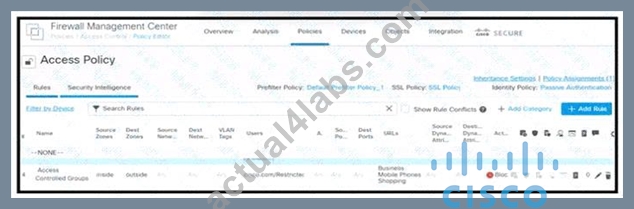
Refer to the exhibit. An engineer must create a policy in Cisco Secure Firewall Management Center to prevent restricted users from being able to browse any business or mobile phone shopping websites. The indicated policy was applied; however, the restricted users still can browse on the mobile phone shopping websites during business hours. What should be done to meet the requirement?
- A. Set Time Range for rule 4 of Access Controlled Groups to All.
- B. Move rule 4 Access Controlled Groups to the top.
- C. Set Dest Networks to Business Mobile Phones Shopping.
- D. Set Dest Zones to Business Mobile Phones Shopping.
Answer: B
Explanation:
In Cisco Secure Firewall Management Center (FMC), access control policies are processed top-down- meaning the first matching rule is applied, and the remaining are ignored. Based on the exhibit, Rule 4 (Access Controlled Groups) is likely being shadowed by a broader rule above it that permits web traffic. To ensure restricted users are denied access to mobile phone shopping categories, Rule 4 must be moved to the top of the rule hierarchy.
Cisco SCAZT (Section 5: Visibility and Assurance, Pages 94-97) describes best practices for rule ordering and inspection logic. Moving the specific block rule (Rule 4) higher ensures it's enforced before general allow rules are evaluated.
Reference: Designing and Implementing Secure Cloud Access for Users and Endpoints (SCAZT), Section 5, Pages 94-97
NEW QUESTION # 54
What helps prevent drive-by compromise?
- A. Ad blockers
- B. VPN
- C. Incognito browsing
- D. Browsing known websites
Answer: A
Explanation:
A drive-by compromise occurs when malicious code is automatically downloaded and executed simply by visiting a compromised website-often through malicious advertising scripts (malvertising). According to SCAZT Section 4: Application and Data Security (Pages 85-87), ad blockers help prevent drive-by downloads by blocking these third-party ad scripts and redirections, which are commonly used in such attacks.
VPNs and private browsing modes (e.g., Incognito) do not provide protection against malicious content hosted on web pages.
Reference: Designing and Implementing Secure Cloud Access for Users and Endpoints (SCAZT), Section 4, Pages 85-87
=========
NEW QUESTION # 55
When choosing a Web Application Firewall (WAF), it is important to consider its ability to:
- A. Defend against a wide range of web application attacks, such as SQL injection and XSS
- B. Serve as the only layer of security for web applications
- C. Replace traditional network firewalls
- D. Only protect against DDoS attacks
Answer: A
NEW QUESTION # 56
Using Duo for verifying user access to applications and data is effective because it:
- A. Ignores the principle of least privilege
- B. Decreases the security of user logins
- C. Provides multifactor authentication to ensure only authorized users gain access
- D. Encourages the use of weak passwords
Answer: C
NEW QUESTION # 57
Response automation tools help in:
- A. Increasing the number of false positives
- B. Complicating incident response procedures
- C. Quickly isolating infected devices from the network
- D. Slowing down the detection of malware
Answer: C
NEW QUESTION # 58
Determining security policies for cloud platform security should involve:
- A. Focusing solely on perimeter defense mechanisms
- B. Assessing the specific features and capabilities of the cloud platform
- C. Ignoring the shared responsibility model
- D. Assuming default configurations are always secure
Answer: B
NEW QUESTION # 59 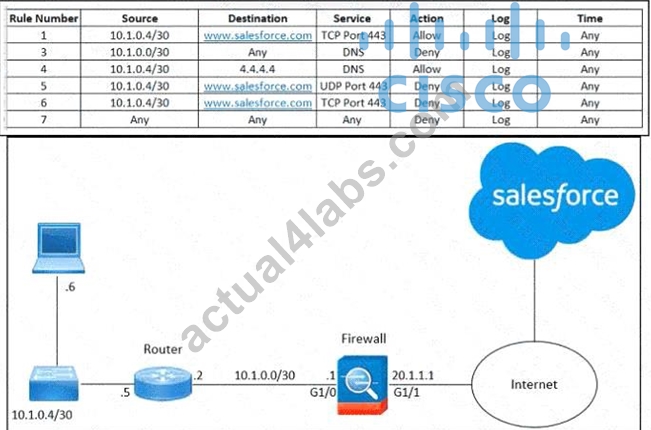
Refer to the exhibit. An engineer must configure the Cisco ASA firewall to allow the client with IP address
10.1.0.6 to access the Salesforce login page at https://www.salesforce.com. The indicated configuration was applied to the firewall and public DNS 4.4.4.4 is used for name resolution; however, the client still cannot access the URL. What should be done to meet the requirements?
- A. Remove rule 3
- B. Move rule 5 to the top
- C. Move rule 6 to the top
- D. Remove rule 7
Answer: A
Explanation:
Rule 3 denies all DNS traffic from the subnet 10.1.0.0/30, which includes the client at 10.1.0.6. Since DNS resolution is required to resolve www.salesforce.com, this DNS deny rule is preventing the client from obtaining the IP address needed for HTTPS connection. Removing Rule 3 allows DNS traffic from the client, while Rule 4 permits it specifically for the 4.4.4.4 DNS server.
As per SCAZT Section 3: Network and Cloud Security (Pages 70-73), DNS resolution must be allowed before HTTPS connectivity is attempted. Rule priority and traffic dependency should always be considered in firewall design.
Reference: Designing and Implementing Secure Cloud Access for Users and Endpoints (SCAZT), Section 3, Pages 70-73
NEW QUESTION # 60
Advanced app control policies are implemented to:
- A. Limit the bandwidth usage of applications
- B. Allow all applications equally without any restrictions
- C. Distinguish between and control individual application actions
- D. Increase the speed of cloud applications
Answer: C
NEW QUESTION # 61
The benefits of utilizing visibility and logging tools such as SIEM include:
- A. Centralized logging and analysis of security data
- B. Improved incident detection and response times
- C. Increased manual workload for security teams
- D. Decreased need for encryption
Answer: A,B
NEW QUESTION # 62
Enforcing application policy at the network security edge is crucial for:
- A. Allowing all applications to bypass security checks
- B. Ensuring only authorized applications can access network resources
- C. Ignoring the security posture of accessing devices
- D. Decreasing the overall security of the network
Answer: B
NEW QUESTION # 63 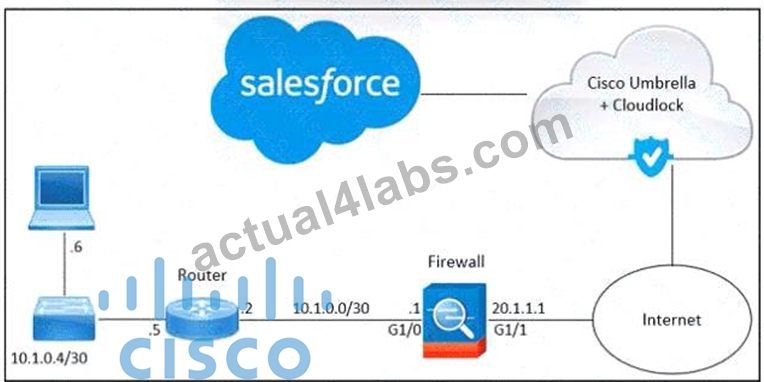
Refer to the exhibit. An engineer must enable access to Salesforce using Cisco Umbrella and Cisco Cloudlock. These actions were performed:
* From Salesforce, add the Cloudlock IP address to the allow list
* From Cloudlock, authorize Salesforce
However, Salesforce access via Cloudlock is still unauthorized. What should be done to meet the requirements?
- A. From the Salesforce admin page, grant API access to Cloudlock.
- B. From the Salesforce admin page, grant network access to Cloudlock
- C. From the Cloudlock dashboard, grant API access to Salesforce.
- D. From the Cloudlock dashboard, grant network access to Salesforce.
Answer: B
Explanation:
When integrating Cisco Cloudlock with SaaS platforms like Salesforce, two core authorizations are required:
network access and API authorization. In the scenario, Cloudlock has been authorized in Salesforce, and its IP has been allow-listed. However, if access is still denied, the most likely cause is that Salesforce has not been configured to accept traffic from Cloudlock's IP range - a process handled from the Salesforce admin panel.
To resolve the issue, network access must be explicitly granted to Cloudlock from within Salesforce. This ensures that Salesforce accepts requests initiated by Cloudlock for monitoring and enforcement.
Reference: Designing and Implementing Secure Cloud Access for Users and Endpoints (SCAZT), Section 4:
Application and Data Security, Pages 85-87.
Also supported by Cisco Cloudlock for Salesforce Deployment Guide.
NEW QUESTION # 64
For a cloud service provider, security policies based on application connectivity requirements might include:
- A. Disabling encryption to enhance performance
- B. Using a single set of security policies for all types of applications
- C. Always allowing direct connections to the internet for all applications
- D. Implementing secure VPN connections for sensitive applications
Answer: D
NEW QUESTION # 65
Cisco Secure Cloud Insights is designed to:
- A. Reduce the effectiveness of cloud security posture management
- B. Focus only on physical data center assets
- C. Provide visibility into cloud assets and their relationships for security purposes
- D. Ignore cloud resources for simplified management
Answer: C
NEW QUESTION # 66 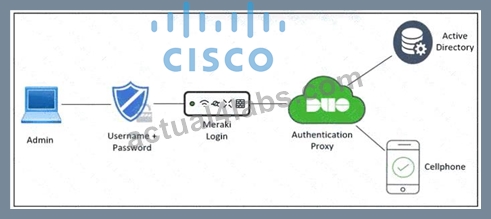
Refer to the exhibit. An engineer must configure multifactor authentication using the Duo Mobile app to provide admin access to a Cisco Meraki switch. The engineer already configured Duo Mobile and received an activation code. Drag and drop the steps from left to right to complete the configuration.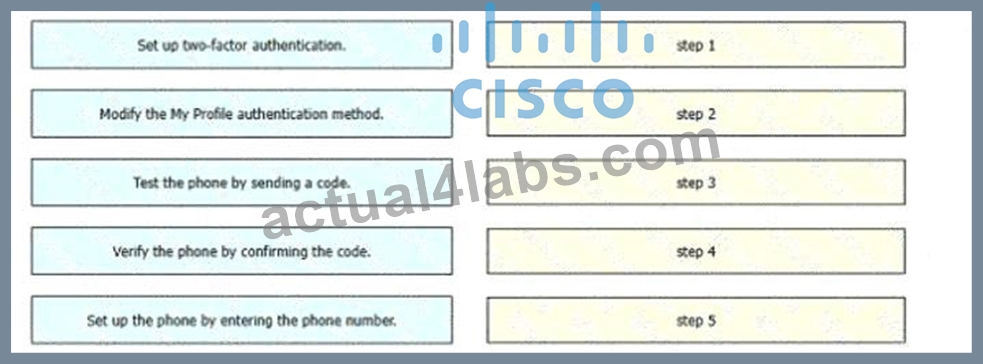
Answer:
Explanation: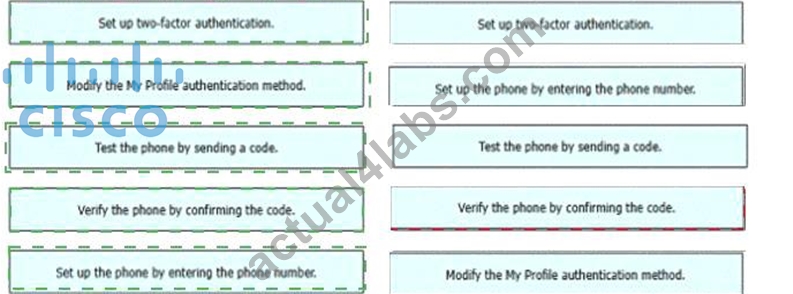
Explanation:
A screenshot of a phone number AI-generated content may be incorrect.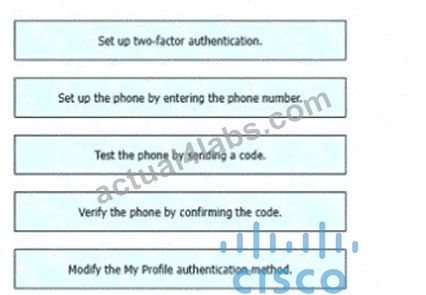
NEW QUESTION # 67
......
100% Free 300-740 Files For passing the exam Quickly: https://www.actual4labs.com/Cisco/300-740-actual-exam-dumps.html
300-740 Dumps Questions Study Exam Guide : https://drive.google.com/open?id=1iXJzQ2e1AXbL5vvhMv0HCIENmyGlYNGc