

Prepare Top CIPS L5M5 Exam Study Guide Practice Questions Edition
Go to L5M5 Questions - Try L5M5 dumps pdf
NEW QUESTION # 21
Mila's Catering Services has committed to paying living wages to its workers as part of its ESG objectives. Which of the following are reasons for this initiative? Select any TWO.
- A. Paying a living wage can be expensive, especially for small businesses with thin profit margins
- B. Creates a positive impact on the society
- C. Improves long term buyer supplier relationships and makes them sustainable
- D. Living wage laws can reduce job opportunities for less-skilled workers
Answer: B,C
Explanation:
Choice B - Paying living wages improves long term buyer supplier relationships and makes them sustainable thus is good for business. This option is correct.
Choice D- Living wages workers are working individuals who can actively take part in the local economy and boost local businesses. This therefore motivates business leaders and employees who want their company to make a positive impact on the society. This is also the correct answer.
Choice A - The imposition of living wages reduces job opportunities for the very families they are intended to help. When wages are legislated by government above those that would result in a competitive market, employers respond by reducing the number of workers they employ and/or the number of hours their employees work. That means living wage laws lead to higher unemployment for low-skilled workers and reduce opportunities for those entering the workforce to gain valuable skills and work experience. This is a downside of living wage and not a reason to take the initiative.
Choice C -Considering cost, paying a living wage can be expensive, especially for small businesses with thin profit margins thus is not a reason to undertake the initiative.
Reference:
LO-1.3; Page 92-93; Wages and social security arrangements
NEW QUESTION # 22
Which of the following is a requirement for an Environmental Management System (EMS) according to ISO 14001?
- A. A sustainability policy statement
- B. Setting recycling targets
- C. An environmental policy statement
- D. Periodic reviews conducted by external auditors
Answer: C
Explanation:
Choice B - Under ISO 14001: Environmental Management System (EMS), an organization is required to establish, implement, and maintain an environmental policy statement that reflects its commitment to environmental protection, regulatory compliance, and continuous improvement.
Incorrect answer:
Choice A - While sustainability is important, ISO 14001 specifically requires an environmental policy statement, not a sustainability policy. Sustainability encompasses a broader scope, including social and economic factors, whereas ISO 14001 focuses primarily on environmental aspects.
Choice C - ISO 14001 does not mandate specific recycling targets. Instead, it requires organizations to identify their environmental aspects and impacts, set environmental objectives, and develop action plans. Recycling may be one of the objectives, but it is not a mandatory requirement.
Choice D- While ISO 14001 requires periodic reviews (such as internal audits and management reviews), external audits are not mandatory unless the organization seeks ISO 14001 certification. Certification audits are conducted by third-party auditors, but internal audits and management reviews are the primary monitoring mechanisms required by the standard.
Reference:
LO-3.2; Page 284-285; Role of industry standards and frameworks used by organizations in securing ESG considerations and ethical standards
NEW QUESTION # 23
Westecs Inc., a leading consumer products manufacturer, has made significant investments in sustainable practices across its supply chains and in promotional advertising. Which of the following is the most likely benefit of this investment?
- A. Increased number of competitors
- B. Unsatisfied shareholders
- C. Improved brand image
- D. Reduced indirect costs
Answer: C
Explanation:
Choice B- Investing in sustainable practices and promoting them effectively can enhance Westecs Inc.'s brand image. Consumers increasingly prefer brands that demonstrate a commitment to sustainability, which can lead to increased customer loyalty and market differentiation.
Incorrect answer:
Choice A- There is an increased spending in indirect costs such as ESG initiatives which is one of the risk of behaving sustainably thus is not a reward.
Choice C- This option is incorrect. Shareholders are typically more satisfied when a company invests in sustainability, as it often aligns with long-term profitability and risk management. However, if the investments are poorly managed or do not lead to expected returns, there could be dissatisfaction, but that is not a likely immediate reward.
Choice D- This option is incorrect. While investing in sustainability may attract new competitors to the market, it is not a direct reward of the investment. Instead, companies might find themselves in a more competitive landscape due to rising consumer demand for sustainable products, but this is not an immediate reward.
Reference:
LO-1.1; Page 28; The risks and rewards of adopting ESG considerations in securing ethical and sustainable procurement and supply arrangements
NEW QUESTION # 24
Smith Industries, a production company, plans to hire an external organization to audit its operations. Which TWO qualifications should be required when selecting an independent third-party auditor?
- A. Appropriate professional qualification
- B. Have strong communication skills
- C. At least 5 years of experience
- D. Be approved by a certified body
Answer: D
Explanation:
Choice B - Approval or accreditation by a recognized certification body ensures that the auditor operates according to established professional and ethical standards. This is critical for maintaining trust and the reliability of the audit process.
Choice D- A formal qualification demonstrates the auditor's foundational knowledge and competency in auditing principles and methodologies. This is mandatory as it establishes the credibility and technical ability of the auditor.
Incorrect answer:
Choice A -Experience indicates practical exposure to audits, which can contribute to the auditor's ability to handle complex or unique scenarios. While valuable, this is not always mandatory, as less experienced auditors can still possess the necessary skills if well-qualified.
Choice C -Strong communication skills enable the auditor to clearly convey findings, recommendations, and areas for improvement to the organization. While important, this is often considered a soft skill rather than a mandatory criterion.
Reference:
LO-2.3; Page 210; Sourcing third parties for auditing services
NEW QUESTION # 25
XYZ Corp is seeking industry certification and has hired an external firm to assess its compliance with regulatory requirements and industry standards. The firm will provide an unbiased evaluation and recommend improvements. What type of audit is XYZ Corp conducting?
- A. Third-party audit
- B. Internal audit
- C. Financial audit
- D. Compliance audit
Answer: A
Explanation:
Choice B- While the audit focuses on compliance (option C), the key detail in the scenario is that the audit is being conducted by an external firm. This makes it a third-party audit. A compliance audit (option C) could be conducted either internally or externally, depending on the organization's approach.
Incorrect answer:
Choice A- Internal audits are conducted by the organization's own employees or an internal audit team to assess compliance, risks, and processes. Since XYZ Corp hired an external firm, this is not an internal audit.
Choice C- Although the audit involves assessing compliance with regulatory and industry standards, the key point in the scenario is the use of an external firm. This makes it a third-party audit. A compliance audit can be conducted internally, externally, or by a third party. Incorrect (in this context) Choice D- A financial audit focuses on verifying the accuracy of an organization's financial statements and records. The scenario does not mention financial data but instead focuses on regulatory and industry compliance. Therefore, this is not a financial audit.
Reference:
LO-2.3; Page 207-208; Sourcing third parties for auditing services
NEW QUESTION # 26
GlobalTechManufacturing (GTM), a multinational company, operates a complex supply chain spanning multiple countries and stakeholders. Recognizing this complexity as a major risk, the Chief Supply Chain Officer (CSCO) has launched a supply chain mapping project. The objective is to analyze GTM's supply chain structure and develop risk mitigation strategies. The initial phase of this project will primarily focus on understanding which of the following aspects within GTM's supply chains?
1. Branding
2. Tiers
3. Complexity
4. Innovation
- A. 1 and 2 only
- B. 2 and 3 only
- C. 3 and 4 only
- D. 1 and 4 only
Answer: B
Explanation:
Option 2 - Supply chain mapping involves a detailed analysis of supplier layers, including Tier 1, Tier 2, and Tier 3 suppliers. Identifying these tiers allows GTM to trace the flow of materials, information, and services throughout the supply chain. This visibility is crucial for assessing supplier relationships, dependencies, and risks at each level, helping to mitigate potential disruptions. Therefore, this is a correct answer.
Option 3 - GTM's supply chain is extensive and intricate, spanning multiple countries with interconnected layers. Understanding this complexity helps identify risks, inefficiencies, and bottlenecks. Mapping the network enables GTM to manage interdependencies and enhance supply chain resilience, making this another correct answer.
Incorrect answer:
Option 1- While branding is important for market presence and customer perception, it is not directly related to supply chain mapping or risk mitigation in this context.
Option 4- Innovation is valuable for driving competitive advantage and improving processes, but the focus here is on understanding the current structure of the supply chain to address risks, not on developing new innovations.
By focusing on tiers and complexity, GTM can lay a strong foundation for managing its global supply chain risks effectively thus the answer is Choice A.
Reference:
LO-2.1; Page 145-148; Mapping supply chains to achieve supply chain transparency
NEW QUESTION # 27
How do Fair Trade organizations protect raw material producers from economic hardship?
- A. They contribute money to communal funds for local investment
- B. They establish standards for working conditions
- C. They set a minimum price for purchasing the raw materials
- D. They ensure the final products are labeled as Fair Trade
Answer: C
Explanation:
Choice B- Fair Trade ensures producers receive a guaranteed minimum price or local living wage for their goods, providing financial security and protection against market fluctuations. This is the correct answer.
Incorrect answer:
Choice A- This is important for community development but does not directly address the immediate economic stability of producers.
Choice C- Although improving working conditions is a key component of Fair Trade, it does not directly protect producers from economic hardships related to pricing or income stability.
Choice D- Labeling products as Fair Trade can help attract ethical consumers, but it doesn't directly protect producers from unstable economic conditions.
Reference:
LO-3.3; Page 295; The World Fair Trade Organization (WFTO) and its principles and Charter of Fair Trade and implications for procurement and supply
NEW QUESTION # 28
Which of the following statements highlights a key limitation of direct trade that critics argue weakens its ability to ensure ethical practices?
- A. Power imbalances between producers and buyers are completely eliminated through direct trade agreements
- B. Direct trade enforces strict regulations to ensure fair wages for all workers, including temporary laborers
- C. Direct trade removes the need for third-party certifications, guaranteeing full transparency in all cases
- D. The lack of standardized criteria in direct trade allows companies to define ethical practices on their own, potentially resulting in inconsistent or misleading claims
Answer: D
Explanation:
Choice B - This is correct because one of the primary criticisms of direct trade is the lack of universal standards. Companies can define "ethical practices" in their own terms, which may vary widely and lead to confusion or even greenwashing.
Choice A - This is incorrect because while direct trade does not rely on third-party certifications, this does not ensure complete transparency. In fact, the lack of third-party oversight is often criticized as a limitation, as it can lead to inconsistent or unverifiable claims.
Choice C - This is incorrect because direct trade does not guarantee fair wages for all workers, especially temporary or seasonal laborers. The focus is typically on producers or cooperatives, leaving other workers vulnerable to exploitation.
Choice D- This is incorrect because power imbalances can still exist in direct trade relationships. Buyers may hold significant leverage, particularly if producers depend on them as their sole buyer. Direct trade does not inherently eliminate these imbalances.
Reference:
LO-3.3; Page 309-310; Fairtrade standards that affect the workplace and producers and their implications for procurement and supply
NEW QUESTION # 29
A Fair Trade-certified coffee cooperative located in a rural area is undergoing an audit to assess its compliance with Fair Trade standards. During the audit, several non-compliance issues are identified, requiring immediate corrective action to align with International Labour Organization (ILO) standards.
For each identified breach, match the corresponding Fair Trade Principle with the most relevant ILO Standard by selecting the appropriate option and placing it in the table below.
Breach 1: Workers in the coffee processing plant are exposed to prolonged noise levels during their shifts. However, many employees do not have or are not using proper hearing protection, raising serious concerns about potential hearing damage.
Breach 2: A significant number of workers, particularly local laborers, receive wages below the living wage threshold. This has resulted in financial hardship for their families, despite the cooperative's Fair Trade certification.
Breach 3: The cooperative is engaged in environmentally harmful waste disposal practices, frequently dumping waste into nearby streams. This has led to increasing concerns among local communities and environmental advocacy groups regarding the negative impact on the local ecosystem.
Breach 4: The cooperative exhibits gender-based employment disparities, where women are not appointed to certain roles, particularly managerial and supervisory positions. Additionally, the required uniforms for these roles fail to accommodate women, further restricting their opportunities due to health and safety regulations.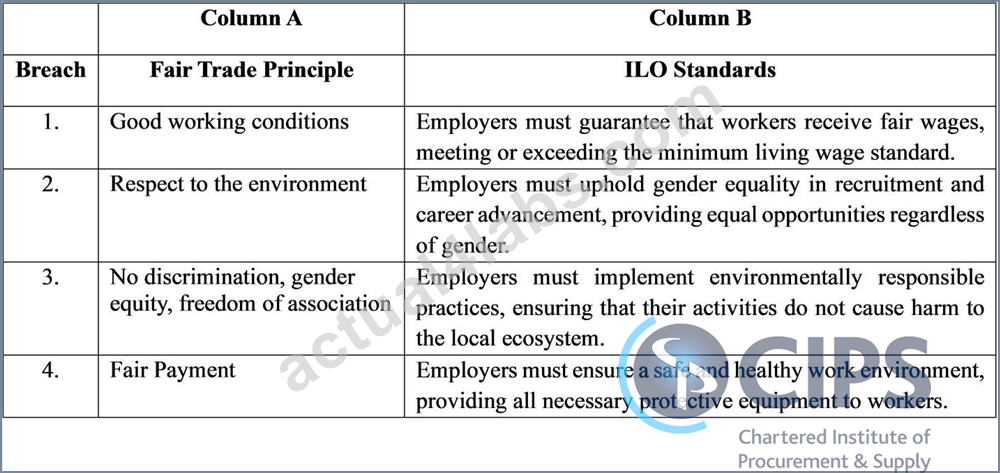
- A. Respect to the environment: Employers must adopt practices that reduce environmental impact and ensure that the working environment does not harm the local ecosystem
- B. Fair Payment: Workers must receive fair wages that meet the minimum living wage requirements.
- C. Good working conditions: Workers must be provided with a safe working environment that meets all health and safety standards, including protective equipment
- D. No discrimination, gender equity, freedom of association: Employers must ensure gender equality in hiring practices and provide equal opportunities for all workers, regardless of gender.
Answer: A,B,C,D
Explanation: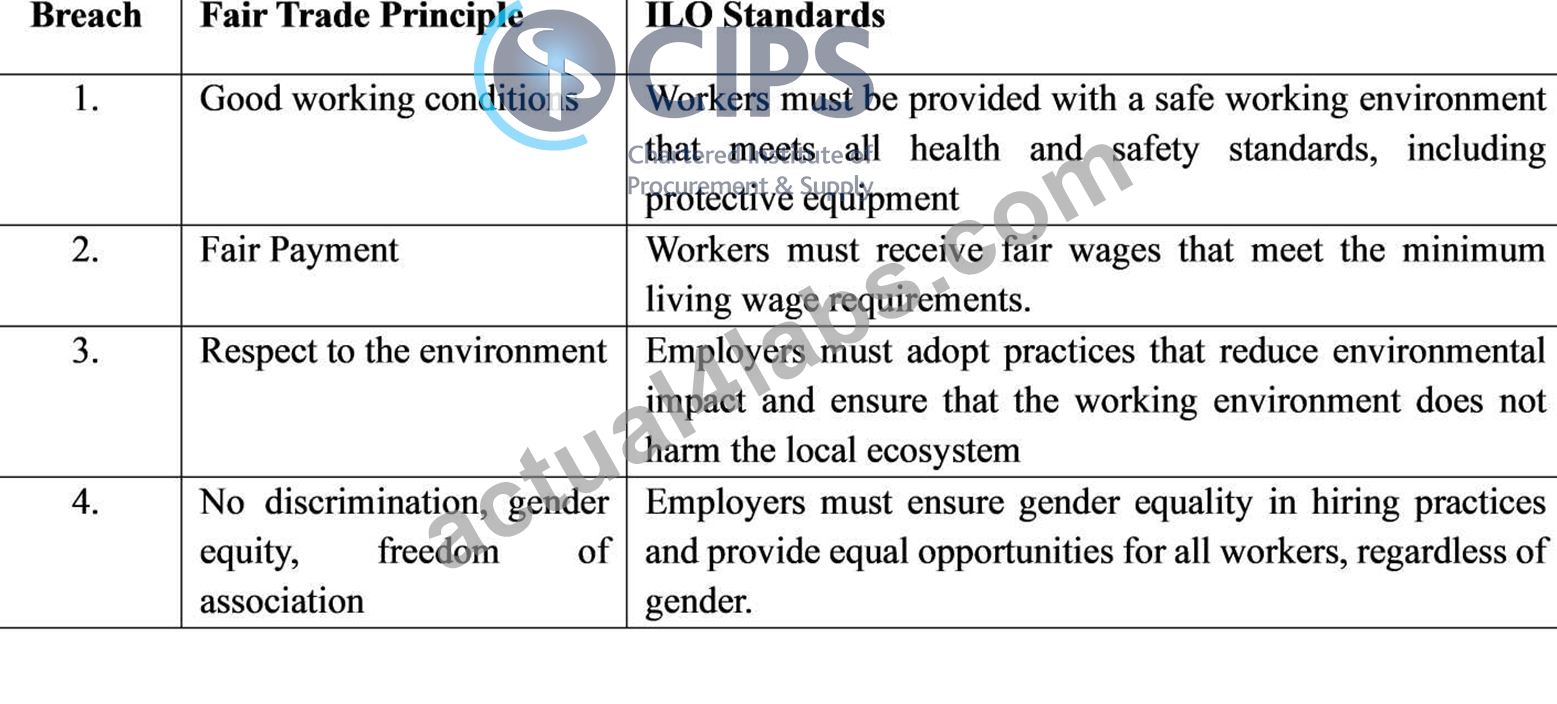
Good Working Conditions → A) Workers must be provided with a safe working environment that meets all health and safety standards, including protective equipment. The Fair-Trade principle of good working conditions emphasizes that workers should have access to a safe, healthy, and supportive work environment. ILO Principle A aligns with this by requiring safety measures such as protective equipment to ensure worker well-being. Fair Payment → C) Workers must receive fair wages that meet the minimum living wage requirements.
NEW QUESTION # 30
A homeowner planning to purchase a new air conditioner notices an energy rating label on each model. This rating scheme provides details on the unit's energy efficiency, cooling capacity, and environmental impact. How does this information assist the buyer in making a decision?
- A. It guarantees that the air conditioner will last for a specific number of years
- B. It ensures that the most expensive air conditioner is always the best choice
- C. It provides clear information on energy efficiency and expected electricity consumption
- D. It ensures that all air conditioners have the same level of performance
Answer: C
Explanation:
Choice B - A rating scheme (such as an Energy Star rating or SEER rating) helps buyers understand how much electricity an air conditioner will use. This allows them to choose a model that is cost-effective and environmentally friendly. This is the correct answer Incorrect answer:
Choice A - Incorrect - A rating scheme does not make all air conditioners equal in performance. Instead, it helps buyers compare different models based on efficiency, cooling capacity, and energy consumption. Air conditioners may vary in technology, features, and effectiveness.
Choice C - A rating scheme does not indicate product lifespan. Durability depends on factors like brand, usage, maintenance, and build quality, which are not necessarily covered by the rating system.
Choice D- A higher price does not always mean better efficiency. Some expensive models may have extra features but still consume more energy. A rating scheme helps buyers focus on energy savings and performance rather than just cost.
Reference:
LO-3.2; Page 287; Role of industry standards and frameworks used by organizations in securing ESG considerations and ethical standards
NEW QUESTION # 31
The World Fair Trade Organization (WFTO) aims to help large global businesses expand into new markets, offering better products and fairer prices for consumers. Is this statement accurate?
- A. No, the WFTO primarily focuses on diminishing the influence of multinational corporations
- B. No, the WFTO focuses on supporting smaller and disadvantaged producers
- C. Yes, the WFTO provides financial aid to international companies
- D. Yes, the WFTO establishes global rules to safeguard consumers
Answer: B
Explanation:
Choice C- This is correct. The WFTO's mission is to support small and disadvantaged producers, ensuring fair wages, ethical trade practices, and market access.
Incorrect answer:
Choice A- This is incorrect. The WFTO does not focus on diminishing multinational corporations but works to empower disadvantaged producers.
Choice B- The WFTO does not establish global regulations but promotes fair trade practices and ethical business standards for producers and consumers, therefore this is wrong.
Choice D- This is incorrect. The WFTO's mission does not involve providing financial aid to businesses; it focuses on promoting fair trade principles.
Reference:
LO-3.3; Page 294-295; The World Fair Trade Organization (WFTO) and its principles
NEW QUESTION # 32
Which of the following is an example where long-term availability of supplies is prioritized over short-term gains?
- A. Reducing quality standards in the short term, accepting that customer rejections will increase in the long term
- B. Selling products manufactured to lower quality standards, resulting in lower unit prices
- C. Cutting costs in the short term, ultimately leading to a reduced range and variety of suppliers in the market
- D. Choosing a new supplier that is initially more expensive than others in the market to expand the supply base and develop market capacity
Answer: D
Explanation:
Choice C- Using a new supplier that is more expensive in the short-term than others in the market, to expand the supply base and to develop capacity in the market is an example of where long-term availability of supplies would be more important than short-term gains. This decision focuses on building relationships and capacity for the future, prioritizing sustainability over immediate cost savings. This is the correct answer.
Incorrect answer:
It is important to consider the broader concept of supply chain management when weighing up short term commercial benefits vs long term availability.
Choice A and B- Lowering quality in every aspect leads to a customer rejects and negative brand publicity. There will be no long term supplies required as customers won't buy the product.
Choice D- Variety reduction involves reducing the number of different solutions used to fulfil the same need. When considering developing a procurement strategy for a new category, it is common to find that there is a variety of different standards and solutions employed across an organization to fulfil broadly the same need. The solution is not sustainable.
Reference:
LO-1.4; Page 114-116; Short term commercial gains and long term availability
NEW QUESTION # 33
A clothing manufacturer seeks SA8000 certification to demonstrate its commitment to social accountability and ethical labor practices. To meet the requirements, it implements a management system to ensure compliance with labor standards, including fair wages, safe working conditions, and the prohibition of forced and child labor. Additionally, the company adopts ISO 14000 to address environmental concerns in its operations.
Based on this scenario, which of the following statements is true?
- A. SA8000 certification focuses exclusively on environmental management
- B. SA8000 requires a management system like ISO 14000 and is not industry-specific
- C. SA8000 certification is only applicable to the clothing industry
- D. SA8000 and ISO 14000 are the same certification systems
Answer: B
Explanation:
Choice A- SA8000 certification is a global standard for social accountability that applies across all industries. It requires the implementation of a management system to ensure compliance with its principles, and ISO 14000 is an example of a complementary system that can address environmental aspects.
Incorrect answer:
Choice B- Incorrect because SA8000 focuses on social accountability, not exclusively on environmental management.
Choice C- Incorrect as SA8000 is not industry-specific and applies to various sectors.
Choice D- Incorrect because SA8000 and ISO 14000 address different areas-social accountability and environmental management, respectively.
Reference:
LO-3.1; Page 264-266; Labor codes of conduct: Ethical Trading Initiative (ETI) and Social Accountability International's standard SA8000
NEW QUESTION # 34
EcoWear, a well-known apparel company committed to sustainability, has recently expanded its supply chain but failed to address key ESG issues, leading to the following concerns:
A supplier has been reported for using toxic dyes, causing environmental harm.
Another supplier has poor labor practices, resulting in worker strikes.
If these ESG issues remain unresolved, what are the most likely consequences for EcoWear? Select any TWO.
- A. Legal Benefits: EcoWear could benefit from reduced regulatory scrutiny and enjoy a more favorable legal environment
- B. Increased Sales: Consumers are likely to overlook the issues and continue purchasing EcoWear products, boosting sales
- C. Reputational Damage: The company may face backlash from consumers and advocacy groups, harming its brand reputation and customer loyalty
- D. Inability to secure or attract potential investments from banks
Answer: C,D
Explanation:
Choice A- Increased Sales is unlikely, as consumers are increasingly aware of ESG issues and may choose to avoid brands that don't align with their values.
Choice B- Legal Benefits is also unlikely, as failing to address ESG issues could actually increase regulatory scrutiny and legal risks.
Option C & D is the answer as per the study guide.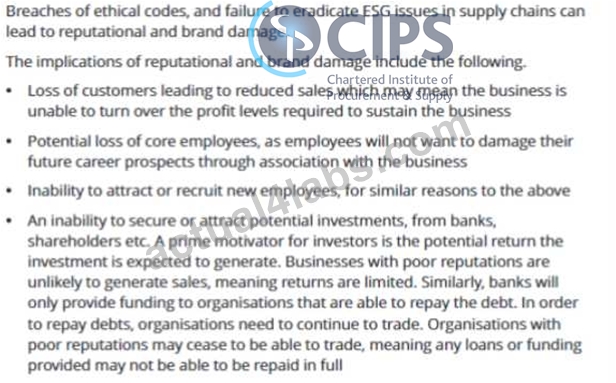
Reference: LO-1.1; Page 53; Impact of breaches of ethical codes or ESG standards on reputation and brand
NEW QUESTION # 35
A leading coffee retailer has launched an initiative to purchase raw materials, such as coffee beans, directly from farmers instead of through intermediaries like exporters. By adopting a partnership approach and investing in the local community, what is this practice called?
- A. Fair Trade
- B. Direct Trade
- C. World Trade
- D. Trade Initiative
Answer: B
Explanation:
Choice C - The above practice is known as Direct Trade, where the buyer (in this case, the coffee retailer) works directly with the producers (farmers) without intermediaries such as exporters or traders. Direct Trade focuses on building strong relationships, ensuring fairer pricing for farmers, and often includes investments in the local community.
Incorrect answer:
Choice A - World Trade is a broad term that refers to the global exchange of goods and services and does not describe the specific practice of eliminating intermediaries.
Choice B - Fair Trade, while similar in its focus on ethical sourcing, operates under specific certification standards and often involves a governing body overseeing the supply chain.
Choice D- Trade Initiative is a general term and not a recognized practice like Direct Trade or Fair Trade.
Reference:
LO-3.3; Page 309; Fairtrade standards that affect the workplace and producers and their implications for procurement and supply
NEW QUESTION # 36
What is the primary purpose of a supplier code of conduct?
- A. To ensure suppliers take full responsibility for product quality
- B. To establish the expectations and standards for supplier behavior and practices
- C. To define the penalties for non-compliance in supplier contracts
- D. To outline the payment terms and delivery schedules for suppliers
Answer: B
Explanation:
Choice B- A supplier code of conduct sets clear guidelines on ethical, social, environmental, and legal responsibilities that suppliers are expected to follow. Therefore B is the correct answer.
Incorrect answer:
Choice A- This is not the primary purpose of a supplier code of conduct. While the code may mention consequences for non-compliance, its primary focus is on establishing ethical and operational standards rather than detailing penalties.
Choice C- Payment terms and delivery schedules are typically included in contractual agreements, not in a supplier code of conduct. The code focuses more on ethical and sustainability standards rather than logistical or financial details.
Choice D- While product quality may be a part of a supplier's responsibilities, it is usually addressed in specific quality agreements or technical specifications rather than the supplier code of conduct. The code primarily deals with broader principles such as ethical labor practices, environmental impact, and compliance with laws.
Reference:
LO-2.2; Page 184; Monitoring Contract Performance
NEW QUESTION # 37
A procurement officer at a global retail company is responsible for sourcing raw materials for a new product line. With the company committed to ethical sourcing practices, including Fair Trade, the officer aims to clearly communicate Fair Trade requirements to potential suppliers. Where should these requirements be included to ensure compliance?
- A. In the specifications section of the tender document
- B. In the company's annual sustainability report
- C. During supplier performance review meetings after contracts are signed
- D. In internal emails to the procurement team
Answer: A
Explanation:
Choice B- Fair Trade requirements must be included in the specifications section of the tender documents so that potential suppliers are aware of and can comply with these requirements before submitting bids or entering into agreements.
Other options, like internal communications or sustainability reports, do not effectively communicate requirements to suppliers in a legally enforceable way.
Reference:
LO-3.3; Page 311-312; Fairtrade standards that affect the workplace and producers and their implications for procurement and supply
NEW QUESTION # 38
Which of the following standard operating procedures do procurement professionals use to prevent fraud within a company?
- A. Allowing a single employee to handle all procurement transactions without oversight
- B. Bypassing formal bidding processes for convenience in purchasing decisions
- C. Using verbal agreements for procurement contracts to expedite the process
- D. Implementing a whistleblower hotline to report suspicious activities anonymously
Answer: D
Explanation:
Choice B- A whistleblower hotline allows employees to report suspected fraudulent activities or unethical behavior anonymously, fostering a culture of transparency and accountability. This tool can help organizations identify and address fraud early, reducing the risk of financial loss.
Incorrect answer:
Choice A- Allowing one person to manage all procurement transactions without oversight significantly increases the risk of fraud. Implementing checks and balances, such as requiring multiple approvals or reviews, is essential for accountability and transparency in procurement processes.
Choice C- Relying on verbal agreements increases the risk of misunderstandings and fraud, as there is no formal documentation to refer to. Written contracts are essential for establishing clear terms and protecting both parties, which helps mitigate fraud risks.
Choice D- This option is incorrect. Bypassing formal bidding processes undermines transparency and competitiveness, increasing the risk of fraud and corruption. Adhering to formal procurement processes ensures fairness, accountability, and proper documentation, reducing the likelihood of fraudulent activities.
Reference:
LO-1.1; Page 22-23; The role of governance considerations in securing ethical and sustainable procurement and supply arrangements
NEW QUESTION # 39
All of the following are advantages of low-cost country sourcing EXCEPT which one?
- A. A wider array of potential suppliers are available
- B. Lower wage rates allow lower manufacturing costs
- C. Intellectual property is easily protected
- D. Access to new and better process technologies
Answer: C
Explanation:
Choice B - LCCS carries the risk of engaging with unethical suppliers, raising concerns about the protection of intellectual property. Consequently, this serves as the answer.
Incorrect answer:
Choice A - This is an advantage of LCCS as LCCS opens up opportunities to engage potential suppliers globally.
Choice C - Companies use LCCS to find more affordable raw materials, labor and manufacturing thereby increasing profits.
Choice D- When considering the profitability of LCCS, a procurement professional will consider the development in technologies have made it easier for their business to communicate with and source from suppliers in low cost countries. This means business can source more affordable products.
Reference:
LO-1.4; Page 106-107; Profit maximization and low-cost sourcing
NEW QUESTION # 40
......
Free CIPS Level 5 Advanced Diploma in Procurement and Supply L5M5 Exam Question: https://www.actual4labs.com/CIPS/L5M5-actual-exam-dumps.html
Dumps Practice Exam Questions Study Guide for the L5M5 Exam: https://drive.google.com/open?id=1uZyNnXY6X44r7M57PMMHw3ze-L-UrvMM