

Pass Salesforce Salesforce Health Cloud Accredited Professional Exam in First Attempt Guaranteed Updated Dump from Actual4Labs!
Pass Health-Cloud-Accredited-Professional Exam with 121 Questions - Verified By Actual4Labs
NEW QUESTION # 14
A developer needs to modify the out-of-the-box Advanced Patient Card to display the Category, SubjectID, and Date for active Clinical Alerts. Which three steps should the developer take to accomplish this?
Choose 3 answers
- A. Create and activate a new child card.
- B. Clone the parent card.
- C. Change the child card state to show active.
- D. Define session variables to control visibility of clinical data.
- E. Create a DataRaptor to extract necessary data.
Answer: B,C,E
Explanation:
To modify the out-of-the-box Advanced Patient Card in Salesforce Health Cloud to display the Category, SubjectID, and Date for active Clinical Alerts, a developer should follow these steps:
Clone the Parent Card (Option A):
Begin by cloning the existing parent FlexCard that represents the Advanced Patient Card. This allows you to create a customized version without altering the original component.
Cloning ensures that the new card retains the base functionality while providing the flexibility to add or modify features as required.
Create a DataRaptor to Extract Necessary Data (Option C):
Utilize OmniStudio's DataRaptor to define a data extraction process that retrieves the specific fields-Category, SubjectID, and Date-from the Clinical Alerts object.
Configure the DataRaptor to filter and return only active clinical alerts, ensuring that the card displays relevant information.
This step is crucial for sourcing the data that will be presented on the customized patient card.
Change the Child Card State to Show Active (Option E):
After cloning the parent card, modify the state of the child card to ensure it displays active clinical alerts.
This involves setting the appropriate conditions within the card's configuration to filter and present only active alerts, aligning with the requirement to display current clinical information.
By executing these steps, the developer customizes the Advanced Patient Card to effectively display the desired fields for active Clinical Alerts, enhancing the utility of the patient card for healthcare providers.
Reference:
Advanced Patient Card - Salesforce Help
OmniStudio for Health Cloud
NEW QUESTION # 15
A provider wants to capture non-clinical factors that impact its patient population, such as food insecurity and lack of transportation.
Which approach should a consultant take to meet this requirement?
- A. Extend the Care Plan data model to meet client requirements.
- B. Leverage the Social Determinants data model in Health Cloud and extend it as needed.
- C. Use the electronic health record (EHR) data model to meet client requirements.
- D. Build a custom entity to address client requirements.
Answer: B
Explanation:
The correct approach is to use the Social Determinants data model in Health Cloud and extend it as needed.
Social Determinants of Health represent non-clinical social and environmental factors that affect a patient or member's wellness, such as food insecurity, transportation barriers, housing instability, and socioeconomic conditions. Salesforce Trailhead explains that the Social Determinants data model gives care teams insight into a patient's physical environment and socioeconomic status, helping them identify intervention tasks and reduce care barriers. Salesforce developer documentation also describes the model as representing barriers, health determinants, and interventions for a patient or member. A custom entity should not be the first choice because Health Cloud already provides a purpose-built data model. The Care Plan and EHR models address clinical care, not broad non-clinical determinants.
NEW QUESTION # 16
A customer is implementing Intelligent Appointment Management in Health Cloud to eliminate swivel chair to other scheduling systems.
Which two connectivity options should a consultant leverage as the scheduling engine?
Choose 2 answers
- A. Business Rules Engine
- B. Salesforce Scheduler
- C. Scheduler for Industries
- D. Electronic Health Record (EHR) System
Answer: B,D
NEW QUESTION # 17
How Should Members and Patients be represented during the............ Managers as per the Salesforce recommendation?
- A. Leveraging Person Accounts is the recommended approach to .........
- B. Leveraging Candidate Accounts are the recommended approach to .........
- C. Salesforce recommends using Member Accounts to represent members ......
- D. The individual Data Model may be used to represent members .........
Answer: D
Explanation:
The individual Data Model may be used to represent members ......(B) is the recommended approach to represent members and patients during the implementation by Patient Managers as per the Salesforce recommendation. Leveraging Person Accounts is not the recommended approach to .........(A), as Person Accounts are used to represent providers, not members or patients. Salesforce does not recommend using Member Accounts to represent members ......, as Member Accounts are used to represent payer organizations, not members or patients. Leveraging Candidate Accounts are not the recommended approach to .........(D), as Candidate Accounts are used to represent potential members or patients, not existing ones.
NEW QUESTION # 18
In which two ways can an administrator support the Health department so that the team can efficiently assess the individual, enroll them in a program, and monitor them during emergency? (Choose two)
- A. Create a healthcare provider enrollment flow
- B. Create Patient Enrollment Console
- C. Install emergency Response Management unmanaged package
- D. Leverage pre-configured flows provided with Health Cloud
Answer: C,D
Explanation:
Reference and details below.
According to the Salesforce documentation3, there are two ways to support the health department so that the team can efficiently assess the individual, enroll them in a program, and monitor them during emergency:
Install Emergency Response Management unmanaged package, which provides prebuilt objects, fields, apps, tabs, reports, dashboards, and more to help health organizations manage emergency response3.
Leverage pre-configured flows provided with Health Cloud, such as Assess Individual Risk Level flow and Enroll in Program flow, which help health workers quickly assess and enroll individuals in emergency programs3. Therefore, options B and C are correct. Option A is incorrect, because there is no such thing as a healthcare provider enrollment flow in Health Cloud. Option D is incorrect, because there is no such thing as a patient enrollment console in Health Cloud.
NEW QUESTION # 19
Bloomington Caregivers would like to display patient information from both Salesforce standard objects and data from an external system.
Which three Health Cloud features should a consultant recommend the company use to display this on the patient record page?
Choose 3 answers
- A. Salesforce Flows
- B. FlexCards
- C. Visualforce Pages
- D. Integration Procedures
- E. DataRaptors
Answer: B,D,E
Explanation:
Step-by-Step Explanation:
* Health Cloud Best Practice for Displaying Internal and External Data:
* FlexCards(part of OmniStudio) can display data from multiple sources in a unified view on a patient record.
* Integration Proceduresconnect to external systems and bring in data (e.g., from EHRs or other sources).
* DataRaptorsextract and transform Salesforce data for display and use in FlexCards.
* Salesforce Documentation Reference:
* "FlexCards can display internal Salesforce data and call Integration Procedures or DataRaptors to bring in external or standard object data."-OmniStudio Standard Guide
* "Integration Procedures are used to retrieve and update data from external systems and can be invoked directly from FlexCards or OmniScripts."-OmniStudio Integration Procedures
* "DataRaptors map Salesforce data to and from FlexCards and Integration Procedures, enabling seamless display of patient information."-OmniStudio DataRaptors
* Other Options:
* Salesforce Flows: Good for automation but not for real-time display of combined external and internal data on record pages.
* Visualforce Pages: Legacy solution, not recommended for modern Health Cloud patient page display, and does not natively integrate with OmniStudio tools.
References:
OmniStudio Standard Guide
OmniStudio Integration Procedures
OmniStudio DataRaptors
NEW QUESTION # 20
A payer is looking to optimize the workflow for its call center, which focuses primarily on members calling to check on the status of their prior authorizationrequests.
How should a consultant conduct discovery to define a workflow for these call center users?
- A. Build a proof of concept to present to the client and ask them for feedback.
- B. Identify personas and ask them to walk through a day in their life, taking notes and identifying opportunities for optimization.
- C. Research industry trends and develop a point of view, then present it to the customer for validation.
- D. Use work from another project to inform the discovery, then review it with the IT department.
Answer: B
Explanation:
Step 1: Requirement
Define workflow for call center users focused on prior authorization status checks.
Step 2: Best Practice for Workflow Discovery
* Discovery should be user-centered, involving direct engagement with actual users (personas).
* Observing and documenting their daily processes identifies real pain points and optimization opportunities.
Extract:
"Best practice for workflow discovery is to interview and observe key personas, document their processes, and map opportunities for automation and optimization." Salesforce Architect - Business Process Discovery
* Other options (industry research, previous projects, or proof of concept) do not provide the necessary user insight for workflow design.
NEW QUESTION # 21
A healthcare organization is launching a new gene therapy program, and an administrator needs to leverage Advanced Therapy Management. In which two ways does Advanced Therapy Management assist the healthcare organization with its complex scheduling requirements?
Choose 2 answers
- A. Schedule a telehealth appointment.
- B. Book multi-step appointments.
- C. Optimize appointment chain with Einstein.
- D. Reschedule part of the appointment chain.
Answer: B,D
Explanation:
Advanced Therapy Management (ATM) in Salesforce Health Cloud is specifically designed to support complex workflows and scheduling requirements, particularly for therapies involving multiple interdependent appointments. For a gene therapy program, ATM provides these features:
* Reschedule Part of the Appointment Chain (Option A):
* In complex workflows where multiple steps are involved (e.g., collection, processing, infusion), ATM allows administrators to reschedule individual appointments within the chain without disrupting the entire workflow.
* This flexibility is crucial for accommodating unexpected delays or changes in the therapy process.
* Book Multi-Step Appointments (Option B):
* ATM supports the scheduling of interdependent, multi-step appointments that are a common feature of advanced therapies such as gene therapy.
* For example, steps like apheresis, manufacturing, and infusion can be scheduled in sequence, ensuring coordination across various stakeholders.
* Optimize Appointment Chain with Einstein (Option C):
* While optimization using Einstein is a broader Salesforce capability, it is not directly tied to Advanced Therapy Management's out-of-the-box scheduling features.
* Schedule a Telehealth Appointment (Option D):
* Telehealth appointments are not the focus of ATM, which is designed for in-person and complex therapy workflows.
References:
Advanced Therapy Management Overview
Scheduling in Advanced Therapy Management
NEW QUESTION # 22
Which three activities does "The Social Determinants" feature in Health cloud help providers perform? (choose three.
- A. Automatically import credit scores and income information into the patient record in Health cloud
- B. Track determinants and barriers to care across their patient populations
- C. Integrate service such as transportation and meal delivery into their patient care plans and programs.
- D. Track the influence of the social network of the patient on the patients' health outcomes
- E. Plan interventions to help address the barriers to care within their patient populations
Answer: B,D,E
NEW QUESTION # 23
A customer wants to view and navigate to critical insurance, clinical, and primary care physician information on a patient's profile.
Which Health Cloud capability should a consultant implement?
- A. Enhanced Timeline
- B. Enhanced Highlights Panel
- C. Patient Path
- D. Advanced Patient Card
Answer: B
NEW QUESTION # 24
Which Three items can be a Life Science company track about a Care Programs using Program Management? (Choose Three. (Repeated question)
- A. The plans that enrollees have been engaged in as part of the care program
- B. The budget & Expenses of the company's associate Care Program
- C. The clinical indicators that need to be monitored in the care programs
- D. The multiple marketing campaigns that enrollees are subjected to as part of the Care Program.
- E. The products that are associate with a given Care Program
Answer: A,D,E
Explanation:
According to the Health Cloud Data Model Developer Guide, Program Management is a feature in Health Cloud that allows life science companies to track and manage care programs that offer products and services to patients and providers. With Program Management, life science companies can track the following three items about a care program:
The multiple marketing campaigns that enrollees are subjected to as part of the care program. This item can be tracked by using the CareProgramEnrolleeCampaign object, which represents a marketing campaign that targets a specific care program enrollee.
The products that are associated with a given care program. This item can be tracked by using the CareProgramEnrolleeProduct object, which represents a product or service that is offered to a care program enrollee.
The plans that enrollees have been engaged in as part of the care program. This item can be tracked by using the CareProgramEnrolleePlan object, which represents a plan or package that contains one or more products or services for a care program enrollee. The budget and expenses of the company's associated care program is not an item that can be tracked by using Program Management. The clinical indicators that need to be monitored in the care programs is not an item that can be tracked by using Program Management.
NEW QUESTION # 25
A Health Cloud administrator has set up risk recalculation by setting the recalculate flag to TRUE but is not seeing the recalculation score for the patient. Which of the following is most likely the reason why recalculation score for the patient is not displaying?
- A. Use the CMS recalculation API
- B. CMS scores cannot be recalculated in health cloud.
- C. Use a 3 - Apply to Real World / Analyze / Evaluated party API to recalculate CMS risk score.
- D. Risk scores are only recalculated for patients who are affiliated with a care program.
Answer: D
Explanation:
Reference and details below.
According to the Health Cloud Data Model Developer Guide, Risk scores are only recalculated for patients who are affiliated with a care program is the most likely reason why recalculation score for the patient is not displaying. Risk scores are calculated based on CMS-HCC (Centers for Medicare & Medicaid Services - Hierarchical Condition Categories) model, which assigns risk factors to patients based on their diagnoses and demographic factors. Risk scores are used to adjust payments for health plans and providers. Risk scores are only recalculated when the recalculate flag is set to TRUE and the patient is affiliated with a care program. Using CMS recalculation API is not a valid reason, as CMS recalculation API is not a feature of Health Cloud. CMS scores cannot be recalculated in health cloud is not a valid reason, as CMS scores can be recalculated in health cloud by setting the recalculate flag to TRUE. Using a third party API to recalculate CMS risk score is not a valid reason, as it has nothing to do with displaying the recalculation score.
NEW QUESTION # 26
A consultant is implementing Identity Verification for their customer's customer service representatives and needs to add a new search parameter.
Which record should the consultant configure to accomplish this?
- A. Identity Verification Parameter Item
- B. Verification Search Feature
- C. Linked Identity Search Detail
- D. Identity Verification Process Detail
Answer: A
Explanation:
To implement Identity Verification in Salesforce and add a new search parameter, the consultant needs to configure the Identity Verification Parameter Item record.
Key Details:
Identity Verification Parameter Item:
Purpose: Defines the parameters used in the identity verification process, such as name, email, phone, or custom attributes.
Configuration Steps:
Navigate to Identity Verification Parameter Item in Setup or the appropriate Health Cloud app.
Create or modify a record to include the new parameter, such as a specific field or custom attribute.
Link it to the corresponding Identity Verification Process Detail to ensure it's utilized during verification.
Supporting Documentation:
Salesforce Health Cloud Admin Guide (help.salesforce.com)
Identity Verification Configuration Overview (developer.salesforce.com)
NEW QUESTION # 27
A Payer Service Cloud org uses Accounts and contacts to model Health Insurance Members. While all teams within the organization Work with all members, only some teams require HC capabilities. What is the recommended best practice for modeling members in HC for this organization?
- A. Use the individual model with HC
- B. Model as Person Accounts, whether they are using HC capabilities or not.
- C. Only groups needing HC capabilities need to use Person Accounts.
- D. Account Record Types for existing members can remain as-is. Future members should be created as Person Accounts.
Answer: B
Explanation:
According to the Health Cloud Implementation Guide, the recommended best practice for modeling members in Health Cloud for a payer service cloud org that uses accounts and contacts to model health insurance members is to model them as person accounts, whether they are using Health Cloud capabilities or not. Person accounts are a type of account that combines account and contact information in a single record. They are suitable for representing individual consumers in healthcare and life sciences. Using person accounts for all members can simplify data management and avoid data duplication. Only groups needing Health Cloud capabilities need to use person accounts is not a recommended best practice, as it can create inconsistency and complexity in data modeling. Account record types for existing members can remain as-is is not a recommended best practice, as it can limit the functionality and integration of Health Cloud features. Using the individual model with Health Cloud is not a valid option, as the individual model is not supported by Health Cloud.
NEW QUESTION # 28
What is the best practice when transitioning an org from Service Cloud to HC?
- A. Approach depends on how each customer usestheir org. Any other options may be used.
- B. Put HC use cases in a new org, leave only Service Cloud use cases in an existing org.
- C. Migrate the entire org in place.
- D. Build out HC capabilities in a new org, then migrate all users and data.
Answer: A
Explanation:
Explanation
Reference and details below.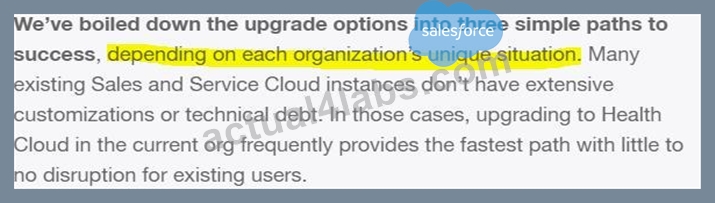
NEW QUESTION # 29
A provider's office wants to verify a patient's insurance plan information and coverage when they call into the call center to book an appointment.
Which capability should a consultant leverage to address this requirement?
- A. Benefits Eligibility and Verification
- B. Identity Verification
- C. Intelligent Appointment Management
- D. Utilization Management
Answer: A
Explanation:
Step 1: Requirement Analysis
* The provider's office needs toverify a patient's insurance plan information and coveragewhen a patient calls to book an appointment.
* This means checking whether the patient's insurance is active, what services are covered, and any applicable copays or eligibility details.
Step 2: Health Cloud Out-of-the-Box Capability
Benefits Eligibility and Verificationis the dedicated Health Cloud capability that allows provider offices and payers toverify a patient's insurance coverage, eligibility, and benefit details in real time, either through integration with payers or using Health Cloud workflows.
Extract:
"Health Cloud offers Benefits Eligibility and Verification, enabling providers and payers to confirm a patient' s plan information and coverage eligibility, reducing the risk of denied claims and improving the patient experience." Administer Health Cloud - Benefits Eligibility and Verification Step 3: Review of Options
* A. Benefits Eligibility and Verification:Directly addresses insurance plan and coverage verification.
* B. Intelligent Appointment Management:For scheduling, not insurance verification.
* C. Utilization Management:For prior authorizations and care request reviews.
* D. Identity Verification:For confirming patient identity, not insurance coverage.
NEW QUESTION # 30
......
Penetration testers simulate Health-Cloud-Accredited-Professional exam: https://www.actual4labs.com/Salesforce/Health-Cloud-Accredited-Professional-actual-exam-dumps.html
Free Test Engine For Salesforce Health Cloud Accredited Professional Certification Exams: https://drive.google.com/open?id=1s5S36men_9vlZG69mm8zlbS37VAXmkZ3