

Get Special Discount Offer on JN0-649 Dumps PDF [UPDATED Sep-2025]
PDF Download Juniper Test To Gain Brilliante Result!
NEW QUESTION # 41
You are running OSPF as your IGP. The interfaces connecting two routers are in the ExStart state. You notice that something is incorrect with the configuration.
Referring to the exhibit, which statement is correct?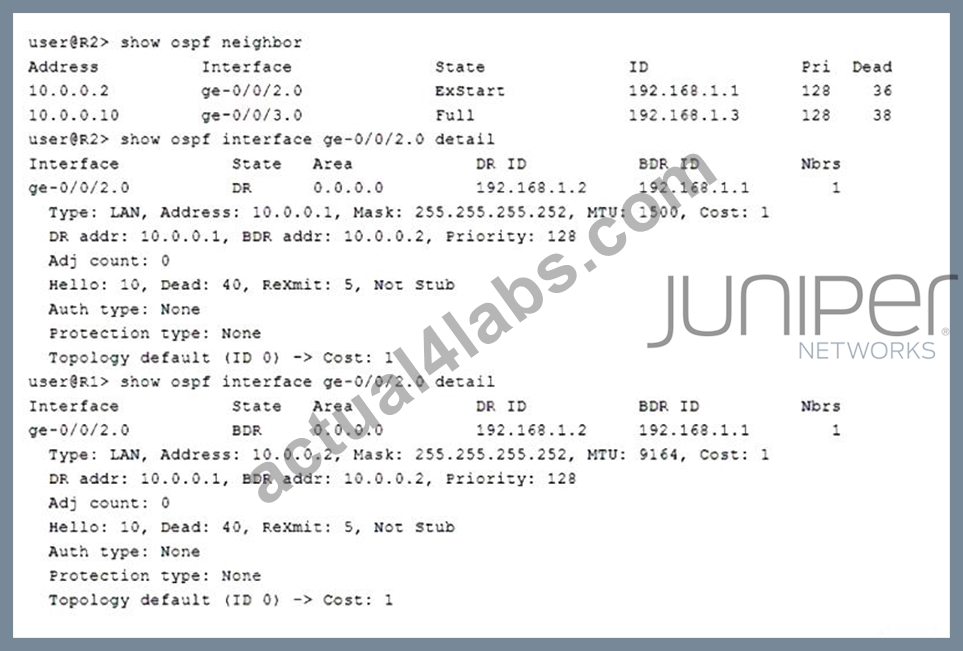
- A. The subnet mask is incorrect.
- B. The interface type is incorrect.
- C. The IP addresses are incorrect.
- D. The MTU setting are incorrect.
Answer: D
Explanation:
In OSPF, the ExStart state indicates that the routers are attempting to establish a relationship and exchange information about their MTU settings. If the MTU settings do not match between the two routers on the link, it can prevent the adjacency from progressing past the ExStart state.
References:
* From the image provided, you can see that the OSPF adjacency on the interface ge-0/0/2.0 is stuck in
* the ExStart state.
* This state often suggests that there is a mismatch in the MTU settings between the routers on that interface.
* To resolve this, ensure that both interfaces have the same MTU setting. You can check and set the MTU on Juniper routers using the following commands:
# Check current MTU settings
show interfaces ge-0/0/2
# Set MTU to a specific value (e.g., 1500)
set interfaces ge-0/0/2 mtu 1500
# Commit the configuration
commit
NEW QUESTION # 42
Which three statements are correct about EVPN route types? (Choose three.)
- A. Type 1 routes carry endpoint MAC address information.
- B. Type 5 routes carry replication information.
- C. Type 2 routes carry endpoint MAC address information.
- D. Type 2 routes carry endpoint IP address information.
- E. Type 3 routes carry replication information.
Answer: C,D,E
Explanation:
* Understanding EVPN Route Types:
* EVPN (Ethernet VPN) is used for providing Ethernet multipoint services over MPLS or VXLAN networks.
* EVPN Route Types:
* Type 1 (Ethernet Auto-Discovery Route): Used for auto-discovery of PEs and for detecting multi-homed devices.
* Type 2 (MAC/IP Advertisement Route):
* Carries endpoint MAC address information.
* Carries endpoint IP address information.
* Facilitates MAC learning and IP-to-MAC binding distribution.
* Type 3 (Inclusive Multicast Route):
* Carries replication information.
* Used for forwarding multicast and broadcast traffic.
* Type 5 (IP Prefix Route): Carries IP prefixes for inter-subnet connectivity, but not replication information.
* Verification:
* Type 2 routes are crucial for distributing MAC and IP information about endpoints.
* Type 3 routes are used to manage multicast traffic effectively.
References:
* Juniper EVPN Configuration Guide
* Understanding EVPN Route Types
NEW QUESTION # 43
Which EVPN route type is used for fast convergence and for advertising the split horizon label?
- A. Type 2
- B. Type 4
- C. Type 5
- D. Type 1
Answer: D
NEW QUESTION # 44
Which two statements are true regarding bidirectional PIM? (Choose two )
- A. It uses multicast tunneling to forward traffic
- B. Devices only store group specific entries.
- C. Forwarding paths can be suboptimal
- D. It eliminates the need for an RP.
Answer: B,C
NEW QUESTION # 45
You are troubleshooting a BGP connection.
Referring to the exhibit, which two statements are correct? (Choose two.)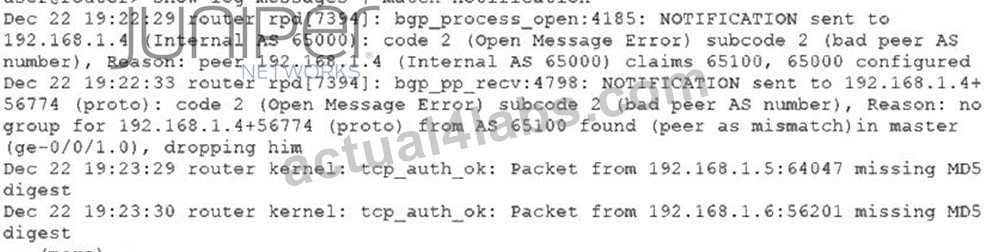
- A. The 192.168.1.4 peer has a misconfigured autonomous system number.
- B. Packet fragmentation is preventing the session from establishing.
- C. The 192.168.1.5 peer has a misconfigured MD5 key.
- D. The ge-0/0/1 interface is disabled.
Answer: A,C
Explanation:
* Step 1: Check the error messages in the log.
The log messages indicate:
vbnet
Copy code
Dec 22 19:22:29 router rpd[7394]: bgp_process_open:4185: NOTIFICATION sent to 192.168.1.4 (Internal AS 65000): code 2 (Open Message Error) subcode 2 (bad peer AS number), Reason: peer 192.168.1.4 (Internal AS 65000) claims 65100, 65000 configured Dec 22 19:22:33 router rpd[7394]: bgp_pp_recv:4788: NOTIFICATION sent to 192.168.1.4+56714 (proto):
code 2 (Open Message Error) subcode 2 (bad peer AS number), Reason: no group for 192.168.1.4+56714 (proto) from AS 65100 found (peer as mismatch) in master
* Step 2: Interpret the messages.
* The first message indicates that a BGP NOTIFICATION was sent to 192.168.1.4 due to an "Open Message Error" with a "bad peer AS number" because peer 192.168.1.4 claims AS 65100, but
65000 is configured.
* The second message reiterates that the peer AS number 65100 does not match the configured AS
65000, causing a mismatch.
* Step 3: Understand the MD5 key error.
sql
Copy code
Dec 22 19:23:29 router kernel: tcp_auth_ok: Packet from 192.168.1.5:64047 missing MD5 digest Dec 22 19:23:30 router kernel: tcp_auth_ok: Packet from 192.168.1.6:56201 missing MD5 digest
* These lines indicate that packets from 192.168.1.5 and 192.168.1.6 are missing the MD5 digest, suggesting a potential MD5 key misconfiguration.
* Step 4: Validate the answers.
* Option B: The 192.168.1.5 peer has a misconfigured MD5 key. This is correct because the logs show that packets from 192.168.1.5 are missing the MD5 digest.
* Option D: The 192.168.1.4 peer has a misconfigured autonomous system number. This is correct because the logs indicate that 192.168.1.4 claims AS 65100, while the router is configured for AS
65000.
References:
* Document on useful Juniper commands for troubleshooting BGP and understanding log messages.
* Commands for checking BGP logs: show log messages | match notification, show bgp summary, show configuration protocols bgp.
NEW QUESTION # 46
Referring to the exhibit, how will router E quickly learn that the remote MAC addresses are no longer reachable through the router attached to the failed link?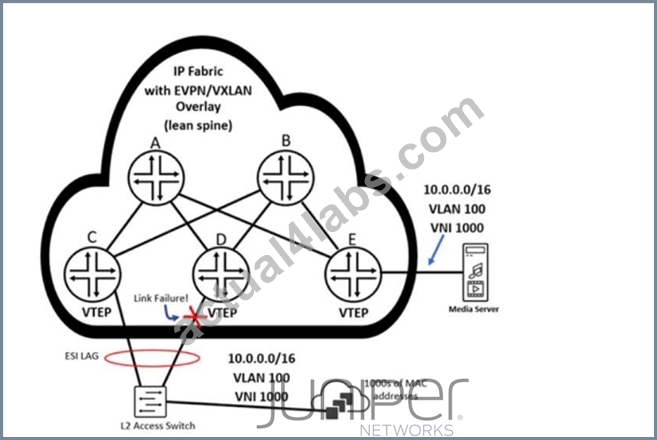
- A. Router E receives Type 2 withdrawal messages from router D.
- B. Router E receives Type 1 withdrawal messages from router C.
- C. Router E receives Type 1 withdrawal messages from router D.
- D. Router E receives Type 2 withdrawal messages from router C.
Answer: C
NEW QUESTION # 47
You are deploying IP phones in your enterprise networks. When plugged in, the IP phones must automatically negotiate the power requirements for the new connection with the EX Series switches.
In this scenario, which protocol should be used to enable this behavior?
- A. LLDP-MED
- B. MP-BGP
- C. LLDP
- D. CDP
Answer: A
NEW QUESTION # 48
You are troubleshooting a BGP connection.
Referring to the exhibit, which two statements are correct? (Choose two.)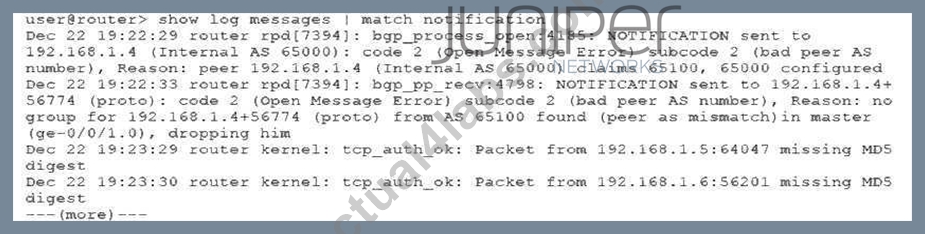
- A. Packet fragmentation is preventing the session from establishing.
- B. The ge-0/0/1 interface is disabled.
- C. The 192.168.1.4 peer has a misconfigured autonomous system number.
- D. The 192.168.1.5 peer has a misconfigured MD5 key.
Answer: A,B
NEW QUESTION # 49
Referring to the exhibit, ServerA sends a single IP packet destined to 10.0.0.127.
Which two statements correctly describe the behavior of the resulting outbound VXLAN packets that contain the original packet destined to 10.0.0.127? (Choose two.)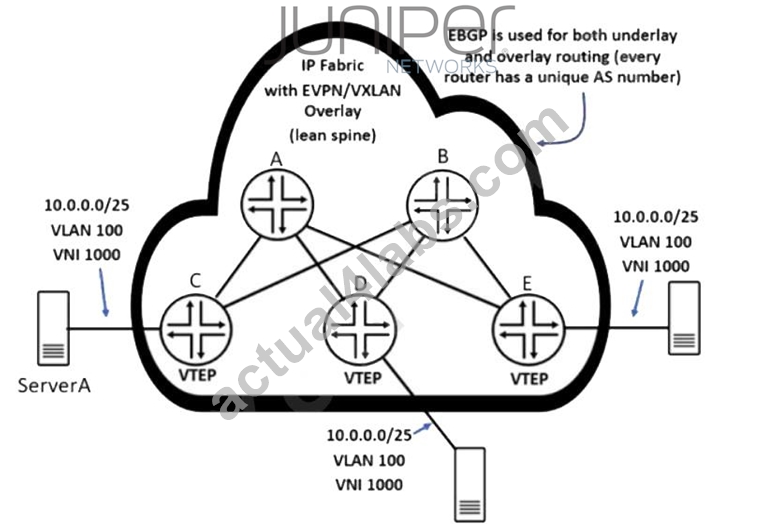
- A. Router D will not replicate and send a copy of the received VXLAN packet to router E.
- B. Router E will replicate and send a copy of the received VXLAN packet to router D.
- C. Router C will send a VXLAN packet destined only to router D and router E.
- D. Router C will send a single VXLAN packet to one remote VTEP.
Answer: B,D
NEW QUESTION # 50
Which address range is used for source-specific multicast?
- A. 239.0.0.0/8
- B. 232.0.0.0/8
- C. 224.2.0.0/16
- D. 233.0.0.0/8
Answer: B
Explanation:
The address range 232.0.0.0/8 is reserved for Source-Specific Multicast (SSM). This range is specifically allocated for SSM where data is sent from a specific source to the receivers.
References:
* Source-Specific Multicast (SSM) Overview, RFC 4607
NEW QUESTION # 51
Referring to the exhibit, there are multiple ASM groups in the 224 0 0.0/4 range Which configuration change is needed to ensure R1 is always the RP for group 224.224.1.1?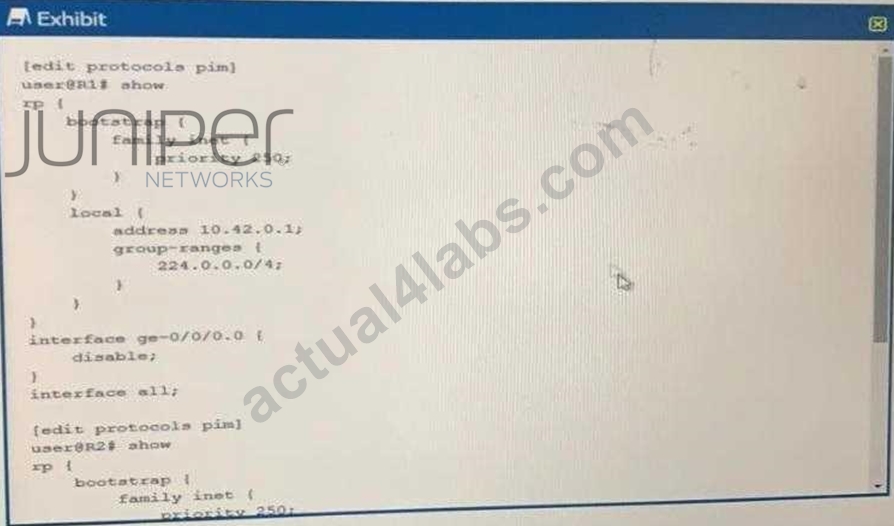
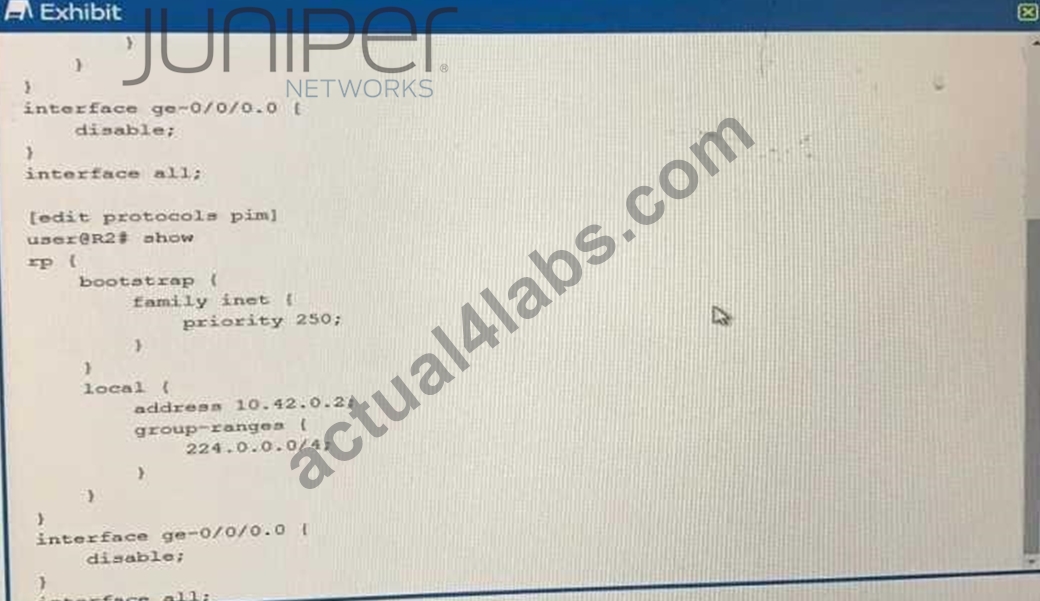
- A. Ensure R1 has a more specific group range
- B. Increase the priority on R1 to higher than R2
- C. Set the priority on R1 to zero
- D. Configure R1 with a higher local RP address
Answer: B
NEW QUESTION # 52
You will to route Layer 3 PVLAN traffic within the secondary VLAN.
What is required to accomplish this task?
- A. a community VIAN
- B. an isolated VLAN
- C. an IRB
- D. an FBF policy
Answer: C
NEW QUESTION # 53
Your enterprise network is running BGP VPNs to support multitenancy. Some of the devices with which you peer BGP do not support the VPN NLRI. You must ensure that you do not send BGP VPN routes to the remote peer.
Which two configuration steps will satisfy this requirement? (Choose two.)
- A. Configure an export policy on the local BGP peer to reject the VPN routes being sent to the remote peer.
- B. Configure the apply-vpn-export feature on the local BGP peer.
- C. Configure a route reflector for the VPN NLRI.
- D. Configure an import policy on the remote peer to reject the routes when they are received.
Answer: A,B
Explanation:
Apply both the VRF export and BGP group or neighbor export policies (VRF first, then BGP) before routes from the vrf or l2vpn routing tables are advertised to other PE routers.
https://www.juniper.net/documentation/us/en/software/junos/bgp/topics/ref/statement/vpn-apply-export-edit-protocols-bgp-vp.html
NEW QUESTION # 54
You must ensure that all routes in the 10.0.0/8 address range are not advertised outside of your AS.
Which well-known BGP community should be assigned to these addresses to accomplish this task?
- A. internet
- B. no-export
- C. no-advertise
- D. no-peer
Answer: B
Explanation:
For specifying the BGP community attribute only, you also can specify community-ids as one of the following well-known community names defined in RFC 1997:
no-advertise-Routes containing this community name are not advertised to other BGP peers.
no-export-Routes containing this community name are not advertised outside a BGP confederation boundary.
no-export-subconfed-Routes containing this community are advertised to IBGP peers with the same AS number, but not to members of other confederations.
llgr-stale-Adds a community to a long-lived stale route when it is readvertised.
no-llgr-Marks routes which a BGP speaker does not want to be retained by LLGR. The Notification message feature does not have any associated configuration parameters.
https://www.juniper.net/documentation/us/en/software/junos/bgp/topics/ref/statement/community-edit-routing-options.html
NEW QUESTION # 55
You are asked to configure an 802.1X solution that supports dynamic VLAN assignment.
In this scenario, which two modes support using vendor-specific attributes (VSAs)? (Choose two.)
- A. single-secure supplicant mode
- B. static MAC bypass mode
- C. single supplicant mode
- D. multiple supplicant mode
Answer: A,C
Explanation:
https://www.juniper.net/documentation/us/en/software/junos/user-access/topics/concept/dynamic-vlan-assignment-colorless-ports.html
NEW QUESTION # 56
You want to create an OSPF area that only contains intra-area route information in the form of Type 1 and Type 2 LSAs.
In this scenario, which area is needed to accomplish this task?
- A. totally non-to-stubby area
- B. stub area
- C. non-to-stubby area
- D. totally stubby area
Answer: D
NEW QUESTION # 57
Click the Exhibit.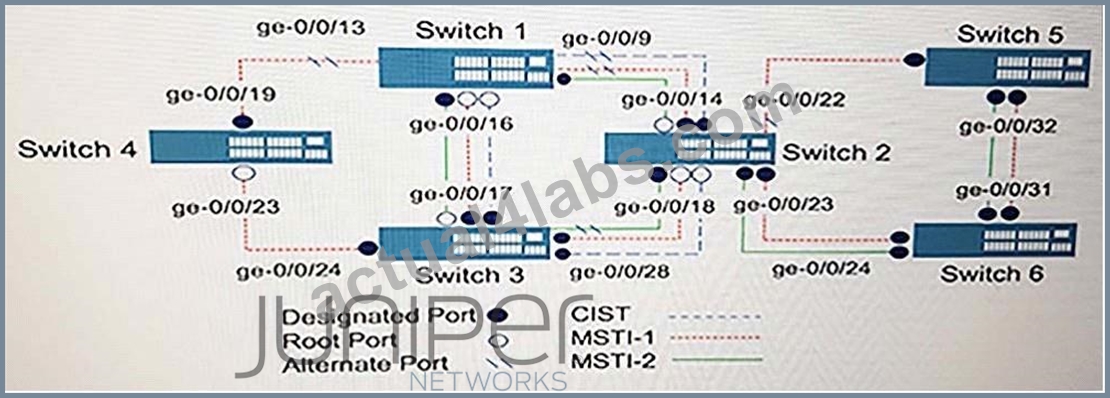
Switch 4 is rebooted as shown in the exhibit.
Which statement is correct in this scenario?
- A. CIST generates notification events.
- B. CIST is reconverged.
- C. MSTI-1 is reconverged.
- D. MSTI-2 is reconverged.
Answer: C
NEW QUESTION # 58
You enable the Multiple VLAN Registration Protocol (MVRP) to automate the creation and management of virtual LANs.
Which statement is correct in this scenario?
- A. Timers dictate when link state changes are propagated.
- B. The forbidden mode does not register or declare VLANs.
- C. MVRP works with RSTP and VSTP.
- D. When enabled, MVRP affects all interfaces.
Answer: B
Explanation:
The forbidden mode does not register or declare VLANs. You can change the registration mode of a specific interface to forbidden. An interface in forbidden registration mode does not participate in MVRP even if MVRP is enabled on the switch.
https://www.juniper.net/documentation/us/en/software/junos/multicast-l2/topics/topic-map/mvrp.html MVRP is disabled by default on the switches and, when enabled, affects only trunk interfaces. Once you enable MVRP, all VLAN interfaces on the switch belong to MVRP (the default normal registration mode) and those interfaces accept PDU messages and send their own PDU messages. forbidden-The interface does not register or declare VLANS (except statically configured VLANs).
NEW QUESTION # 59
Referring to the exhibit, which two statements are correct? (Choose two.)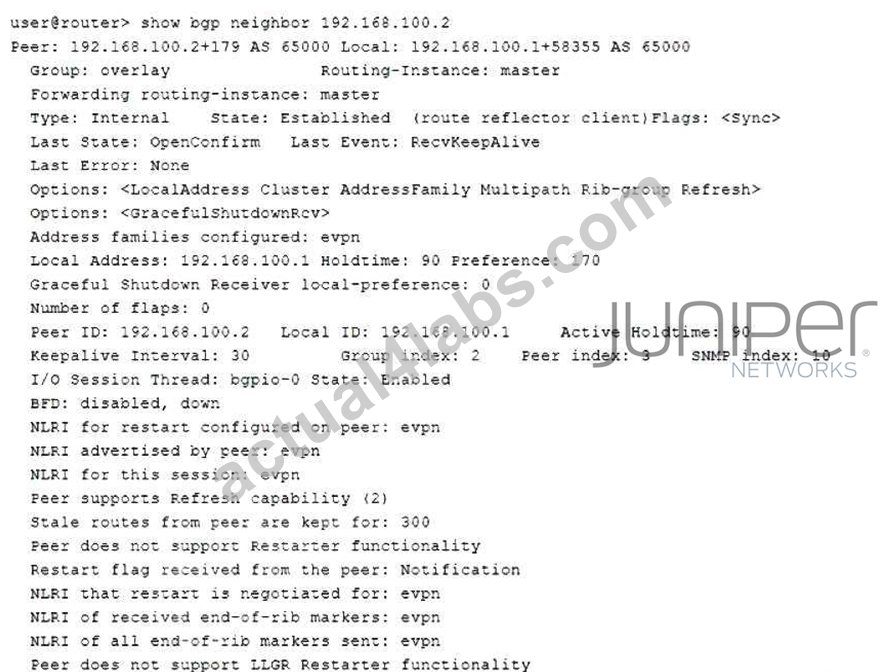
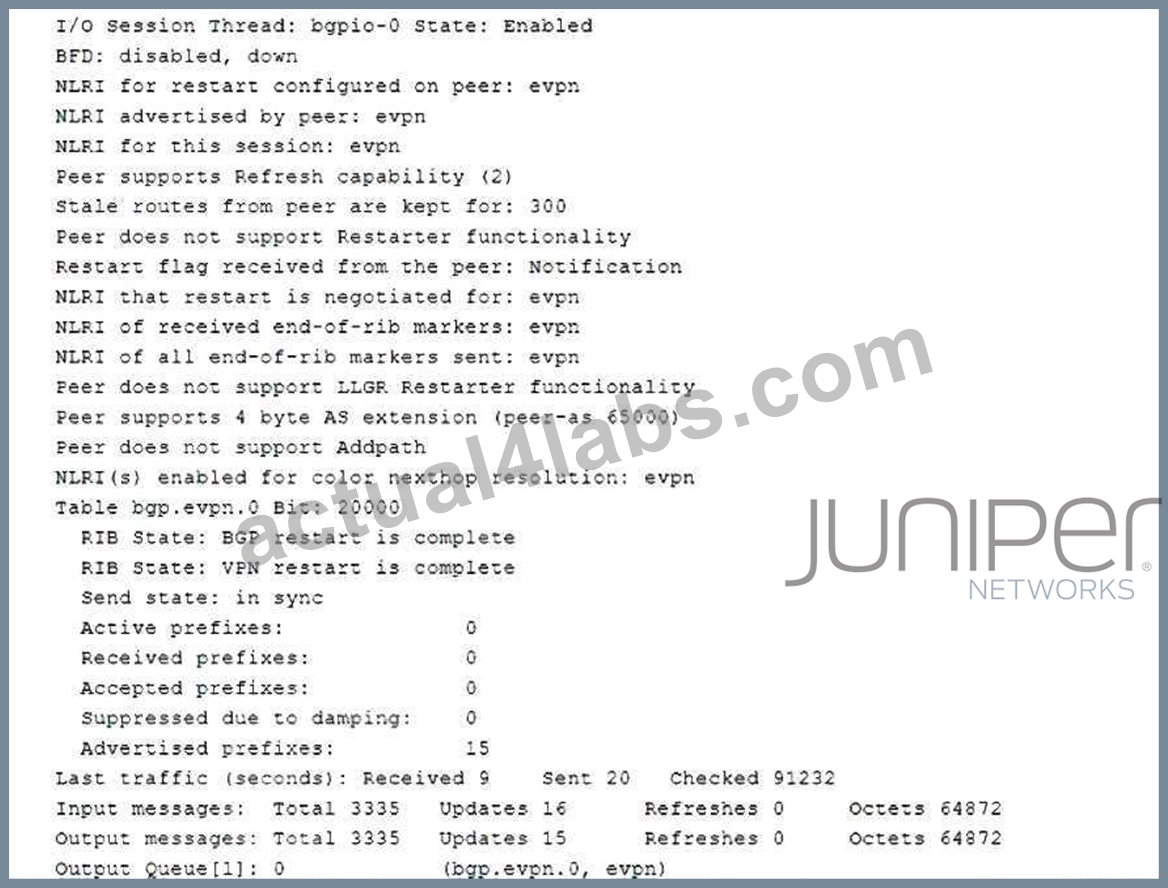
- A. The BGP neighbor cannot advertise EVPN related routes.
- B. The BGP neighbor can advertise EVPN related routes.
- C. The BGP neighbor cannot advertise L3 VPN related routes.
- D. The BGP neighbor can advertise L3 VPN related routes.
Answer: B,D
NEW QUESTION # 60
Your network has an unmanaged switch between the hosts and your EX Series switch. After the traffic enters the EX Series switch, each host must be on a separate VLAN.
How would you accomplish this task?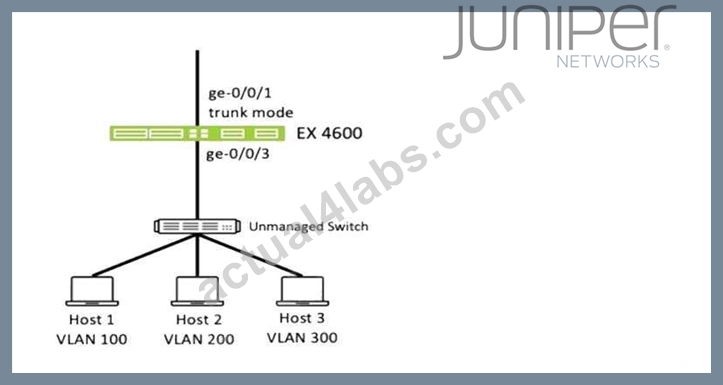
- A. Configure an output firewall filter on interface ge-0/0/1 to match the destination MAC or IP address of the hosts to assign the VLANs.
- B. Configure an input firewall filter on interface ge-0/0/3 to match the source MAC or IP address of the hosts to assign the VLANs.
- C. Configure VSTP on interface ge-0/0/1 to assign the VLANs.
- D. Configure interface ge-0/0/3 to a mode trunk to assign the VLANs.
Answer: D
NEW QUESTION # 61
......
Juniper JN0-649 certification is a valuable credential for networking professionals who want to advance their careers. It demonstrates that they have the knowledge and skills required to work with Juniper Networks devices in an enterprise environment. Holding this certification can lead to better job opportunities, higher salaries, and increased credibility in the industry.
JN0-649 Dumps are Available for Instant Access: https://www.actual4labs.com/Juniper/JN0-649-actual-exam-dumps.html
Provide Updated Juniper JN0-649 Dumps as Practice Test and PDF: https://drive.google.com/open?id=18jK5faLc_xbemI-TyvukaTRzXd0iRaPf