

Sample Questions of Mule-Dev-301 Dumps With 100% Exam Passing Guarantee
Pass Key features of Mule-Dev-301 Course with Updated 62 Questions
NEW QUESTION # 22
A Mule application uses API autodiscovery to access and enforce policies for a RESTful implementation.
- A. Northing because flowRef is an optional attribute which can be passed runtime
- B. The name of the flow that has APlkit Console to receive all incoming RESTful operation requests.
- C. The name of the flow that has HTTP listener to receive all incoming RESTful operation requests
- D. Any of the APIkit generate implement flows
Answer: C
Explanation:
To use API autodiscovery to access and enforce policies for a RESTful implementation, flowRef must be set to the name of the flow that has HTTP listener to receive all incoming RESTful operation requests. This way, API autodiscovery can identify the API implementation and associate it with the corresponding API specification and policies in API Manager. The flow that has HTTP listener is usually the main flow that contains the APIKit Router. Reference: https://docs.mulesoft.com/api-manager/2.x/api-auto-discovery-new-concept#flowref
NEW QUESTION # 23
Which statement is true when working with correlation IDS?
- A. The HTTP Listener generates correlation IDS unless a correlation ID is received in the HTTP request
- B. The HTTP Listener regenerates correlation IDs regardless of the HTTP request
- C. The Anypoint MQ Connector automatically propagates correlation IDS
- D. The VM Connector does not automatically propagate correction IDs
Answer: A
Explanation:
When working with correlation IDs, the HTTP Listener generates correlation IDs unless a correlation ID is received in the HTTP request. In that case, it propagates the received correlation ID throughout the flow execution. Correlation IDs are used to track events across different flows or applications. Reference: https://docs.mulesoft.com/mule-runtime/4.3/about-mule-message#message-attributes
NEW QUESTION # 24
Refer to the exhibit.
What is the result of the Mule Maven Plugin configuration of the value of property its,keystorePassoword in CloudHub 2.0?
- A. Runtime Manager masks the value
- B. Anypoint Studio secures the value
- C. CloudHub encrypts the value
- D. The Mule server encrypts the value
Answer: A
Explanation:
The result of the Mule Maven Plugin configuration of the value of property its,keystorePassword in CloudHub 2.0 is that Runtime Manager masks the value. This means that Runtime Manager hides or obscures the value from anyone who views it in Runtime Manager or Anypoint Platform. Reference: https://docs.mulesoft.com/runtime-manager/runtime-manager-agent-for-mule4#properties-tab
NEW QUESTION # 25
Multiple individual Mute application need to use the Mule Maven plugin to deploy to CloudHub.
The plugin configuration should .. reused where necessary and anything project, specific should be property-based.
Where should the Mule Maven details be configured?
- A. Settings, xml
- B. A parent pom.xml
- C. A Bill of Materials (BOM) parent pm
- D. Pom, xml
Answer: B
Explanation:
To reuse Mule Maven plugin configuration across multiple individual Mule applications, the developer should use a parent pom.xml file. A parent pom.xml file defines common configuration for one or more child projects that inherit from it. The developer can specify common properties and dependencies for all child projects in the parent pom.xml file, such as Mule Maven plugin configuration, and then reference them in each child project's pom.xml file using placeholders. Reference: https://docs.mulesoft.com/mule-runtime/4.3/mmp-concept#parent-pom https://maven.apache.org/guides/introduction/introduction-to-the-pom.html#Project_Inheritance
NEW QUESTION # 26
A company with MuleSoft Titanium develops a Salesforce System API using MuleSoft out-of-the-box Salesforce Connector and deploys the API to CloudHub.
Which steps provide the average number of requests and average response time of the Salesforce Connector?
- A. Change the API Implementation to capture the information in the log.
Retrieve the information from the log file. - B. Access Anypoint Monitoring's built-in dashboard
Seclect a resource.
Create a custom dashboard to retrieve the information. - C. Access Anypoint Monitoring built-in dashboard.
Select a resource.
Locate the information under Log Manager < Raw Data. - D. Access Anypoint Monitoring's built-in dashboard. Select a resource.
Locate the information under the Connectors tab.
Answer: D
Explanation:
To get the average number of requests and average response time of the Salesforce Connector, the developer should access Anypoint Monitoring's built-in dashboard, select a resource (such as an application or an API), and locate the information under the Connectors tab. The Connectors tab shows metrics for each connector used by the resource, such as average requests per minute, average response time, and failures. Reference: https://docs.mulesoft.com/monitoring/built-in-dashboard-reference
NEW QUESTION # 27
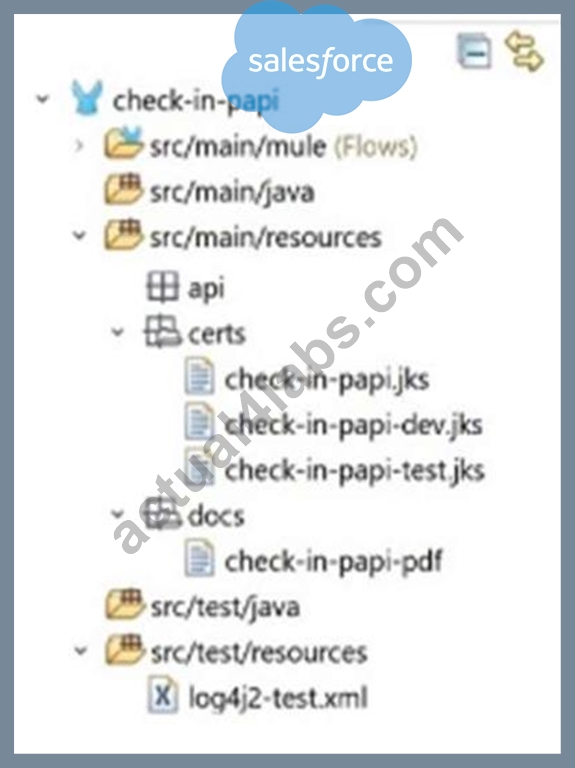
Refer to the exhibit.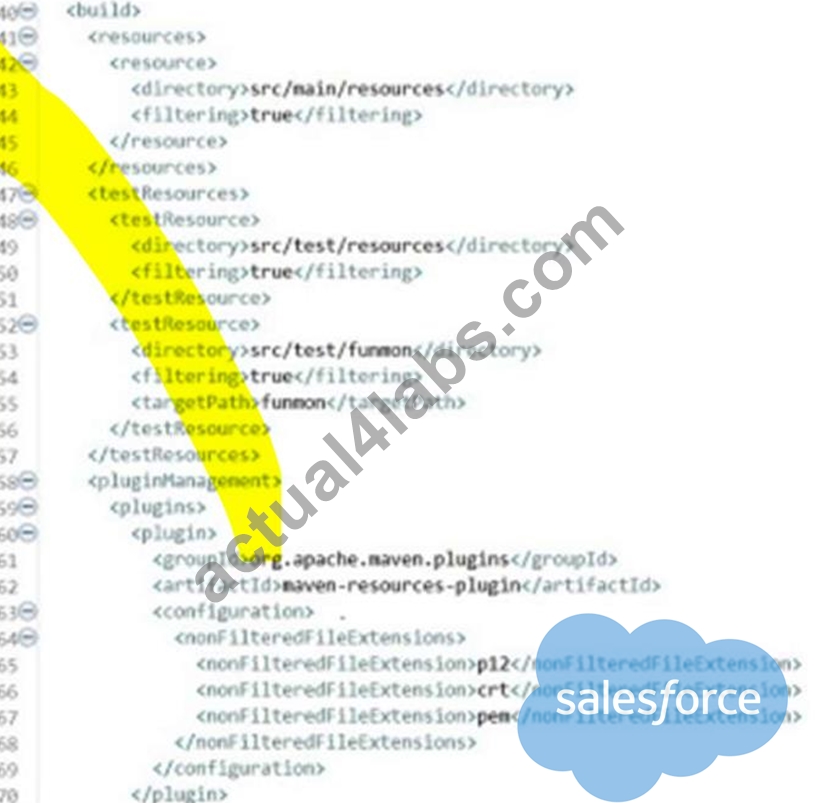
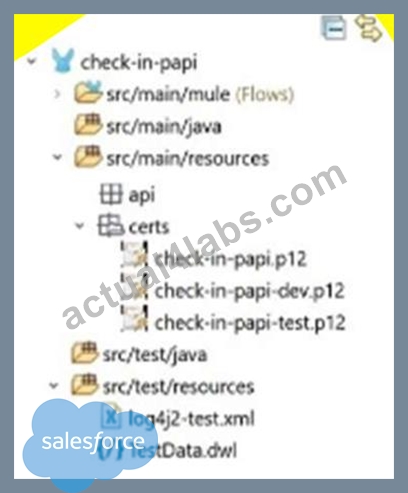
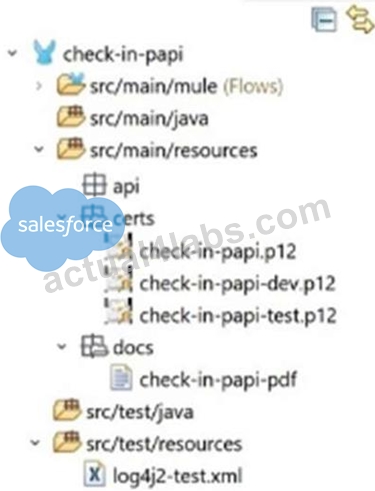
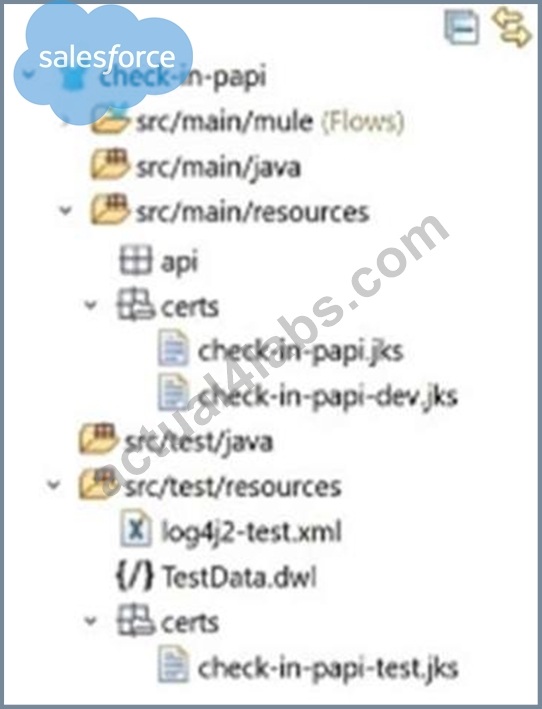
A Mule application pom.xml configures the Maven Resources plugin to exclude parsing binary files in the project's src/main/resources/certs directory.
Which configuration of this plugin achieves a successful build?
- A.
- B.
- C.
- D.
Answer: B
Explanation:
To configure the Maven Resources plugin to exclude parsing binary files in the project's src/main/resources/certs directory, option C should be used. This option specifies that any files with .cer or .jks extensions under the certs directory should be excluded from filtering. Filtering is a process of replacing placeholders with actual values in resource files during the build process. Binary files should not be filtered because they may become corrupted or unusable. Reference: https://maven.apache.org/plugins/maven-resources-plugin/examples/filter.html https://maven.apache.org/plugins/maven-resources-plugin/examples/include-exclude.html
NEW QUESTION # 28
What is the MuleSoft recommended method to encrypt sensitive property data?
- A. The encryption key should be different for each environment and the sensitive data should be the same for all environments
- B. The encryption key should be identical for all environments and the sensitive data should be different for each environment
- C. The encryption key should be identical for all environments
- D. The encryption key and sensitive data should be different for each environment
Answer: D
Explanation:
The MuleSoft recommended method to encrypt sensitive property data is to use the Secure Properties Tool that comes with Anypoint Studio. This tool allows encrypting properties files with a secret key and then decrypting them at runtime using the same key. The encryption key and sensitive data should be different for each environment to ensure security and avoid accidental exposure of sensitive data. Reference: https://docs.mulesoft.com/mule-runtime/4.3/secure-configuration-properties
NEW QUESTION # 29
Refer to the exhibit.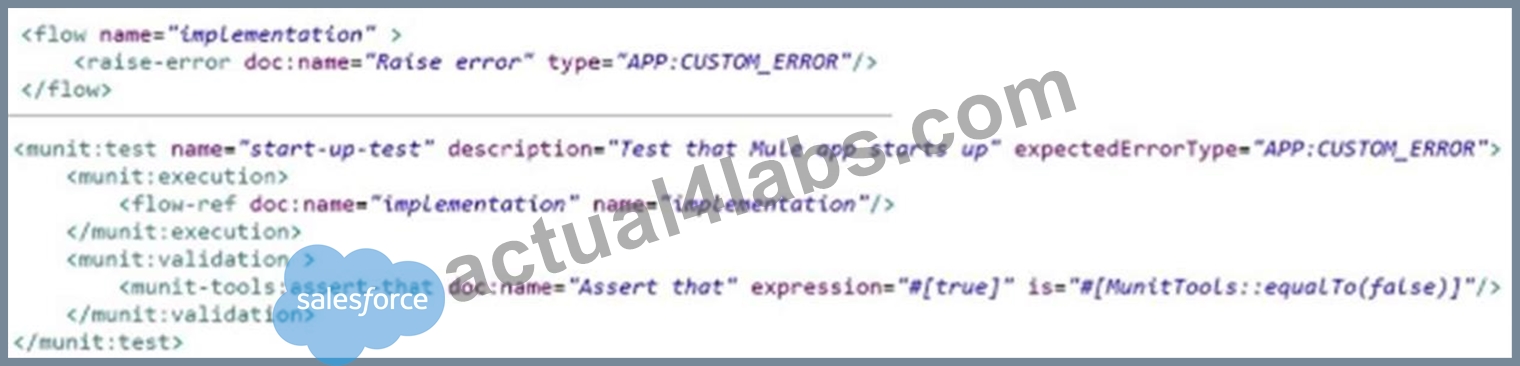
The flow name is ''implementation'' with code for the MUnit test case.
When the MUnit test case is executed, what is the expected result?
- A. The test case fails with an unexpected error type
- B. The test case fails with an assertion error
- C. The test case passes
- D. The test throws an error and does not start
Answer: B
Explanation:
Based on the code snippet and MUnit test case below, when the MUnit test case is executed, the expected result is that the test case fails with an assertion error. This is because the assert-equals processor compares two values for equality, and fails if they are not equal. In this case, the expected value is 'Hello World', but the actual value returned by the implementation flow is 'Hello Mule'. Therefore, the assertion fails and an error is thrown. Reference: https://docs.mulesoft.com/munit/2.3/assert-equals-processor
NEW QUESTION # 30
An order processing system is composed of multiple Mule application responsible for warehouse, sales and shipping. Each application communication using Anypoint MQ. Each message must be correlated against the original order ID for observability and tracing.
How should a developer propagate the order ID as the correlation ID across each message?
- A. Wrap all Anypoint MQ Publish operations within a With CorrelationID scope from the Tracing module, setting the correlation ID to the order ID
- B. Set a custom Anypoint MQ user property to propagate the order ID and set the correlation ID in the receiving applications.
- C. Use the default correlation ID, Anypoint MQ will sutomatically propagate it.
- D. Use the underlying HTTP request of Anypoint MQ to set the 'X-CORRELATION_ID' header to the order ID
Answer: A
Explanation:
To propagate the order ID as the correlation ID across each message using Anypoint MQ, the developer should wrap all Anypoint MQ Publish operations within a With CorrelationID scope from the Tracing module, setting the correlation ID to the order ID. The With CorrelationID scope allows setting a custom correlation ID for any event that occurs within it. The Tracing module also enables distributed tracing across different Mule applications and services using Anypoint Monitoring. Reference: https://docs.mulesoft.com/tracing-module/1.0/tracing-module-reference#with-correlation-id-scope https://docs.mulesoft.com/tracing-module/1.0/tracing-module-concepts
NEW QUESTION # 31
Which pattern should be used to invoke multiple HTTP APIs in parallel and roll back failed requests in sequence?
- A. VM queues as a reliability pattern with error handlers to roll back any requests
- B. Scatter-Gather as central Saga orchestrator for all API request with compensating actions for failing routes
- C. A Parallel for Each scope with each HTTP request wrapped in a Try scope
- D. A database as a transactional outbox and an Until Successful router to retry any requests
Answer: B
Explanation:
To invoke multiple HTTP APIs in parallel and roll back failed requests in sequence, the developer should use a Scatter-Gather router as a central Saga orchestrator for all API requests with compensating actions for failing routes. A Scatter-Gather router executes multiple routes concurrently and aggregates the results. A Saga orchestrator coordinates a series of actions across different services and handles failures by executing compensating actions. Therefore, using a Scatter-Gather router as a Saga orchestrator allows invoking multiple HTTP APIs in parallel and rolling back any failed requests in sequence. Reference: https://docs.mulesoft.com/mule-runtime/4.3/scatter-gather-concept https://docs.mulesoft.com/mule-runtime/4.3/saga
NEW QUESTION # 32
An organization uses CloudHub to deploy all of its applications.
How can a common-global-handler flow be configured so that it can be reused across all of the organization's deployed applications?
- A. Create a common-global-error-handler flow in all Mule Applications Refer to it flow-ref wherever needed.
- B. Create a Mule Plugin project
- C. Create a Mule plugin project
Create a common-global-error-handler flow inside the plugin project.
Use this plugin as a dependency in all Mute applications.
Import that configuration file in Mute applications.
Answer: B
Explanation:
Create a common-global-error-handler flow inside the plugin project.
Use this plugin as a dependency in all Mule applications
D.
Create a Mule daman project.
Create a common-global-error-handler flow inside the domain project.
Use this domain project as a dependency.
Explanation:
To configure a common-global-handler flow that can be reused across all of the organization's deployed applications, the developer should create a Mule Plugin project, create a common-global-error-handler flow inside the plugin project, and use this plugin as a dependency in all Mule applications. This way, the developer can import the common-global-error-handler flow in any application that needs it and avoid duplicating the error handling logic. Reference: https://docs.mulesoft.com/mule-runtime/4.3/error-handling#global-error-handler
NEW QUESTION # 33
Refer to the exhibit.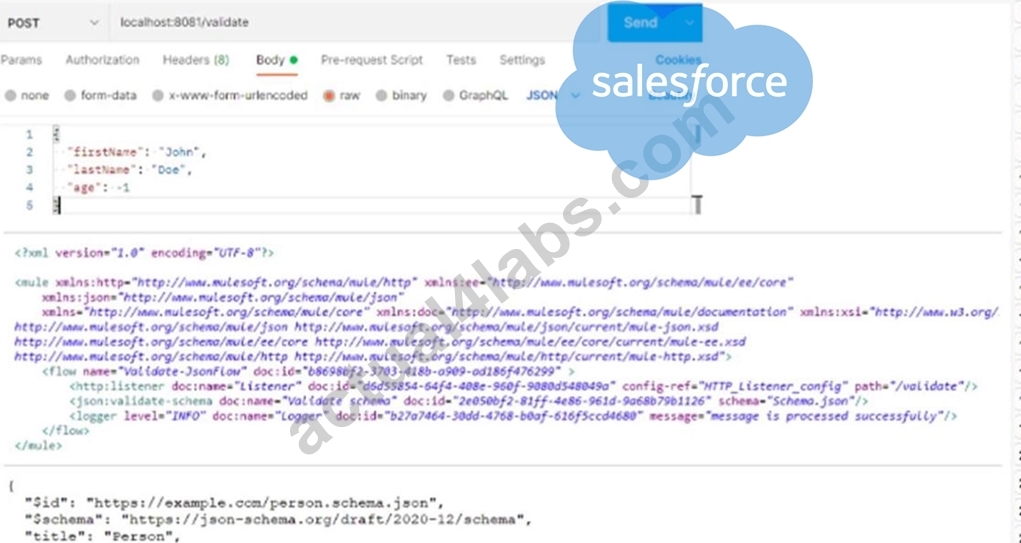
Based on the code snippet, schema,json file, and payload below, what is the outcome of the given code snippet when a request is sent with the payload?
- A. The Mule flow will execute successfully with status code 200m and a response will display the message '' Age in years which must equal to or greater than zero.''
- B. The Mule flow will throw the exception 'JSON:SCHEMA_NOT_HONOURED
- C. The Mule flow will execute successfully with status code 200, and the response will be the JSON sent in request
- D. The Mule flow will execute successfully with status code 204
Answer: B
Explanation:
Based on the code snippet, schema.json file, and payload below, the outcome of the given code snippet when a request is sent with the payload is that the Mule flow will throw the exception 'JSON:SCHEMA_NOT_HONOURED'. This is because the payload does not conform to the schema.json file, which specifies that age must be a number greater than or equal to zero. The payload has age as a string with a negative value, which violates the schema. Therefore, the validate-schema operation throws an error with type 'JSON:SCHEMA_NOT_HONOURED'. Reference: https://docs.mulesoft.com/json-module/1.1/json-validate-schema
NEW QUESTION # 34
A scatter-gather router is configured with four routes:Route A, B, C and D.
Route C false.
- A. Error,errorMessage,payload.failures['2']
- B. Error,errorMesage.payload.results ['2']
- C. Payload failures['2']
- D. Payload ['2']
Answer: B
Explanation:
The result of accessing route C failure is Error,errorMessage,payload.failures['2']. This is because a scatter-gather router returns an aggregated message that contains an array of results from each route and an array of failures from each route. The failures array contains error objects with information about each failed route execution. To access route C failure, which is the third route (index 2), the developer needs to use Error.errorMessage.payload.failures['2'] expression. Reference: https://docs.mulesoft.com/mule-runtime/4.3/scatter-gather-reference#scatter-gather-output
NEW QUESTION # 35
The HTTP Request operation raises an HTTP CONNECTIVITY error.
Which HTTP status code and body are returned to the web client?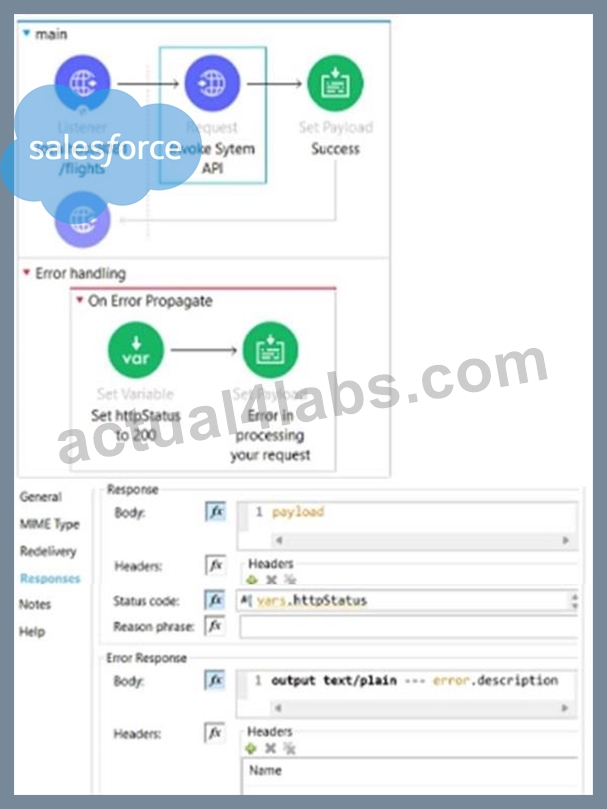
- A. HTTP Status Code:500.
Body 'Error in processing your request - B. HTTP Status Code:500.
Body 'Error in processing your request - C. HTTP Status Code:500.
Body 'The HTTP CONNECTIVITY Error description - D. HTTP Status Code:200.
Body 'Error in processing your request
Answer: B
Explanation:
When the HTTP Request operation raises an HTTP CONNECTIVITY error, it triggers an on-error-continue handler that sets a payload with 'Error in processing your request'. Since no status code is explicitly set in this handler, it defaults to 500 (INTERNAL SERVER ERROR). Therefore, the web client receives an HTTP response with status code 500 and body 'Error in processing your request'. Reference: https://docs.mulesoft.com/mule-runtime/4.3/error-handling#on-error-continue
NEW QUESTION # 36
An API has been built to enable scheduling email provider. The front-end system does very little data entry validation, and problems have started to appear in the email that go to patients. A validate-customer'' flow is added validate the data.
What is he expected behavior of the 'validate-customer'' flow?
- A. If only the email address Is invalid a VALIDATION.INVALID_EMAIL error is raised
- B. If the email address is invalid, processing continues to see if the appointment data and customer name are also invalid
- C. If the appointment date and customer name are invalid, a SCHEDULE:INVALID_APPOINTMENT_DATE error is raised
- D. If all of the values are invalid the last validation error is raised:SCHEDULE:INVALID_CUSTOMER_NAME
Answer: A
Explanation:
The validate-customer flow uses an until-successful scope to validate each field of the customer data. The until-successful scope executes its processors until they succeed or exhausts the maximum number of retries. If any processor fails, it raises an error and stops executing the remaining processors. Therefore, if only the email address is invalid, a VALIDATION.INVALID_EMAIL error is raised and the validation of appointment date and customer name is skipped. Reference: https://docs.mulesoft.com/mule-runtime/4.3/until-successful-scope
NEW QUESTION # 37
A Mule application for processing orders must log the order ID for every log message output.
What is a best practice to enrich every log message with the order ID?
- A. Use flow variables within every logger processor to log the order ID
- B. Use the Tracing module to set logging variables with a Mapped Diagnostic Context
- C. Set a flow variable and edit the log4/2.xml file to output the variable as part of the message pattern
- D. Create a custom XML SDK component to wrap the logger processor and automatically add the order ID within the connector
Answer: B
Explanation:
To enrich every log message with the order ID, the developer should use the Tracing module to set logging variables with a Mapped Diagnostic Context (MDC). The Tracing module allows adding custom key-value pairs to log messages using MDC variables. The developer can use Set Logging Variables operation to set the order ID as an MDC variable and then use it in any logger processor within the same thread or event. Reference: https://docs.mulesoft.com/tracing-module/1.0/tracing-module-reference#set-logging-variables
NEW QUESTION # 38
Which plugin or dependency is required to unit test modules created with XML SDK?
- A. XMLUnit
- B. MUnit Maven plugin
- C. Junit
- D. MUnit Extensions Maven plugin
Answer: D
Explanation:
To unit test modules created with XML SDK, the developer needs to use the MUnit Extensions Maven plugin. This plugin allows testing XML SDK modules using MUnit by adding a dependency to the module under test and using a custom processor tag to invoke it. Reference: https://docs.mulesoft.com/mule-sdk/1.1/xml-sdk#testing
NEW QUESTION # 39
Which command is used to convert a JKS keystore to PKCS12?
- A. Keytool-importkeystore -srckeystore keystore p12-srcstoretype PKCS12 -destkeystore keystore.jks -deststoretype JKS
- B. Keytool-importkeystore -srckeystore keystore jks-srcstoretype PKCS12 -destkeystore keystore.p12 -deststoretype JKS
- C. Keytool-importkeystore -srckeystore keystore jks-srcstoretype JKS -destkeystore keystore.p13 -deststoretype PKCS12
- D. Keytool-importkeystore -srckeystore keystore p12-srcstoretype JKS -destkeystore keystore.p12 -deststoretype PKCS12
Answer: D
Explanation:
To convert a JKS keystore to PKCS12, the developer needs to use the keytool-importkeystore command with the following options: -srckeystore keystore.jks -srcstoretype JKS -destkeystore keystore.p12 -deststoretype PKCS12. This command imports all entries from a source JKS keystore (keystore.jks) into a destination PKCS12 keystore (keystore.p12). Reference: https://docs.oracle.com/en/java/javase/11/tools/keytool.html#GUID-5990A2E4-78E3-47B7-AE75-6D1826259549
NEW QUESTION # 40
Two APIs are deployed to a two-node on-prem cluster. Due to a requirements change, the two APIs must communicate to exchange data asynchronously.
- A. It is not possible to use the VM Connector since the APIs are running in a cluster mode and each mode has it own set of VM Queues
- B. Instead of using the VM Connector use <flow-ref>directly
- C. If the two APIs use the same domain, the VM Connector can be leveraged
- D. The VM Connector is used to inter-application communication, so it is not possible to use the VM Connector
Answer: C
Explanation:
To communicate asynchronously between two APIs deployed to a two-node on-prem cluster, the developer can use the VM Connector if the two APIs use the same domain. The VM Connector allows passing messages between different Mule applications within a single Mule runtime instance or across different instances using shared memory or persistent storage. If two APIs are deployed under the same domain, they can share resources such as VM queues and communicate asynchronously using VM Connector operations. Reference: https://docs.mulesoft.com/mule-runtime/4.3/vm-connector https://docs.mulesoft.com/mule-runtime/4.3/shared-resources
NEW QUESTION # 41
Refer to the exhibit.
What is the result if ''Insecure'' selected as part of the HTTP Listener configuration?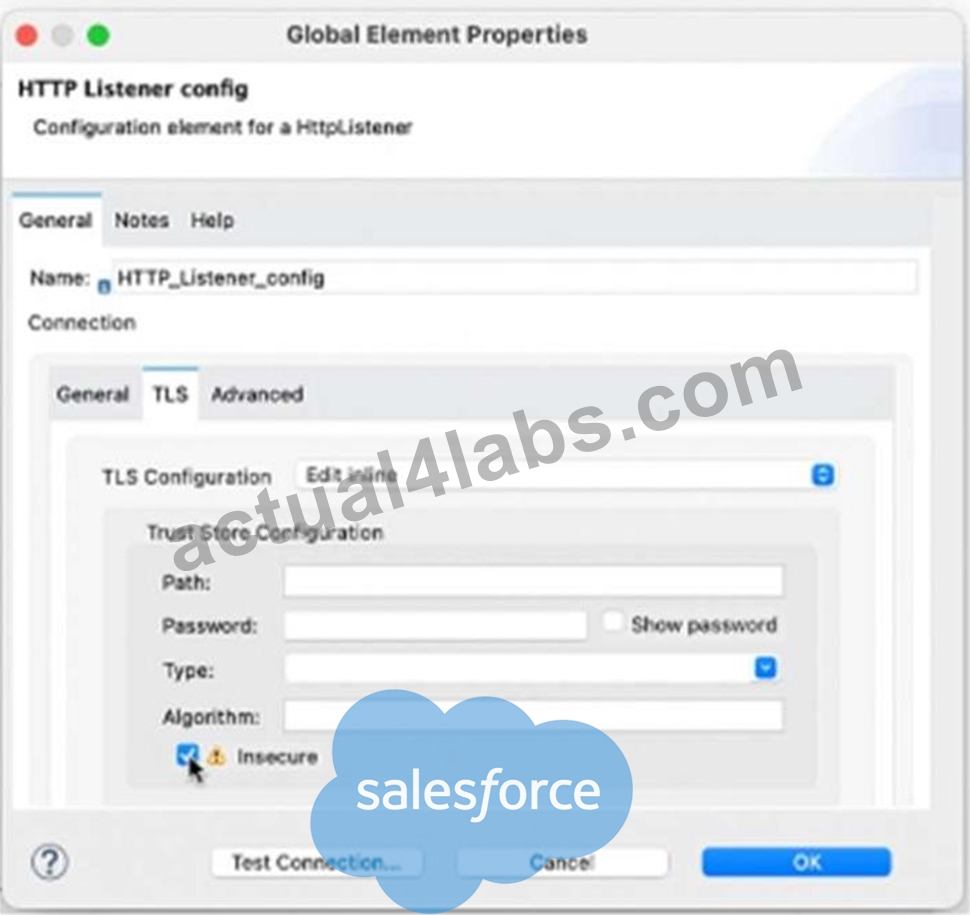
- A. The HTTP Listener will trust any certificate presented by the HTTP client
- B. The HTTP listener will only accept HTTP requests
- C. Mutual TLS authentication will be enabled between this HTTP Listener and an HTTP client
- D. The HTTP Lister will accept any unauthenticated request
Answer: B
Explanation:
Based on the exhibit below, if 'Insecure' is selected as part of the HTTP Listener configuration, the HTTP listener will only accept HTTP requests. This means that no TLS context will be configured for this listener and no encryption or authentication will be applied to incoming requests. The protocol attribute of this listener will be set to HTTP instead of HTTPS. Reference: https://docs.mulesoft.com/http-connector/1.6/http-listener-ref#insecure
NEW QUESTION # 42
Refer to the exhibit.
A Mute Object Store is configured with an entry TTL of one second and an expiration interval of 30 seconds.
What is the result of the flow if processing between os'store and os:retrieve takes 10 seconds?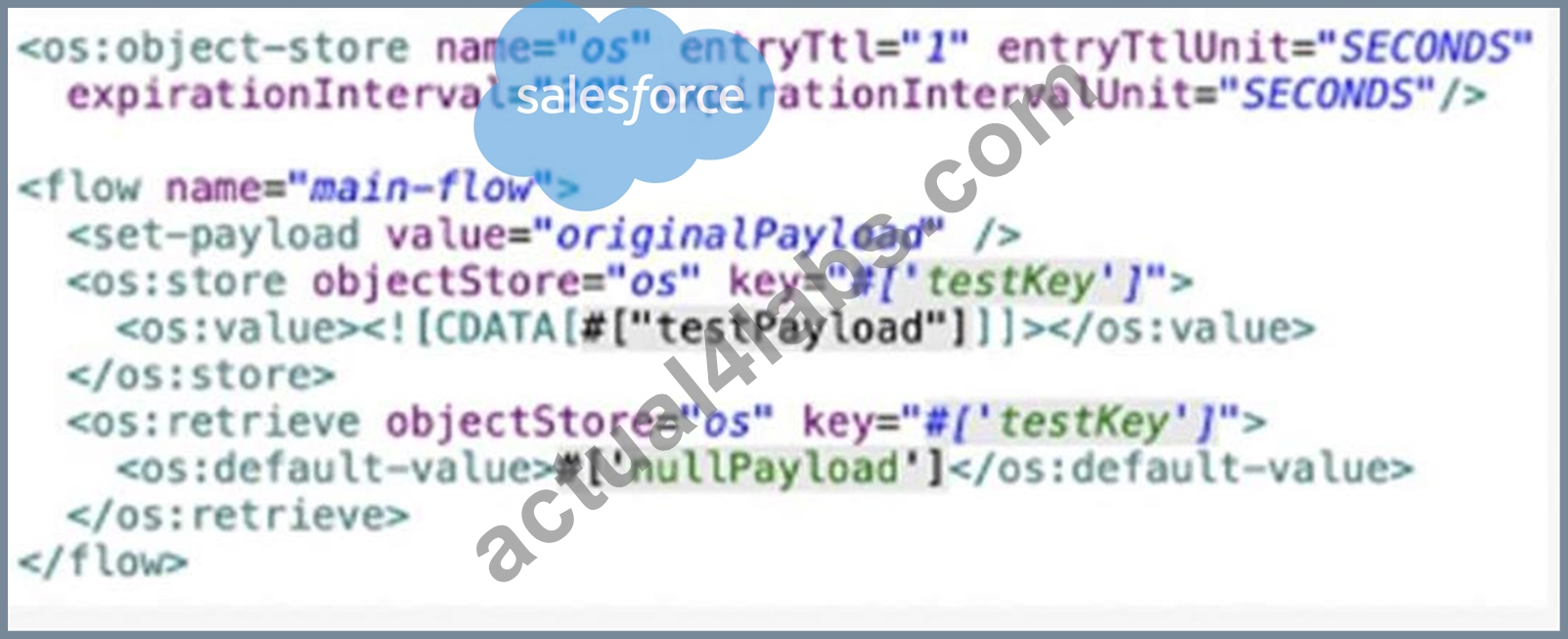
- A. originalPayload
- B. nullPayload
- C. testPayload
- D. OS:KEY_NOT_FOUND
Answer: B
Explanation:
The result of the flow is nullPayload if processing between os:store and os:retrieve takes 10 seconds. This is because the entry TTL of the object store is one second, which means that any stored value expires after one second and is removed from the object store. The expiration interval of 30 seconds only determines how often the object store checks for expired values, but it does not affect the TTL. Therefore, when os:retrieve tries to get the value after 10 seconds, it returns nullPayload because the value has already expired and been removed. Reference: https://docs.mulesoft.com/object-store/osv2-faq#how-does-the-time-to-live-work
NEW QUESTION # 43
A developer has created the first version of an API designed for business partners to work commodity prices.
What should developer do to allow more than one major version of the same API to be exposed by the implementation?
- A. In Anypoint Studio, generate scaffolding from the RAML, and the modify the <http:listerner> in the generated flows to include a parameter to replace the version number
- B. In Design Center, open the RAML and modify baseUn to include a variable that indicates the version number
- C. In Design Center, open the RAML and modify each operation to include the major version number
- D. In Anypoint Studio, generate scaffolding from the RAML, and then modify the flow names generated by APIKit to include a variable with the major version number
Answer: B
Explanation:
To allow more than one major version of the same API to be exposed by the implementation, the developer should modify the baseUri property in the RAML file to include a variable that indicates the version number. The baseUri property defines the base URL of the API and can include variables that are replaced with actual values when mocking or deploying the API. By using a variable for the version number, the developer can expose different versions of the API using different base URLs and avoid conflicts or confusion. Reference: https://docs.mulesoft.com/api-designer/design-modify-raml-specs#baseuri https://docs.mulesoft.com/api-manager/2.x/api-versioning
NEW QUESTION # 44
A Mule application deployed to multiple Cloudhub 2.0 replicas needs to temporarily persist large files over 10MB between flow executions, and routinely needs to query whether the file data exists on separate executions.
How can this be achieved?
- A. Store the contents of the file on separate storage, and store the key and location of the file Object using Object Store v2
- B. Use an in-memory Object Store
- C. Store the key and full contents of the file in an Object Store
- D. Store the key and full contents of the file, caching the filename and location between requests
Answer: A
Explanation:
To temporarily persist large files over 10MB between flow executions, and routinely query whether the file data exists on separate executions, the developer should store the contents of the file on separate storage, and store the key and location of the file object using Object Store v2. This way, the developer can avoid storing large files in memory or exceeding the size limit of Object Store v2 (10MB per object). The developer can also use Object Store v2 operations to query, retrieve, or delete the file object by its key. Reference: https://docs.mulesoft.com/object-store/osv2-faq#can-i-store-files-in-object-store-v2
NEW QUESTION # 45
......
Mule-Dev-301 Sample Practice Exam Questions 2026 Updated Verified: https://www.actual4labs.com/Salesforce/Mule-Dev-301-actual-exam-dumps.html
Exam Study Guide Free Practice Test LAST UPDATED : https://drive.google.com/open?id=1qoa0Tkrwma053okXMsI24U5W71PU0k3z