

[Sep-2025] The Best HP ACNSP Study Guide for the HPE7-A02 Exam
HPE7-A02 certification guide Q&A from Training Expert Actual4Labs
Aruba is a well-known provider of networking solutions and has established itself as an industry leader in wireless networking, network access control, and network security. The HPE7-A02 certification exam focuses on Aruba's network security solutions and is an essential certification for IT professionals working with Aruba's products and solutions.
HP HPE7-A02: Aruba Certified Network Security Professional exam is a certification that showcases the ability of an individual to implement advanced firewall and VPN technologies. Aruba Certified Network Security Professional Exam certification is designed to validate the skills needed to secure a network from advanced threats. HPE7-A02 exam is ideal for anyone who wants to establish a career in the field of networking and cybersecurity.
HP HPE7-A02 exam is an excellent opportunity for professionals to validate their knowledge and skills in network security. Obtaining the Aruba Certified Network Security Professional certification can enhance career prospects and provide a competitive edge in the job market. With the increasing demand for network security professionals, this certification can help professionals stand out and advance their careers.
NEW QUESTION # 69
Which issue can an HPE Aruba Networking Secure Web Gateway (SWG) solution help customers address?
- A. The organization currently has no way to prevent users from exfiltrating sensitive data from SaaS applications.
- B. Remote workers need access to private data center applications without exposing those applications to unauthorized users.
- C. Hybrid workers are exposing their computers to risky internet sites and infection by malware when they work from home.
- D. The organization needs a faster way to quarantine clients that have generated threats, as detected by third-party firewalls.
Answer: C
Explanation:
An HPE Aruba Networking Secure Web Gateway (SWG) is designed to provide secure internet access by monitoring and controlling web traffic. It primarily focuses on protecting users from malicious content and ensuring compliance with corporate security policies, particularly for hybrid and remote workers.
Explanation of Each Option
A: The organization needs a faster way to quarantine clients that have generated threats, as detected by third-party firewalls.
* Incorrect:
* Quarantining clients based on detected threats is typically managed by endpoint detection and response (EDR) solutions or next-generation firewalls (NGFWs).
* While an SWG can monitor and block risky web activity, it does not manage threat quarantine actions directly.
B: Hybrid workers are exposing their computers to risky internet sites and infection by malware when they work from home.
* Correct:
* SWGs monitor and control web traffic to block malicious websites and prevent exposure to malware.
* They enforce web usage policies even when users work remotely, protecting against phishing, drive-by downloads, and other web-based threats.
* With the proliferation of hybrid work environments, an SWG ensures that users are protected from risky sites regardless of their location.
C: Remote workers need access to private data center applications without exposing those applications to unauthorized users.
* Incorrect:
* This use case falls under secure access service edge (SASE) solutions with Zero Trust Network Access (ZTNA), not an SWG.
* ZTNA focuses on granting secure, conditional access to applications, while SWGs focus on internet traffic security.
D: The organization currently has no way to prevent users from exfiltrating sensitive data from SaaS applications.
* Incorrect:
* Data loss prevention (DLP) tools or cloud access security brokers (CASBs) are designed for monitoring and preventing data exfiltration from SaaS applications.
* While SWGs can block access to specific websites or categories, they do not offer advanced DLP capabilities for SaaS environments.
References
* Aruba Secure Web Gateway Documentation.
* HPE Aruba SASE Solutions Guide.
* Best Practices for Hybrid Workforce Security with Aruba SWG.
NEW QUESTION # 70
A company has HPE Aruba Networking APs running AOS-10 that connect to AOS-CX switches. The APs will:
. Authenticate as 802.1X supplicants to HPE Aruba Networking ClearPass Policy Manager (CPPM)
. Be assigned to the "APs" role on the switches
. Have their traffic forwarded locally
What information do you need to help you determine the VLAN settings for the "APs" role?
- A. Whether the APs bridge or tunnel traffic on their SSIDs
- B. Whether the switches have established tunnels with an HPE Aruba Networking gateway
- C. Whether the switches are using local user-roles (LURs) or downloadable user-roles (DURs)
- D. Whether the APs have static or DHCP-assigned IP addresses
Answer: A
Explanation:
To determine the VLAN settings for the "APs" role on AOS-CX switches, it is crucial to know whether the APs bridge or tunnel traffic on their SSIDs. If the APs are bridging traffic, the VLAN settings on the switch need to align with the VLANs used by the SSIDs. If the APs are tunneling traffic to a controller or gateway, the VLAN settings might differ as the traffic is encapsulated and forwardedthrough the tunnel. Understanding this aspect ensures that the VLAN configuration on the switches correctly supports the traffic forwarding method employed by the APs.
NEW QUESTION # 71
A company has HPE Aruba Networking APs running AOS-10 and managed by HPE Aruba Networking Central. The company also has AOS-CX switches. The security team wants you to capture traffic from a particular wireless client. You should capture this client's traffic over a 15-minute time period and then send the traffic to them in a PCAP file. What should you do?
- A. Go to the client's AP in HPE Aruba Networking Central. Use the "Security" page to run a packet capture.
- B. Access the CLI for the client's AP. Set up a mirroring session between its radio and a management station running Wireshark.
- C. Go to that client in HPE Aruba Networking Central. Use the "Live Events" page to run a packet capture.
- D. Access the CLI for the client's AP's switch. Set up a mirroring session between the AP's port and a management station running Wireshark.
Answer: A
Explanation:
* Packet Capture in Aruba Central:
* Aruba Central provides tools for remote packet captures directly from the APs.
* On the "Security" page for the AP, you can initiate a packet capture session, specifying the client device and capture duration.
* The traffic is captured into a PCAP file, which can be downloaded and analyzed using tools like Wireshark.
* Option Analysis:
* Option A: Incorrect. While possible via CLI, Aruba Central provides a simpler method for packet captures.
* Option B: Correct. Aruba Central's "Security" page allows you to capture and export client traffic efficiently.
* Option C: Incorrect. The "Live Events" page focuses on monitoring events, not packet captures.
* Option D: Incorrect. Port mirroring on the switch captures AP traffic but requires more manual configuration and does not isolate client-specific wireless traffic easily.
NEW QUESTION # 72
A company has HPE Aruba Networking APs running AOS-10 that connect to AOS-CX switches. The APs will:
* Authenticate as 802.1X supplicants to HPE Aruba Networking ClearPass Policy Manager (CPPM)
* Be assigned to the "APs" role on the switches
* Have their traffic forwarded locally
What information do you need to help you determine the VLAN settings for the "APs" role?
- A. Whether the APs have static or DHCP-assigned IP addresses.
- B. Whether the APs bridge or tunnel traffic on their SSIDs.
- C. Whether the switches are using local user-roles (LURs) or downloadable user-roles (DURs).
- D. Whether the switches have established tunnels with an HPE Aruba Networking gateway.
Answer: B
Explanation:
* Traffic Forwarding for APs:
* In AOS-10, AP traffic forwarding can happen locally (bridged) or through tunnels to a gateway.
* The VLAN settings on the "APs" role depend on whether the APs bridge the SSID traffic locally or forward it through a tunnel.
* Option B: Correct. You need to know whether the traffic is bridged or tunneled to determine the VLAN assignments.
* Option A: Incorrect. LURs/DURs affect role assignment but not VLAN settings for traffic forwarding.
* Option C: Incorrect. Establishing tunnels with gateways is relevant to centralized traffic forwarding, not VLANs for bridged traffic.
* Option D: Incorrect. AP IP addressing (static or DHCP) does not impact the VLAN for forwarded SSID traffic.
NEW QUESTION # 73
A company is using HPE Aruba Networking ClearPass Device Insight (CPDI) (the standalone application). In the CPDI security settings, Security Analysis is On, the Data Source is ClearPass Devices Insight, and Enable Posture Assessment is On. You see that device has a Risk Score of 90.
What can you know from this information?
- A. The posture is unhealthy, and CPDI has also detected at least one vulnerability on the device.
- B. The posture is unknown, and CPDI has detected exactly four vulnerabilities on the device.
- C. The posture is unhealthy, but CPDI has not detected any vulnerabilities on the device.
- D. The posture is healthy, but CPDI has detected multiple vulnerabilities on the device.
Answer: A
Explanation:
In HPE Aruba Networking ClearPass Device Insight (CPDI), a device with a Risk Score of 90 indicates that the posture is unhealthy, and CPDI has detected at least one vulnerability on the device. The risk score is a reflection of the device's security posture and detected vulnerabilities. A high risk score, such as 90, typically signifies significant security concerns, including the presence of vulnerabilities that could be exploited, thereby categorizing the device as a high-risk asset within the network.
NEW QUESTION # 74
Your company wants to implement Tunneled EAP (TEAP).
How can you set up HPE Aruba Networking ClearPass Policy Manager (CPPM) to enforce certificated-based authentication for clients using TEAP?
- A. Select a service certificate when you specify TEAP as a service's authentication method.
- B. Create an authentication method named "TEAP" with the type set to EAP-TLS.
- C. Select an EAP-TLS-type authentication method for the TEAP method's inner method.
- D. For the service using TEAP, set the authentication source to an internal database.
Answer: C
Explanation:
To set up HPE Aruba Networking ClearPass Policy Manager (CPPM) to enforce certificate-based authentication for clients using Tunneled EAP (TEAP), you need to select an EAP-TLS-type authentication method for TEAP's inner method. TEAP allows for a combination of certificate-based (EAP-TLS) and password-based (EAP-MSCHAPv2) authentication. By choosing EAP-TLS as the inner method, you ensure that the clients are authenticated using their certificates, thus enforcing certificate-based authentication within the TEAP framework.
NEW QUESTION # 75
A company has an HPE Aruba Networking ClearPass cluster with several servers. ClearPass Policy Manager (CPPM) is set up to:
. Update client attributes based on Syslog messages from third-party appliances
. Have the clients reauthenticate and apply new profiles to the clients based on the updates To ensure that the correct profiles apply, what is one step you should take?
- A. Set the cluster's Endpoint Context Servers polling interval to a value of 5 seconds or less.
- B. Tune the CoA delay on the ClearPass servers to a value of 5 seconds or greater.
- C. Configure the cluster to periodically clean up (delete) unknown endpoints.
- D. Configure a CoA action for all tag updates in the ClearPass Device Insight integration settings.
Answer: B
Explanation:
To ensure that the correct profiles apply after client attributes are updated based on Syslog messages, you should tune the Change of Authorization (CoA) delay on the ClearPass servers to a value of 5 seconds or greater. This delay allows sufficient time for the attribute updates to be processed and for the reauthentication to occur correctly, ensuring that the updated profiles are accurately applied to the clients.
1.CoA Delay: Adjusting the CoA delay ensures that the system has enough time to update client attributes and reauthenticate them properly before applying new profiles.
2.Profile Accuracy: This delay helps in preventing premature reauthentication and ensures that the most recent attribute updates are considered when applying profiles.
3.System Synchronization: Ensures synchronization between the attribute update and the reauthentication process.
NEW QUESTION # 76
HPE Aruba Networking Central displays an alert about an Infrastructure Attack that was detected. You go to the Security > RAPIDS events and see that the attack was "Detect adhoc using Valid SSID." What is one possible next step?
- A. Look for the IP address associated with the offender and then check for that IP address among HPE Aruba Networking Central clients.
- B. Use HPE Aruba Networking Central floorplans or the detecting AP identities to locate the general area for the threat.
- C. Make sure that clients have updated drivers, as faulty drivers are a common explanation for this attack type.
- D. Make sure that you have tuned the threshold for that check, as false positives are common for it.
Answer: B
Explanation:
When HPE Aruba Networking Central detects an Infrastructure Attack, such as "Detect adhoc using Valid SSID," the next step is to locate the general area of the threat. You can use HPE ArubaNetworking Central floorplans or the identities of the detecting APs to pinpoint the approximate location of the adhoc network.
This allows you to physically investigate and address the source of the threat, ensuring that unauthorized or rogue networks are quickly identified and mitigated.
NEW QUESTION # 77
Refer to Exhibit.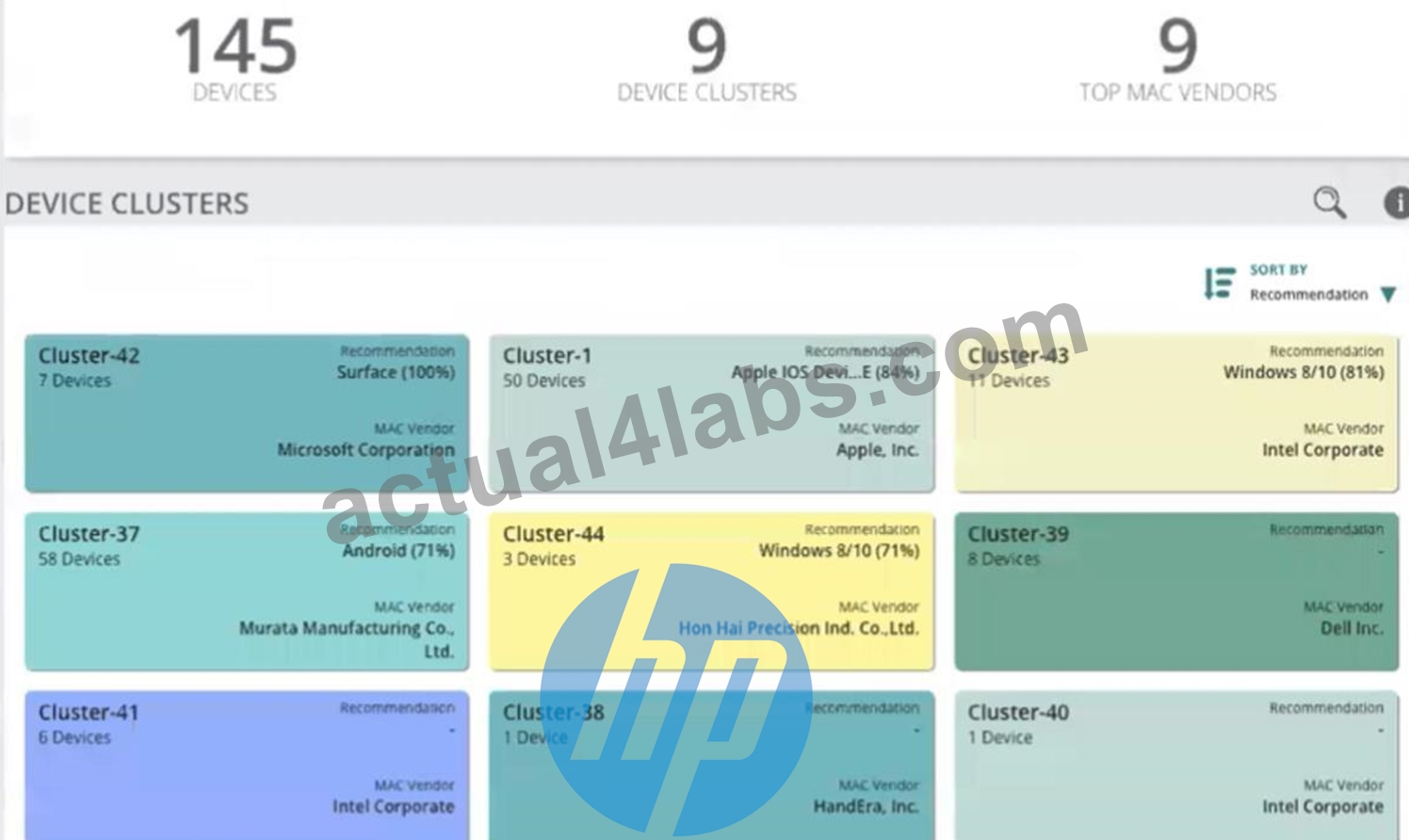
A company is using HPE Aruba Networking ClearPass Device Insight (CPDI) (the standalone application).
In the CPDI interface, you go to the Generic Devices
page and see the view shown in the exhibit.
What correctly describes what you see?
- A. Each cluster is a group of unclassified devices that CPDI's machine learning has discovered to have similar attributes.
- B. Each cluster is all the devices that have been assigned to the same category by one of CPDI's built-in system rules.
- C. Each cluster is a group of devices that match one of the tags configured by admins.
- D. Each cluster is a group of devices that have been classified with user rules, but for which CPDI offers different recommendations.
Answer: A
Explanation:
In HPE Aruba Networking ClearPass Device Insight (CPDI), the clusters shown in the exhibit represent groups of unclassified devices that CPDI's machine learning algorithms have identified as having similar attributes. These clusters are formed based on observed characteristics and behaviors of the devices, helping administrators to categorize and manage devices more effectively.
1.Machine Learning: CPDI uses machine learning to analyze device attributes and group them into clusters based on similarities.
2.Unclassified Devices: These clusters typically represent devices that have not yet been explicitly classified by admins but share common attributes that suggest they belong to the same category.
3.Management: This clustering helps in simplifying the process of managing and applying policies to groups of similar devices.
NEW QUESTION # 78
A company wants to use HPE Aruba Networking ClearPass Policy Manager (CPPM) to profile Linux devices. You have decided to schedule a subnet scan of the devices' subnets. Which additional step should you complete before scheduling the scan?
- A. Set up SSH accounts on CPPM and map them to the Linux devices' subnets.
- B. Configure SNMP in the network device settings for the switches that support the Linux devices.
- C. Enable WMI probing in the cluster-wide parameters.
- D. Enable the Data Port in the ClearPass server settings and connect that port to the network.
Answer: D
Explanation:
* Subnet Scan Requirements for Profiling:
* For ClearPass to scan and profile devices in a subnet, the Data Port must be enabled on the ClearPass server and connected to the network.
* This ensures that ClearPass can send and receive the required packets for device discovery and profiling.
* Option Analysis:
* Option A: Incorrect. SSH accounts are not required for subnet scanning.
* Option B: Incorrect. WMI probing is for Windows systems, not Linux devices.
* Option C: Correct. The Data Port is essential for subnet scans and must be properly configured and connected.
* Option D: Incorrect. SNMP is used for network device monitoring, not Linux device profiling.
NEW QUESTION # 79
You are deploying a virtual Data Collector for use with HPE Aruba Networking ClearPass Device Insight (CPDI). You have identified VLAN 101 in the data center as the VLAN to which the Data Collector should connect to receive its IP address and connect to HPE Aruba Networking Central.
Which Data Collector virtual ports should you tell the virtual admins to connect to VLAN 101?
- A. The one with the lowest port ID
- B. The one with the highest MAC address
- C. The one with the lowest MAC address
- D. The one with the highest port ID
Answer: A
Explanation:
When deploying a virtual Data Collector for HPE Aruba Networking ClearPass Device Insight (CPDI), it is essential to ensure that the correct virtual port is connected to the designated VLAN. In this case, VLAN 101 is used to receive the IP address and connect to Aruba Central. The best practice is to use the virtual port with the lowest port ID. This is typically the primary port used for management and network connectivity in virtual environments, ensuring proper network integration and communication.
NEW QUESTION # 80 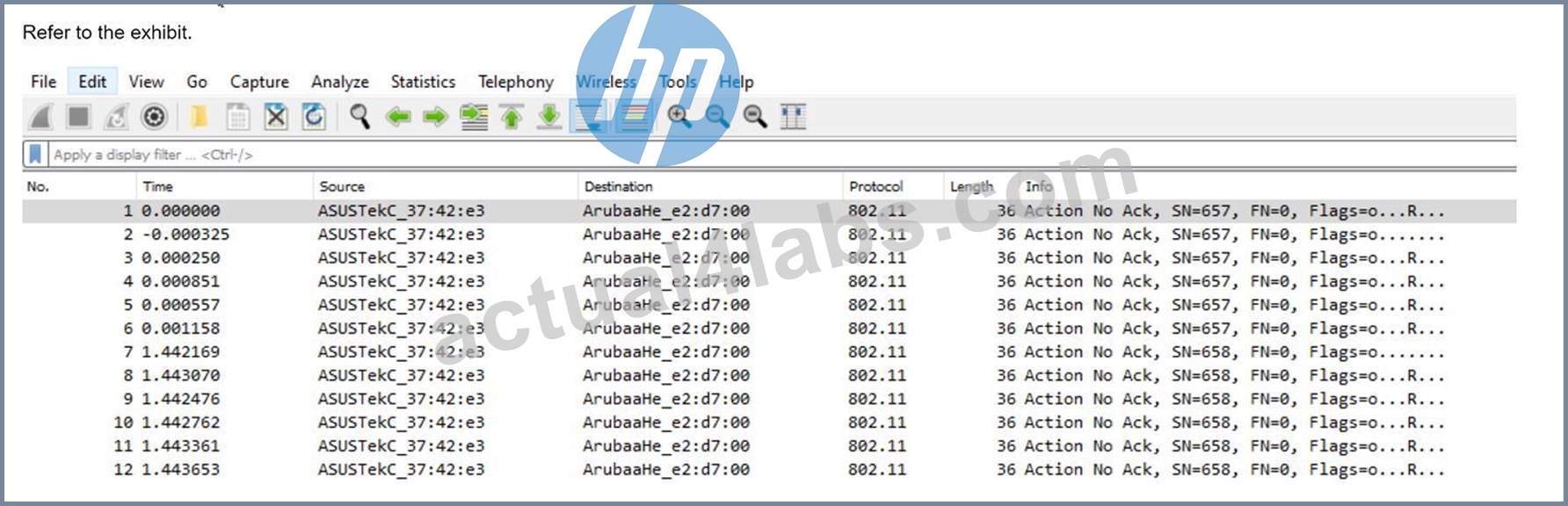
You have downloaded a packet capture that you generated on HPE Aruba Networking Central. When you open the capture in Wireshark, you see the output shown in the exhibit.
What should you do in Wireshark so that you can better interpret the packets?
- A. Apply the following display filter: wlan.fc.type == 1.
- B. Choose to decode UDP port 5555 packets as ARUBA_ERM and set the Aruba ERM Type to 0.
- C. Edit preferences for IEEE 802.11 and chose to ignore the Protection bit with IV.
- D. Edit the Enabled Protocols and make sure that 802.11, GRE, and Aruba_ERM are enabled.
Answer: B
Explanation:
To better interpret the packets shown in the Wireshark capture, you should choose to decode UDP port 5555 packets as ARUBA_ERM and set the Aruba ERM Type to 0. This configuration will allow Wireshark to properly decode and display the Aruba-specific encapsulated remote mirroring (ERM) packets, providing a clearer understanding of the traffic.
1.Decoding Protocols: Selecting the correct protocol decoding in Wireshark ensures that the captured packets are interpreted correctly, displaying the relevant information.
2.Aruba ERM: The packets in the capture are likely encapsulated remote mirroring (ERM) packets specific to Aruba, which require proper decoding settings in Wireshark.
3.Clear Interpretation: By setting the Aruba ERM Type to 0 and decoding the packets as ARUBA_ERM, you can view the encapsulated data accurately.
NEW QUESTION # 81
You are setting up user-based tunneling (UBT) between access layer AOS-CX switches and AOS-10 gateways. You have selected reserved (local) VLAN mode.
Tunneled devices include IoT devices, which should be assigned to:
* Roles: iot on the switches and iot-wired on the gateways
* VLAN: 64, for which the gateways route traffic.
IoT devices connect to the access layer switches' edge ports, and the access layer switches reach the gateways on their uplinks.
Where must you configure VLAN 64?
- A. In the iot role and the iot-wired role and on no physical interfaces
- B. In the iot-wired role and the access switch uplinks
- C. In the iot role and the access switch uplinks
- D. In the iot-wired role and on no physical interfaces
Answer: D
Explanation:
Comprehensive Detailed Explanation
In a user-based tunneling (UBT) setup with reserved VLAN mode, VLAN 64 is used for routing traffic at the gateways. Since the IoT traffic is tunneled to the AOS-10 gateway:
* On the gateways:
* VLAN 64 must be configured in the iot-wired role for routing purposes.
* On the switches:
* VLAN 64 does not need to be configured on the access switch physical uplinks because the IoT traffic is tunneled directly to the gateway and does not rely on VLAN configurations at the access layer switches.
* Reserved VLAN mode:
* Ensures that traffic is encapsulated within the UBT tunnel, and VLANs like 64 are only relevant at the gateway for routing and enforcement.
Therefore, the correct configuration is to define VLAN 64 in the iot-wired role on the AOS-10 gateways and not on any physical interfaces.
References
* Aruba AOS-CX UBT configuration guide.
* Aruba AOS-10 Gateway Role and VLAN Management documentation.
NEW QUESTION # 82
What role can Internet Key Exchange (IKE)/IKEv2 play in an HPE Aruba Networking client-to-site VPN?
- A. It helps to negotiate the IPsec SA automatically and securely.
- B. It provides a more modern and secure alternative to IPsec.
- C. It helps remote clients download IPsec profiles for later use.
- D. It provides an alternative to IPsec that is suitable for legacy clients.
Answer: A
Explanation:
Internet Key Exchange (IKE)/IKEv2 plays a crucial role in an HPE Aruba Networking client-to-site VPN by helping to negotiate the IPsec Security Association (SA) automatically and securely. IKE/IKEv2 handles the authentication and key exchange processes, ensuring that both the client and the VPN gateway can establish a secure IPsec tunnel.
1.SA Negotiation: IKE/IKEv2 automates the negotiation of the Security Association, which defines the parameters for the secure IPsec tunnel.
2.Secure Authentication: It provides a secure method for authenticating the communicating parties and exchanging cryptographic keys.
3.Efficiency: Using IKE/IKEv2 simplifies the setup and maintenance of secure VPN connections, enhancing the overall security and reliability of the VPN.
NEW QUESTION # 83
An AOS-CX switch has been configured to implement UBT to two HPE Aruba Networking gateways that implement VRRP on the users' VLAN. What correctly describes how the switch tunnels UBT users' traffic to those gateways?
- A. The switch always sends all users' traffic to the gateway assigned as the active device designed gateway.
- B. The switch always sends all users' traffic to the primary gateway configured in the UBT zone.
- C. The switch always load shares the users' traffic across both gateways.
- D. The switch always sends the users' traffic to the VRRP master.
Answer: B
Explanation:
* User-Based Tunneling (UBT) with VRRP:
* UBT allows traffic from authenticated users to be tunneled to an HPE Aruba Networking gateway.
* In the case of VRRP, where two gateways are configured for redundancy, the AOS-CX switch will always send the traffic to the primary gateway defined in the UBT zone configuration.
* The VRRP state (master/backup) does not impact the UBT decision; the UBT primary configuration takes precedence.
* Option Analysis:
* Option A: Incorrect. UBT does not strictly follow the VRRP master; it adheres to the UBT primary gateway configuration.
* Option B: Correct. The switch tunnels all traffic to the primary gateway configured in the UBT zone.
* Option C: Incorrect. UBT does not load-share traffic between gateways.
* Option D: Incorrect. UBT uses the primary gateway configured in the UBT zone, not dynamically determined active devices.
NEW QUESTION # 84
A company wants you to integrate HPE Aruba Networking ClearPass Policy Manager (CPPM) with HPE Aruba Networking ClearPass Device Insight (CPDI).
What is one aspect of the integration that you should explain?
- A. CPDI must have security analysis disabled on it for the integration to be successful.
- B. CPPM no longer supports any Device Profiler features and relies on CPDI for this profile information.
- C. CPDI must be configured as an audit server on CPPM for the integration to be successful.
- D. CPPM can submit profile information to CPDI, but if CPDI derives a different classification, CPDI takes precedence.
Answer: D
Explanation:
When integrating ClearPass Policy Manager (CPPM) with ClearPass Device Insight (CPDI), it is important to understand how device profiling and classification work between the two solutions:
1. CPPM and CPDI Integration Overview
* CPPM is primarily used for access control and policy enforcement, while CPDI specializes in device profiling and classification through advanced analytics and machine learning.
* Integration allows CPPM to leverage CPDI's enhanced profiling capabilities for more accurate device identification and policy enforcement.
2. Detailed Analysis of Each Option
A: CPPM no longer supports any Device Profiler features and relies on CPDI for this profile information:
* Incorrect: CPPM still supports its own basic device profiling features and can operate independently.
However, when integrated with CPDI, CPPM can use CPDI's advanced profiling capabilities as a supplement.
B: CPDI must be configured as an audit server on CPPM for the integration to be successful:
* Incorrect: CPDI is not configured as an audit server on CPPM. Integration is achieved via API integration and communication between the two solutions, not through audit server settings.
C: CPDI must have security analysis disabled on it for the integration to be successful:
* Incorrect: Security analysis does not need to be disabled for integration. In fact, CPDI's security analysis enhances the classification process by identifying anomalous behaviors.
D: CPPM can submit profile information to CPDI, but if CPDI derives a different classification, CPDI takes precedence:
* Correct:
* CPPM and CPDI exchange profile data, but CPDI has more advanced device classification capabilities due to its machine learning-based engine.
* When CPDI derives a different classification than CPPM, CPDI's classification is considered more accurate and takes precedence.
* This ensures that policies are based on the most reliable device classification.
References
* Aruba ClearPass Policy Manager and Device Insight Integration Guide.
* ClearPass Device Profiling and Classification Documentation.
* Best Practices for CPPM and CPDI Integration in Network Security.
NEW QUESTION # 85
You are using OpenSSL to obtain a certificate signed by a Certification Authority (CA). You have entered this command:
openssl req -new -out file1.pem -newkey rsa:3072 -keyout file2.pem
Enter PEM pass phrase: **********
Verifying - Enter PEM pass phrase: **********
Country Name (2 letter code) [AU]:US
State or Province Name (full name) [Some-State]:California
Locality Name (eg, city) []:Sunnyvale
Organization Name (eg, company) [Internet Widgits Pty Ltd]:example.com
Organizational Unit Name (eg, section) []:Infrastructure
Common Name (e.g. server FQDN or YOUR name) []:radius.example.com
What is one guideline for continuing to obtain a certificate?
- A. You should submit file2.pem, but not file1.pem, to the desired CA to sign.
- B. You should concatenate file1.pem and file2.pem into a single file, and submit that to the desired CA to sign.
- C. You should submit file1.pem, but not file2.pem, to the desired CA to sign.
- D. You should use a third-party tool to encrypt file2.pem before sending it and file1.pem to the CA.
Answer: C
Explanation:
When using OpenSSL to obtain a certificate signed by a Certification Authority (CA), you should submit the Certificate Signing Request (CSR) file, which is file1.pem, to the CA. The CSR contains the information about the entity requesting the certificate and the public key, but not the private key, which is in file2.pem.
The CA uses the information in the CSR to create and sign the certificate.
1.CSR Submission: The CSR (file1.pem) includes the public key and the entity information required by the CA to issue a certificate.
2.Private Key Security: The private key (file2.pem) should never be sent to the CA or shared; it remains securely stored on the requestor's server.
3.Certificate Issuance: After the CA signs the CSR, the resulting certificate can be used with the private key to establish secure communications.
NEW QUESTION # 86
You need to set up HPE Aruba Networking ClearPass Policy Manager (CPPM) to provide certificate- based authentication of 802.1X supplicants. How should you upload the root CA certificate for the supplicants' certificates?
- A. As a ClearPass Server certificate with the RADIUS/EAP usage.
- B. As a Trusted CA with the EAP usage.
- C. As a Trusted CA with the AD/LDAP usage.
- D. As a ClearPass Server certificate with the Database usage.
Answer: B
Explanation:
* 802.1X Authentication Workflow: Requires the root CA certificate of the issuing authority for the supplicants' certificates. This ensures that the server can validate the client certificate during the EAP- TLS handshake.
* Trusted CA Usage: In ClearPass, certificates with "Trusted CA" usage are used for validating client and server identities during secure authentication exchanges.
* Option A: Incorrect. The "ClearPass Server certificate" is used for server-side identity verification and is not used to validate client certificates.
* Option B: Incorrect. Database usage is unrelated to RADIUS/EAP or certificate validation.
* Option C: Incorrect. While LDAP/AD integration supports certificate validation, this is not the primary purpose of Trusted CAs for 802.1X.
* Option D: Correct. Trusted CAs for EAP are required to validate client certificates during the authentication process.
By uploading the root CA as a "Trusted CA with EAP usage," the CPPM can properly authenticate the certificates presented by the supplicants during EAP-TLS negotiations.
NEW QUESTION # 87
What is one use case that companies can fulfill using HPE Aruba Networking ClearPass Policy Manager's (CPPM's) Device Profiler?
- A. Assigning different AOS firewall roles to users on computers and the same users on smartphones
- B. Quarantining devices that do not have the required antivirus software installed on them
- C. OIdentifying device security vulnerabilities by CVE ID and receiving remediation recommendations
- D. Leveraging artificial intelligence to more accurately identify Internet of Things (loT) devices
Answer: D
Explanation:
One use case that companies can fulfill using HPE Aruba Networking ClearPass Policy Manager's (CPPM's) Device Profiler is leveraging artificial intelligence to more accurately identify Internet of Things (IoT) devices. ClearPass Device Profiler uses AI and machine learning to analyze network traffic and device behavior, providing detailed and accurate identification of IoT devices on thenetwork. This helps in managing and securing diverse and numerous IoT devices by ensuring they are correctly profiled and assigned appropriate access policies.
NEW QUESTION # 88
......
The Best HP HPE7-A02 Study Guides and Dumps of 2025: https://www.actual4labs.com/HP/HPE7-A02-actual-exam-dumps.html
HPE7-A02 Certification Overview Latest HPE7-A02 PDF Dumps: https://drive.google.com/open?id=1TLLlKpg5_3qzp92b3FuASLrGsyV3ilIi