

100% Updated Splunk SPLK-2003 Enterprise PDF Dumps
Use Valid Exam SPLK-2003 by Actual4Labs Books For Free Website
Splunk SPLK-2003 (Splunk Phantom Certified Admin) Exam is designed to test the skills and knowledge of professionals who are responsible for managing and administering Splunk Phantom. Splunk Phantom Certified Admin certification is ideal for administrators, security analysts, and IT professionals who are looking to demonstrate their expertise in using Splunk Phantom to automate and orchestrate security operations.
NEW QUESTION # 29
What are the differences between cases and events?
- A. Cases: only include high-level incident artifacts.
Events: only include low-level incident artifacts. - B. Cases: contain a collection of containers.
Events: contain potential threats. - C. Case: potential threats.
Events: identified as a specific kind of problem and need a structured approach. - D. Cases: incidents with a known violation and a plan for correction.
Events: occurrences in the system that may require a response.
Answer: D
Explanation:
Explanation
Cases and events are two types of containers in Phantom. Cases are incidents with a known violation and a plan for correction, such as a malware infection, a phishing attack, or a data breach. Events are occurrences in the system that may require a response, such as an alert, a log entry, or an email. Cases and events can contain both high-level and low-level incident artifacts, such as IP addresses, URLs, files, or users. Cases do not contain a collection of containers, but rather a collection of artifacts, tasks, notes, and comments. Events are not necessarily potential threats, but rather indicators of potential threats. Reference, page 9.
NEW QUESTION # 30
An active playbook can be configured to operate on all containers that share which attribute?
- A. Label
- B. Artifact
- C. Tag
- D. Severity
Answer: A
NEW QUESTION # 31
How can a child playbook access the parent playbook's action results?
- A. Child playbooks can access parent playbook data while the parent Is still running.
- B. When configuring the playbook block in the parent, add the desired results in the Scope parameter.
- C. The parent can create an artifact with the data needed by the did.
- D. By setting scope to ALL when starting the child.
Answer: B
Explanation:
Explanation
A child playbook can access the parent playbook's action results by using the scope parameter when configuring the playbook block in the parent. The scope parameter allows the user to specify which action results from the parent playbook should be passed to the child playbook as input parameters. Child playbooks cannot access parent playbook data while the parent is still running, and setting the scope to ALL when starting the child does not affect the data access. The parent can create an artifact with the data needed by the child, but this is not the only mechanism to do so. Reference, page 17.
NEW QUESTION # 32
During a second test of a playbook, a user receives an error that states: 'an empty parameters list was passed to phantom.act()." What does this indicate?
- A. The playbook is using an incorrect container.
- B. The playbook debugger's scope is set to new.
- C. The container has artifacts not parameters.
- D. The playbook debugger's scope is set to all.
Answer: B
Explanation:
Explanation
The correct answer is C because the error message indicates that the playbook debugger's scope is set to new.
The scope option determines which containers are used for debugging the playbook. If the scope is set to new, the debugger will only use containers that are created after the debugger is started. If the scope is set to all, the debugger will use all containers that match the playbook's filter criteria. The error message means that the debugger did not find any new containers with parameters to pass to the phantom.act() function. See Splunk SOAR Documentation for more details.
NEW QUESTION # 33
How can an individual asset action be manually started?
- A. With the > asset button in the asset configuration section.
- B. With the > action button in the Investigation page.
- C. By executing a playbook in the Playbooks section.
- D. With the > action button in the analyst queue page.
Answer: B
NEW QUESTION # 34
Which of the following describes the use of labels m Phantom?
- A. Labels control which apps are allowed to execute actions on the container.
- B. Labels determine which playbook(s) are executed when a container is created.
- C. Labels determine the service level agreement (SLA) for a container.
- D. Labels control the default seventy, ownership, and sensitivity for the container.
Answer: D
NEW QUESTION # 35
An active playbook can be configured to operate on all containers that share which attribute?
- A. Label
- B. Artifact
- C. Tag
- D. Severity
Answer: A
Explanation:
Explanation
The correct answer is B because an active playbook can be configured to operate on all containers that share a label. A label is a user-defined attribute that can be applied to containers to group them by a common characteristic, such as source, type, severity, etc. Labels can be used to filter containers and trigger active playbooks based on the label value. See Splunk SOAR Documentation for more details.
NEW QUESTION # 36
When analyzing events a working on a case, significant items can be marked as evidence. Where can ail of a case's evidence items be viewed together?
- A. Evidence report.
- B. At the bottom of the Investigation page widget panel.
- C. Investigation page Evidence tab.
- D. Workbook page Evidence tab.
Answer: C
NEW QUESTION # 37
How can an individual asset action be manually started?
- A. With the > asset button in the asset configuration section.
- B. With the > action button in the Investigation page.
- C. By executing a playbook in the Playbooks section.
- D. With the > action button in the analyst queue page.
Answer: B
Explanation:
Explanation
An individual asset action can be manually started with the > action button in the Investigation page. This allows the user to select an asset and an action to perform on it. The other options are not valid ways to start an asset action manually. See Performing asset actions for more information.
NEW QUESTION # 38
Within the 12A2 design methodology, which of the following most accurately describes the last step?
- A. List of the actions of the playbook design.
- B. List of the outputs of the playbook design.
- C. List of the apps used by the playbook.
- D. List of the data needed to run the playbook.
Answer: B
Explanation:
Explanation
The correct answer is C because the last step of the 12A2 design methodology is to list the outputs of the playbook design. The outputs are the expected results or outcomes of the playbook execution, such as sending an email, creating a ticket, blocking an IP, etc. The outputs should be aligned with the objectives and goals of the playbook. See Splunk SOAR Certified Automation Developer for more details.
NEW QUESTION # 39
Which app allows a user to send Splunk Enterprise Security notable events to Phantom?
- A. Phantom App for Splunk.
- B. Splunk App for Phantom.
- C. Any of the integrated Splunk/Phantom Apps
- D. Splunk App for Phantom Reporting.
Answer: C
NEW QUESTION # 40
What values can be applied when creating Custom CEF field?
- A. Name, Data Type, Severity
- B. Name
- C. Name, Value
- D. Name, Data Type
Answer: A
NEW QUESTION # 41
On a multi-tenant Phantom server, what is the default tenant's ID?
- A. 0
- B. 1
- C. Default
- D. *
Answer: A
Explanation:
Explanation
The correct answer is C because the default tenant's ID is 1. The tenant ID is a unique identifier for each tenant on a multi-tenant Phantom server. The default tenant is the tenant that is created when Phantom is installed and contains all the existing data and assets. The default tenant's ID is always 1 and cannot be changed. Other tenants have IDs that are assigned sequentially starting from 2. See Splunk SOAR Documentation for more details.
NEW QUESTION # 42
In this image, which container fields are searched for the text "Malware"?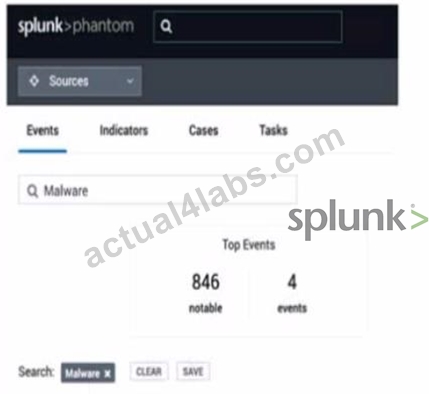
- A. Event Name, Notes, Comments.
- B. Event Name or ID.
- C. Event Name and Artifact Names.
Answer: C
NEW QUESTION # 43
Which of the following supported approaches enables Phantom to run on a Windows server?
- A. Run the Phantom OVA as a virtual machine.
- B. Install the Phantom RPM in a GNU Cygwin implementation.
- C. Install the Phantom RPM file in Windows Subsystem for Linux (WSL).
- D. Run the Phantom OVA as a cloud instance.
Answer: D
NEW QUESTION # 44
Which of the following can be configured in the ROl Settings?
- A. Analyst hours per month.
- B. Annual analyst salary.
- C. Time lost.
- D. Number of full time employees (FTEs).
Answer: D
Explanation:
Explanation
The correct answer is C because the number of full time employees (FTEs) is one of the settings that can be configured in the Return on Investment (ROI) Settings page. This setting is used to calculate the ROI metrics based on the number of analysts in the organization. The answer A is incorrect because the analyst hours per month is not a configurable setting, but a calculated metric based on the FTEs and the average hours per month. The answer B is incorrect because the time lost is not a configurable setting, but a calculated metric based on the number of incidents and the average time lost per incident. The answer D is incorrect because the annual analyst salary is not a configurable setting, but a calculated metric based on the FTEs and the average salary per analyst. Reference: Splunk SOAR Admin Guide, page 131.
NEW QUESTION # 45
......
The Splunk SPLK-2003 exam consists of 60 multiple-choice questions and is delivered online. Candidates have 90 minutes to complete the exam, and a passing score of 70% or higher is required to earn the certification. SPLK-2003 exam covers a range of topics, including Phantom architecture and components, installation and configuration, playbook development, automation and orchestration, and integrations with other security tools.
Splunk SPLK-2003 Official Cert Guide PDF: https://www.actual4labs.com/Splunk/SPLK-2003-actual-exam-dumps.html
Free Splunk SOAR Certified Automation Developer SPLK-2003 Official Cert Guide PDF Download: https://drive.google.com/open?id=1RtqsCLyRX7qUVyWWRhf2w9Z2ad7eLviS