

The Most In-Demand Google Associate-Cloud-Engineer Pass Guaranteed Quiz
New Version Associate-Cloud-Engineer Certificate & Helpful Exam Dumps is Online
NEW QUESTION # 38
You've finally been given a new laptop, but you need to install all of the tools you need. You already installed the Cloud SDK, but none of the commands seem to be working correctly. What step did you likely forget?
- A. gcloud application_init
- B. gcloud init
- C. gcloud config_list
- D. gcloud config list
Answer: B,D
NEW QUESTION # 39
Your organization has user identities in Active Directory. Your organization wants to use Active Directory as their source of truth for identities. Your organization wants to have full control over the Google accounts used by employees for all Google services, including your Google Cloud Platform (GCP) organization. What should you do?
- A. Ask each employee to create a Google account using self signup. Require that each employee use their company email address and password.
- B. Export users from Active Directory as a CSV and import them to Cloud Identity via the Admin Console.
- C. Use Google Cloud Directory Sync (GCDS) to synchronize users into Cloud Identity.
- D. Use the cloud Identity APIs and write a script to synchronize users to Cloud Identity.
Answer: C
Explanation:
Reference:
Directory Sync Google Cloud Directory Sync enables administrators to synchronize users, groups and other data from an Active Directory/LDAP service to their Google Cloud domain directory https://tools.google.com/dlpage/dirsync/
NEW QUESTION # 40
You are designing an application that lets users upload and share photos. You expect your application to grow really fast and you are targeting a worldwide audience. You want to delete uploaded photos after 30 days. You want to minimize costs while ensuring your application is highly available. Which GCP storage solution should you choose?
- A. Cloud Filestore.
- B. Cloud Datastore database.
- C. Persistent SSD on VM instances.
- D. Multiregional Cloud Storage bucket.
Answer: D
Explanation:
Cloud Storage allows world-wide storage and retrieval of any amount of data at any time. We dont need to set up auto-scaling ourselves. Cloud Storage autoscaling is managed by GCP. Cloud Storage is an object store so it is suitable for storing photos. Cloud Storage allows world-wide storage and retrieval so cater well to our worldwide audience. Cloud storage provides us lifecycle rules that can be configured to automatically delete objects older than 30 days. This also fits our requirements. Finally, Google Cloud Storage offers several storage classes such as Nearline Storage ($0.01 per GB per Month) Coldline Storage ($0.007 per GB per Month) and Archive Storage ($0.004 per GB per month) which are significantly cheaper than any of the options above.
Ref: https://cloud.google.com/storage/docs
Ref: https://cloud.google.com/storage/pricing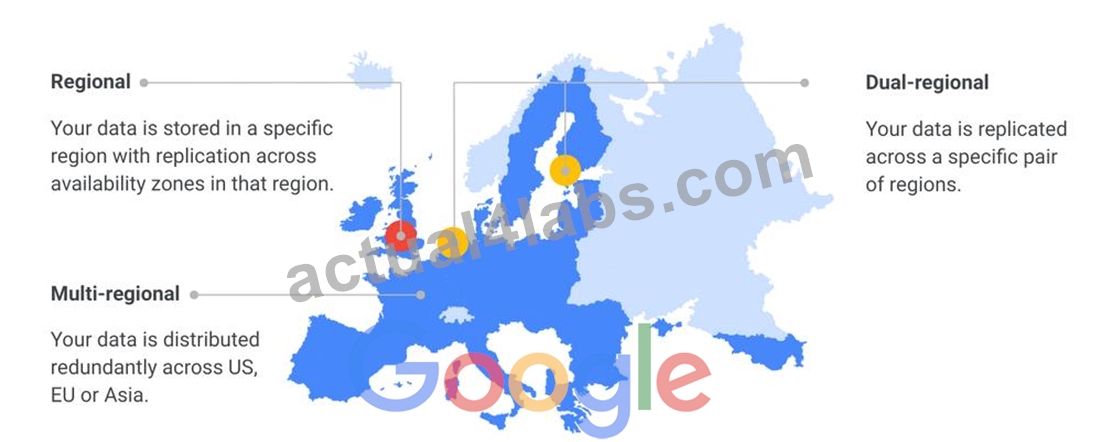
NEW QUESTION # 41
Every employee of your company has a Google account. Your operational team needs to manage a large number of instances on Compute Engine. Each member of this team needs only administrative access to the servers. Your security team wants to ensure that the deployment of credentials is operationally efficient and must be able to determine who accessed a given instance. What should you do?
- A. Ask each member of the team to generate a new SSH key pair and to add the public key to their Google account. Grant the "compute.osAdminLogin" role to the Google group corresponding to this team.
- B. Generate a new SSH key pair. Give the private key to each member of your team. Configure the public key as a project-wide public SSH key in your Cloud Platform project and allow project-wide public SSH keys on each instance.
- C. Ask each member of the team to generate a new SSH key pair and to send you their public key. Use a configuration management tool to deploy those keys on each instance.
- D. Generate a new SSH key pair. Give the private key to each member of your team. Configure the public key in the metadata of each instance.
Answer: B
NEW QUESTION # 42
You want to configure an SSH connection to a single Compute Engine instance for users in the dev1 group.
This instance is the only resource in this particular Google Cloud Platform project that the dev1 users should be able to connect to. What should you do?
- A. Enable block project wide keysfor the instance. Generate an SSH key and associate the key with that instance. Distribute the key to dev1 users and direct them to use their third-party tools to connect.
- B. Enable block project wide keysfor the instance. Generate an SSH key for each user in the dev1 group. Distribute the keys to dev1 users and direct them to use their third-party tools to connect.
- C. Set metadata to enable-oslogin=truefor the instance. Grant the dev1 group the compute.osLogin role. Direct them to use the Cloud Shell to ssh to that instance.
- D. Set metadata to enable-oslogin=truefor the instance. Set the service account to no service accountfor that instance. Direct them to use the Cloud Shell to ssh to that instance.
Answer: A
Explanation:
Explanation/Reference: https://cloud.google.com/compute/docs/instances/adding-removing-ssh-keys
NEW QUESTION # 43
You need to configure optimal data storage for files stored in Cloud Storage for minimal cost. The files are used in a mission-critical analytics pipeline that is used continually. The users are in Boston, MA (United States). What should you do?
- A. Configure dual-regional storage for the dual region closest to the users Configure a Standard storage class
- B. Configure regional storage for the region closest to the users Configure a Standard storage class
- C. Configure dual-regional storage for the dual region closest to the users Configure a Nearline storage class
- D. Configure regional storage for the region closest to the users Configure a Nearline storage class
Answer: B
Explanation:
Explanation
Keywords: - continually -> Standard - mission-critical analytics -> dual-regional
NEW QUESTION # 44
You have an application server running on Compute Engine in the europe-west1-d zone. You need to ensure high availability and replicate the server to the europe-west2-c zone using the fewest steps possible. What should you do?
- A. Create a snapshot from the disk. Create a disk from the snapshot in the europe-west1-d zone and then move the disk to europe-west2-c. Create a new VM with that disk.
- B. Create a snapshot from the disk. Create a disk from the snapshot in the europe-west2-c zone.
Create a new VM with that disk. - C. Use "gcloud compute instances move" with parameter "--destination-zone europe-west2-c" to move the instance to the new zone.
- D. Use "gcloud" to copy the disk to the europe-west2-c zone. Create a new VM with that disk.
Answer: B
Explanation:
A is correct because this makes sure the VM gets replicated in the new zone.
B is not correct because this takes more steps than A.
C is not correct because this will generate an error, because gcloud cannot copy disks.
D is not correct because the original VM will be moved, not replicated.
NEW QUESTION # 45
You are given a project with a single virtual private cloud (VPC) and a single subnetwork in the us-central1 region. There is a Compute Engine instance hosting an application in this subnetwork. You need to deploy a new instance in the same project in the europe-west1 region. This new instance needs access to the application. You want to follow Google-recommended practices. What should you do?
- A. 1. Create a VPC and a subnetwork in europe-west1.2. Peer the 2 VPCs.3. Create the new instance in the new subnetwork and use the first instance's private address as the endpoint.
- B. 1. Create a subnetwork in the same VPC, in europe-west1.2. Use Cloud VPN to connect the two subnetworks.3. Create the new instance in the new subnetwork and use the first instance's private address as the endpoint.
- C. 1. Create a VPC and a subnetwork in europe-west1.2. Expose the application with an internal load balancer.3. Create the new instance in the new subnetwork and use the load balancer's address as the endpoint.
- D. 1. Create a subnetwork in the same VPC, in europe-west1.2. Create the new instance in the new subnetwork and use the first instance's private address as the endpoint.
Answer: D
NEW QUESTION # 46
You need to enable traffic between multiple groups of Compute Engine instances that are currently running two different GCP projects. Each group of Compute Engine instances is running in its own VPC. What should you do?
- A. Verify that you are the Project Administrator of both projects. Create two new VPCs and add all instances.
- B. Verify that both projects are in a GCP Organization. Create a new VPC and add all instances.
- C. Verify that both projects are in a GCP Organization. Share the VPC from one project and request that the Compute Engine instances in the other project use this shared VPC.
- D. Verify that you are the Project Administrator of both projects. Create a new VPC and add all instances.
Answer: C
Explanation:
Shared VPC allows an organization to connect resources from multiple projects to a common Virtual Private Cloud (VPC) network, so that they can communicate with each other securely and efficiently using internal IPs from that network. When you use Shared VPC, you designate a project as a host project and attach one or more other service projects to it. The VPC networks in the host project are called Shared VPC networks. Eligible resources from service projects can use subnets in the Shared VPC network
https://cloud.google.com/vpc/docs/shared-vpc
"For example, an existing instance in a service project cannot be reconfigured to use a Shared VPC network, but a new instance can be created to use available subnets in a Shared VPC network."
NEW QUESTION # 47
You need to provide a cost estimate for a Kubernetes cluster using the GCP pricing calculator for Kubernetes. Your workload requires high IOPs, and you will also be using disk snapshots. You start by entering the number of nodes, average hours, and average days. What should you do next?
- A. Select Add GPUs. Fill in persistent disk storage and snapshot storage.
- B. Fill in local SSD. Add estimated cost for cluster management.
- C. Select Add GPUs. Add estimated cost for cluster management.
- D. Fill in local SSD. Fill in persistent disk storage and snapshot storage.
Answer: A
NEW QUESTION # 48
You created an instance of SQL Server 2017 on Compute Engine to test features in the new version. You want to connect to this instance using the fewest number of steps. What should you do?
- A. Set a Windows username and password in the GCP Console. Verify that a firewall rule for port 3389 exists. Click the RDP button in the GCP Console, and supply the credentials to log in.
- B. Set a Windows password in the GCP Console. Verify that a firewall rule for port 22 exists. Click the RDP button in the GCP Console and supply the credentials to log in.
- C. Install a RDP client on your desktop. Verify that a firewall rule for port 3389 exists.
- D. Install a RDP client in your desktop. Set a Windows username and password in the GCP Console. Use the credentials to log in to the instance.
Answer: D
Explanation:
Reference:
https://medium.com/falafel-software/sql-server-in-the-google-cloud-a17e8a1f11ce
NEW QUESTION # 49
You are building an application that stores relational data from users. Users across the globe will use this application. Your CTO is concerned about the scaling requirements because the size of the user base is unknown. You need to implement a database solution that can scale with your user growth with minimum configuration changes. Which storage solution should you use?
- A. Cloud Firestore
- B. Cloud SQL
- C. Cloud Datastore
- D. Cloud Spanner
Answer: C
NEW QUESTION # 50
You have a Compute Engine instance hosting an application used between 9 AM and 6 PM on weekdays. You want to back up this instance daily for disaster recovery purposes. You want to keep the backups for 30 days. You want the Google-recommended solution with the least management overhead and the least number of services. What should you do?
- A. 1. In the Cloud Console, go to the Compute Engine Disks page and select your instance's disk.
2. In the Snapshot Schedule section, select Create Schedule and configure the following parameters:
- Schedule frequency: Daily
- Start time: 1:00 AM ?2:00 AM
- Autodelete snapshots after 30 days - B. 1. Update your instances' metadata to add the following value: snapshot-schedule: 0 1 * * *
2. Update your instances' metadata to add the following value: snapshot-retention: 30 - C. 1. Create a Cloud Function that creates a snapshot of your instance's disk.
2. Create a Cloud Function that deletes snapshots that are older than 30 days.
3. Use Cloud Scheduler to trigger both Cloud Functions daily at 1:00 AM. - D. 1. Create a bash script in the instance that copies the content of the disk to Cloud Storage.
2. Create a bash script in the instance that deletes data older than 30 days in the backup Cloud Storage bucket.
3. Configure the instance's crontab to execute these scripts daily at 1:00 AM.
Answer: A
NEW QUESTION # 51
You recently deployed a new version of an application to App Engine and then discovered a bug in the release. You need to immediately revert to the prior version of the application. What should you do?
- A. On the App Engine page of the GCP Console, select the application that needs to be reverted and click Revert.
- B. On the App Engine Versions page of the GCP Console, route 100% of the traffic to the previous version.
- C. Deploy the original version as a separate application. Then go to App Engine settings and split traffic between applications so that the original version serves 100% of the requests.
- D. Run gcloud app restore.
Answer: C
NEW QUESTION # 52
You are using Data Studio to visualize a table from your data warehouse that is built on top of BigQuery. Data is appended to the data warehouse during the day. At night, the daily summary is recalculated by overwriting the table. You just noticed that the charts in Data Studio are broken, and you want to analyze the problem.
What should you do?
- A. Use Cloud Debugger to find out why the data was not refreshed correctly
- B. Review the Error Reporting page in the Cloud Console to find any errors.
- C. In Cloud Logging create a filter for your Data Studio report
- D. Use the BigQuery interface to review the nightly Job and look for any errors
Answer: D
Explanation:
Explanation
Cloud Debugger helps inspect the state of an application, at any code location, without stopping or slowing down the running app // https://cloud.google.com/debugger/docs
NEW QUESTION # 53
A colleague handed over a Google Cloud Platform project for you to maintain. As part of a security checkup, you want to review who has been granted the Project Owner role. What should you do?
- A. Enable Audit Logs on the IAM & admin page for all resources, and validate the results.
- B. In the console, validate which SSH keys have been stored as project-wide keys.
- C. Navigate to Identity-Aware Proxy and check the permissions for these resources.
- D. Use the command gcloud projects get-iam-policy to view the current role assignments.
Answer: C
NEW QUESTION # 54
You want to configure 10 Compute Engine instances for availability when maintenance occurs. Your requirements state that these instances should attempt to automatically restart if they crash. Also, the instances should be highly available including during system maintenance. What should you do?
- A. Create an instance group for the instances. Set the 'Autohealing' health check to healthy (HTTP).
- B. Create an instance template for the instances. Set 'Automatic Restart' to off. Set 'On-host maintenance' to Terminate VM instances. Add the instance template to an instance group.
- C. Create an instance group for the instance. Verify that the 'Advanced creation options' setting for 'do not retry machine creation' is set to off.
- D. Create an instance template for the instances. Set the 'Automatic Restart' to on. Set the 'On-host maintenance' to Migrate VM instance. Add the instance template to an instance group.
Answer: B
NEW QUESTION # 55
You have been asked to migrate a docker application from datacenter to cloud. Your solution architect has suggested uploading docker images to GCR in one project and running an application in a GKE cluster in a separate project. You want to store images in the project img-278322 and run the application in the project prod-278986. You want to tag the image as acme_track_n_trace:v1. You want to follow Google-recommended practices. What should you do?
- A. Run gcloud builds submit --tag gcr.io/prod-278986/acme_track_n_trace:v1
- B. Run gcloud builds submit --tag gcr.io/prod-278986/acme_track_n_trace
- C. Run gcloud builds submit --tag gcr.io/img-278322/acme_track_n_trace
- D. Run gcloud builds submit --tag gcr.io/img-278322/acme_track_n_trace:v1
Answer: D
Explanation:
Run gcloud builds submit tag gcr.io/img-278322/acme_track_n_trace:v1. is the right answer.
This command correctly tags the image as acme_track_n_trace:v1 and uploads the image to the img-278322 project.
Ref: https://cloud.google.com/sdk/gcloud/reference/builds/submit
NEW QUESTION # 56
You recently received a new Google Cloud project with an attached billing account where you will work. You need to create instances, set firewalls, and store data in Cloud Storage. You want to follow Google-recommended practices. What should you do?
- A. Use the gcloud CLI services enable cloudresourcemanager.googleapis.com command to enable all resources.
- B. Open the Google Cloud console and enable all Google Cloud APIs from the API dashboard.
- C. Use the gcloud services enable compute.googleapis.com command to enable Compute Engine and the gcloud services enable storage-api.googleapis.com command to enable the Cloud Storage APIs.
- D. Open the Google Cloud console and run gcloud init --project <project-id> in a Cloud Shell.
Answer: C
NEW QUESTION # 57
Your organization is a financial company that needs to store audit log files for 3 years. Your organization has hundreds of Google Cloud projects. You need to implement a cost-effective approach for log file retention. What should you do?
- A. Write a custom script that uses logging API to copy the logs from Stackdriver logs to BigQuery.
- B. Export these logs to Cloud Pub/Sub and write a Cloud Dataflow pipeline to store logs to Cloud SQL.
- C. Create an export to the sink that saves logs from Cloud Audit to BigQuery.
- D. Create an export to the sink that saves logs from Cloud Audit to a Coldline Storage bucket.
Answer: C
NEW QUESTION # 58
You deployed a new application inside your Google Kubernetes Engine cluster using the YAML file specified below.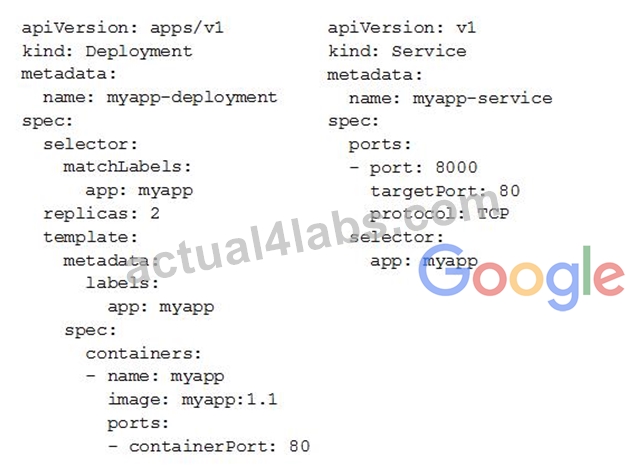
You check the status of the deployed pods and notice that one of them is still in PENDING status:
You want to find out why the pod is stuck in pending status. What should you do?
- A. View logs of the container in myapp-deployment-58ddbbb995-lp86m pod and check for warning messages.
- B. Review details of the myapp-service Service object and check for error messages.
- C. Review details of myapp-deployment-58ddbbb995-lp86m Pod and check for warning messages.
- D. Review details of the myapp-deployment Deployment object and check for error messages.
Answer: C
Explanation:
Reference:
https://cloud.google.com/run/docs/gke/troubleshooting
NEW QUESTION # 59
You want to select and configure a cost-effective solution for relational data on Google Cloud Platform.You are working with a small set of operational data in one geographic location. You need to support point-in-time recovery. What should you do?
- A. Select Cloud SQL (MySQL). Verify that the enable binary logging option is selected.
- B. Select Cloud Spanner. Set up your instance as multi-regional.
- C. Select Cloud SQL (MySQL). Select the create failover replicas option.
- D. Select Cloud Spanner. Set up your instance with 2 nodes.
Answer: A
NEW QUESTION # 60
Your company implemented BigQuery as an enterprise data warehouse. Users from multiple business units run queries on this data warehouse. However, you notice that query costs for BigQuery are very high, and you need to control costs. Which two methods should you use?
(Choose two.)
- A. Create separate copies of your BigQuery data warehouse for each business unit.
- B. Split your BigQuery data warehouse into multiple data warehouses for each business unit.
- C. Change your BigQuery query model from on-demand to flat rate. Apply the appropriate number of slots to each Project.
- D. Apply a user- or project-level custom query quota for BigQuery data warehouse.
- E. Split the users from business units to multiple projects.
Answer: C,D
Explanation:
First of all you can define quotas on project or user level and 2nd one is you can change from on demand to flat rate model and define the parameters based on your requirement.
https://cloud.google.com/bigquery/docs/custom-quotas
https://cloud.google.com/bigquery/pricing#flat_rate_pricing
NEW QUESTION # 61
......
Associate-Cloud-Engineer Free Certification Exam Material with 266 Q&As : https://www.actual4labs.com/Google/Associate-Cloud-Engineer-actual-exam-dumps.html
UPDATED Associate-Cloud-Engineer Exam Questions Certification Test Engine to PDF: https://drive.google.com/open?id=1L5JgSeMjq4LjupoclUcWXMZZ0dImdKCI