

Latest 2026 Realistic Verified AB-210 Dumps - 100% Free AB-210 Exam Dumps
Get 2026 Updated Free Microsoft AB-210 Exam Questions and Answer
NEW QUESTION # 52
You are creating a business process flow named " Onboard new pet " to support onboarding of new clients for a pet care business.
A partially completed business process flow is shown in the following exhibit.
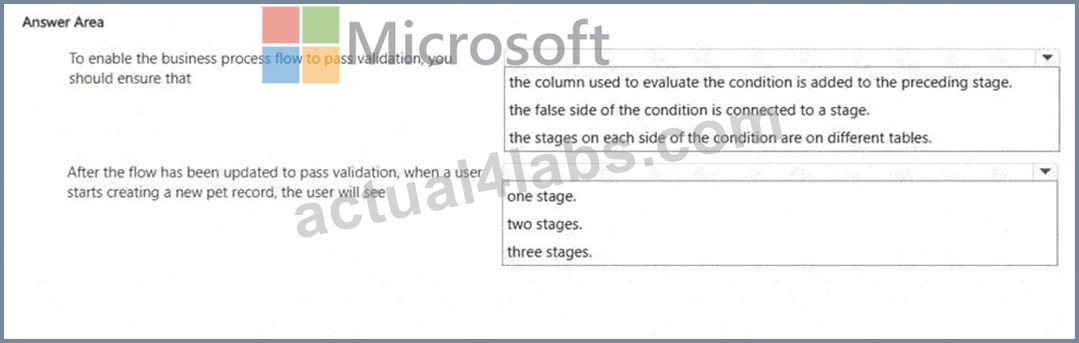
Use the drop-down menus to select the answer choice that completes each statement based on the information presented in the exhibit.
NOTE: Each correct selection is worth one point.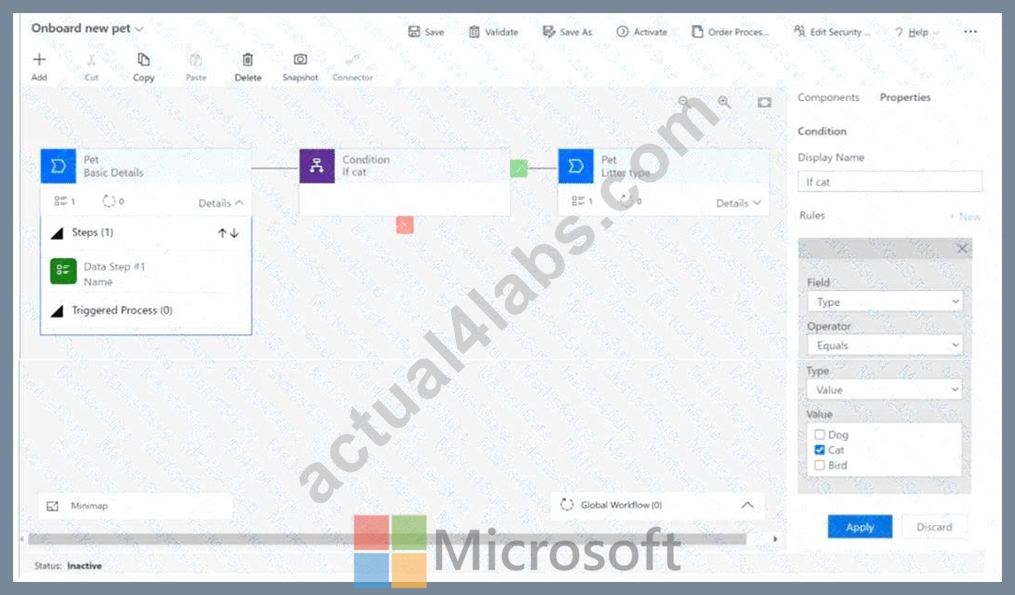
Answer:
Explanation: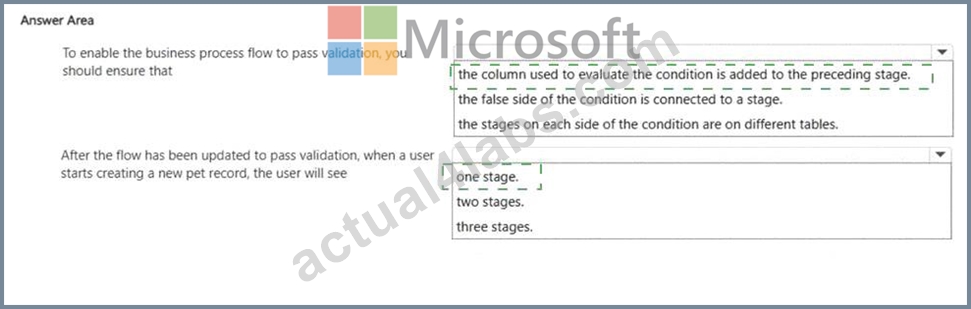
Explanation:
Statement
Correct selection
To enable the business process flow to pass validation, you should ensure that the column used to evaluate the condition is added to the preceding stage.
After the flow has been updated to pass validation, when a user starts creating a new pet record, the user will see one stage.
The condition in the business process flow evaluates the Type column to determine whether the pet is a Cat .
However, the preceding stage, Basic Details , only contains the Name step. In a business process flow, a branching rule must be based on steps in the stage immediately before the condition. Microsoft's business process flow design guidance states that branching rules must be based on the steps in the preceding stage, so the Type column must be added as a step in the Basic Details stage before the condition can validate correctly.
After validation is corrected, a user who starts creating a new pet record will initially see one stage : Basic Details . The Litter type stage is conditional and appears only when the Type value satisfies the rule, meaning the pet type equals Cat. Microsoft explains that branch selection is automatic and happens in real time based on the rules defined in the process definition. Until the user enters a Type value that satisfies the condition, the cat-specific branch is not part of the visible process path.
References/topics: Business process flows; conditional branching; preceding-stage steps; process validation; model-driven app process bar.
NEW QUESTION # 53
A seller asks Copilot to identify important customer concerns discussed across multiple emails before preparing a proposal. Which capability should be used?
- A. Goal Management
- B. Conversation summarization
- C. Duplicate detection
- D. Forecast recalculation
Answer: B
Explanation:
Conversation summarization analyzes multiple email exchanges to identify recurring concerns, commitments, questions, and discussion themes. Sellers receive a concise overview that helps them prepare proposals aligned with customer priorities and expectations.
NEW QUESTION # 54
A company is using Dynamics 365 Sales.
The company is NOT using predictive lead scoring. The company has historical sales records for the last three years.
You need to configure a predictive lead scoring model.
What is the minimum number of records required?
- A. 40 qualified leads and 40 disqualified leads
- B. 40 qualified leads and 40 won opportunities
- C. 40 qualified leads and 40 lost opportunities
Answer: A
Explanation:
The minimum dataset for a predictive lead scoring model is 40 qualified leads and 40 disqualified leads .
Microsoft's Dynamics 365 Sales documentation states that an organization must have created and closed at least 40 qualified and 40 disqualified leads within the selected training period to train the model. The broader lead and opportunity scoring documentation confirms the same threshold and distinguishes lead scoring from opportunity scoring: lead scoring requires qualified and disqualified leads, while opportunity scoring requires won and lost opportunities.
This distinction is critical. Predictive lead scoring predicts the likelihood that a lead will qualify or convert based on historical lead outcomes, so the model needs examples of both successful and unsuccessful lead qualification results. Won and lost opportunities are not the correct training records for lead scoring; they apply to predictive opportunity scoring. The question also states that the company has historical sales records for three years, but the model requirement is based on the minimum qualifying lead dataset, not merely the total age of available data. Therefore, the required minimum is 40 qualified leads and 40 disqualified leads .
References/topics: Predictive lead scoring; lead scoring model prerequisites; qualified leads; disqualified leads; AI-driven lead prioritization.
NEW QUESTION # 55
A sales team contacts customers to promote and sell products.
You need the sales team to place outbound calls directly from Dynamics 365 Sales records using Microsoft Teams.
You need to enable calling directly from records.
What should you configure?
- A. Enable the Microsoft Teams dialer.
- B. Install the Dynamics 365 Sales mobile app.
- C. Enable Microsoft Teams meeting integration.
- D. Configure phone numbers for outbound calling.
Answer: A
Explanation:
The correct configuration is to enable the Microsoft Teams dialer . Microsoft's Dynamics 365 Sales documentation states that Microsoft Teams dialer brings Teams calling directly into Dynamics 365 Sales so sellers can make and receive calls without leaving the application. The documented setup path is to go to Sales Hub app settings, open Teams calls , and turn on Teams calls for the selected security roles and apps.
This matches the requirement precisely: the sales team must place outbound calls directly from Dynamics 365 Sales records using Microsoft Teams. Phone numbers and PSTN connectivity are prerequisites for Teams calling, but option A is not the Dynamics 365 Sales feature that enables record-level calling. The mobile app is irrelevant because the question asks for calling from Dynamics 365 Sales records, not mobile access. Teams meeting integration supports meetings and collaboration, but it does not enable click-to-call or Teams dialer calling from Sales records. Therefore, the required feature is Microsoft Teams dialer .
References/topics: Microsoft Teams dialer; Teams calls in Dynamics 365 Sales; outbound calling from Sales records; Sales Hub Teams calls configuration.
NEW QUESTION # 56
A company tracks opportunities using the pipeline view.
The sales managers want pipeline stages configured so they can quickly identify deal progress.
The configuration must meet the following requirements:
. Open the Pipeline view by default in Opportunities.
. Open a specific form for the opportunity side panel.
. Provide the ability to expand or collapse the grid by sections, for example Owner or Account.
. Display the average value at the bottom of the grid.
You need to identify the opportunity configuration.
Which configuration should you apply for each requirement? To answer, move the appropriate configurations to the correct requirements. You may use each configuration once, more than once, or not at all. You may need to move the split bar between panes or scroll to view content.
NOTE: Each correct selection is worth one point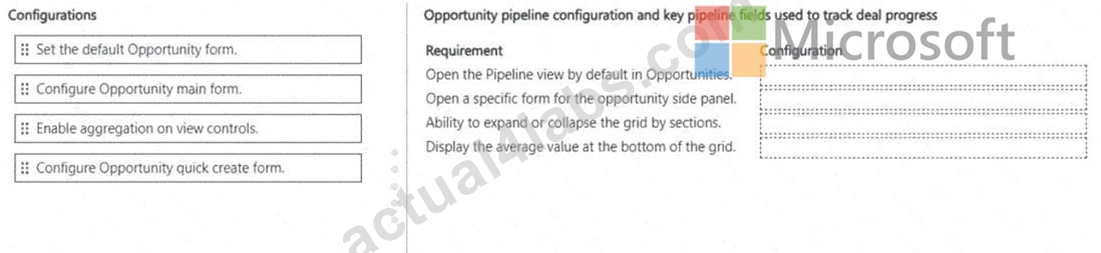
Answer:
Explanation: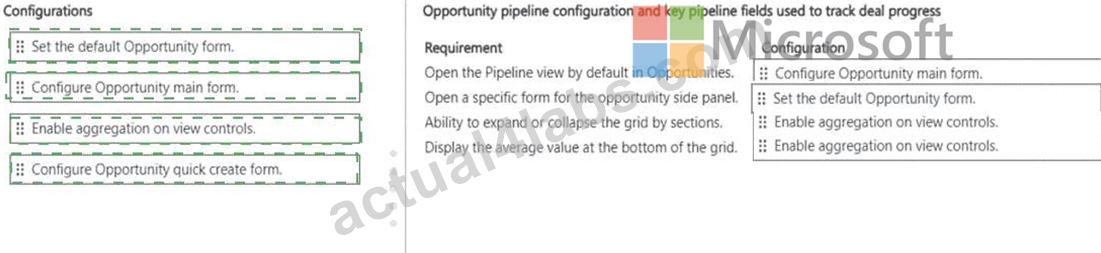
Explanation:
Requirement
Configuration
Open the Pipeline view by default in Opportunities
Configure Opportunity main form
Open a specific form for the opportunity side panel
Set the default Opportunity form
Ability to expand or collapse the grid by sections
Enable aggregation on view controls
Display the average value at the bottom of the grid
Enable aggregation on view controls
To open the Pipeline view by default, configure the Opportunity main form by adding the Pipeline view control for Opportunities. Microsoft states that the read-only grid is the default view for opportunities, but administrators can set the Opportunities pipeline view as the default by customizing the Opportunity table form and adding the Pipeline view component. The configuration includes selecting the Opportunities table, choosing the opportunity view, and enabling grouping and aggregation.
To open a specific form in the opportunity side panel, use Set the default Opportunity form . Microsoft's configuration guidance states that when sellers open an opportunity from the pipeline view, the side panel displays opportunity details, and administrators can change the default side-panel form to the main opportunity form or a custom form.
For expanding/collapsing by sections such as Owner or Account and displaying average values at the bottom of the grid, enable aggregation/grouping behavior on the Pipeline view control. Microsoft states that Enable grouping and Enable aggregation allow sellers to group and aggregate opportunities in the pipeline view.
This supports sectioned grid behavior and aggregate values such as average, sum, or count. The quick create form is irrelevant because it controls record creation, not pipeline display behavior.
References/topics: Opportunity pipeline view; Opportunity main form; side panel default form; grouping and aggregation; pipeline grid configuration.
NEW QUESTION # 57
Case Study 1 - AdventureWorks
Background
AdventureWorks Cycles is a global manufacturer of high-performance bicycles headquartered in Seattle. The company sells products through distributors, specialty retailers, and a growing direct- to-consumer online channel. AdventureWorks Cycles recently expanded its product catalog to include the athlete package. This package includes a cycle, connected devices and subscription- based analytics services.
To support this expansion, the company wants to modernize its sales operations by implementing Microsoft Dynamics 365 Sales. The leadership team wants sellers to focus on building relationships with distributors and enterprise buyers rather than manually qualifying leads or assembling product packages.
The sales operations team is responsible for configuring the Dynamics 365 Sales environment.
Their goal is to implement Al-driven processes that streamline the lead-to-cash workflow while ensuring that sellers can easily identify the most promising opportunities.
Current Environment
AdventureWorks Cycles previously used a legacy CRM system that tracked leads and opportunities but lacked predictive intelligence or automated lead qualification. Sellers manually evaluate incoming leads, which creates delays and inconsistent prioritization.
The global sales team manages approximately 15,000 leads per month generated from marketing campaigns, trade shows, and partner referrals.
Product data is stored in multiple systems. Product managers maintain products and pricing in spreadsheets. Information regarding custom relationships, competitor analysis, and region- specific marketing content is stored in a SharePoint site called the sales portfolio.
The organization has identified several challenges they want to resolve with a new solution:
Sellers often spend significant time researching leads that ultimately do not convert.
Regional managers require in-depth reporting using information from the sales pipeline and seller activities, the point-of-sale solution, website analytics, and the accounting system.
Multiple product offerings are difficult to manage because components are defined in different systems.
Team leads require real-time information on active opportunities, as well as visibility of seller's appointments and phone calls, without needing to navigate into multiple views.
All sellers are assigned Dynamics 365 Sales Enterprise licenses, Also, the CFO has requested that Copilot message packs are pre-purchased by using the Copilot Studio subscription license.
A Dynamics 365 sales sandbox environment has been in use for six months. There are 60 leads records with 30 records that are qualified and 20 that are disqualified. Ten of the qualified leads are over three months old.
Business Requirements:
AdventureWorks Cycles has defined the following business requirements for the production environment of Dynamics 365 Sales:
Sellers in all regions should be able to review the new mountaineer cycles. The cycles include economy and premium fittings. When creating opportunities, sellers should be able to select a metal type when adding a mountaineer cycle to an opportunity. The metal types include chrome, aluminum, and titanium.
Pricing managers must be able to create deals for the same products in their own currencies and at their own prices, without reference to the cost of the product.
Sellers must be able to quickly view their own opportunities by phase.
Predictive scoring should be enabled for leads created within the last three months in the sandbox environment. This should provide seller training on the scoring's interpretation and usage.
A segment of leads named Hot is needed that will contain all leads where the source is phone, employee referral or partner. Leads from this segment should be distributed to sellers by using a round robin method.
Agents should not be able to take action on any data that is created in the production environment before they are started.
All sellers should be able to access disqualified leads.
Technical Information and Requirements:
The new Dynamics 365 Sales environment must meet the following technical requirements:
Agents must use a dedicated service identity to execute write actions with a controlled security role in Dataverse.
The sales operations team lead must be assigned the Power Platform administrator role.
The lead pricing manager must be assigned to the Microsoft 365 billing admin role.
The vice president of sales must be assigned the Al admin role.
A sandbox and a production environment must be created. Both of the environments must be enabled for Al capacity, but usage should be capped on the sandbox environment.
A trial environment must be created, with the Sales Qualification Agent configured to business requirements.
Sellers must be assigned the security roles on the production environment only.
All sellers must be assigned a customized version of the salesperson role. This role should grant read access only to the leads that the sellers own.
The EnableRoleBasedSystemViews property must be set to true for the production environment.
No Azure subscriptions are available in the tenant.
Issues:
During early testing, the sales operations team identify the following issues:
The Sales Qualification Agent has disqualified several leads in the trial environment. The vice president of sales has requested to understand the reason for the disqualified leads.
Sellers are unable to create agents in the production environment.
Agent consumption has been unreliable. The company requires that Al capacity is always available to sellers.
You need to allow sellers to view leads disqualified by the Sales Qualification Agent in production.
Which two actions should you perform? Each correct answer presents part of the solution.
Choose two.
- A. Upgrade the agent to research and engage mode.
- B. Update the EnableRoleBasedSystemViews setting.
- C. Update the agent look back period.
- D. Assign organization level read on lead table to sellers.
Answer: B,D
Explanation:
The required fix is about visibility and security, not agent operating mode. In the scenario, production has EnableRoleBasedSystemViews set to true, which restricts system views based on role configuration. Because the business requirement says all sellers should be able to access disqualified leads, the role-based system view setting must be updated so sellers can access the view that exposes leads disqualified by the Sales Qualification Agent.
The second required action is to change Lead table permissions. The customized Salesperson role currently grants sellers read access only to leads they own. That is too restrictive because leads disqualified by the Sales Qualification Agent may not be owned by each seller. To let all sellers view those records, sellers need organization-level Read permission on the Lead table.
Option A is wrong because upgrading the agent to research and engage mode affects how the agent researches and interacts with leads; it does not solve seller access to disqualified records.
Option C is also wrong because the look-back period controls which historical leads the agent evaluates, not who can view disqualified leads.
NEW QUESTION # 58
Note: This question is part of a series of questions that present the same scenario. Each question in the series contains a unique solution that might meet the stated goals. Some question sets might have more than one correct solution, while others might not have a correct solution.
After you answer a question in this section, you will NOT be able to return to it. As a result, these questions will not appear on the review screen.
You are deploying AI agents for a company using Microsoft Dynamics 365 Sales.
The company wants to ensure that AI usage is tracked and billed monthly.
The company requires that AI billing uses pre-paid credits.
You need to configure the billing based on the requirements.
Solution: Configure capacity overages to the billing plan on the Dynamics 365 Sales environment.
Does the solution meet the goal?
- A. No
- B. Yes
Answer: A
Explanation:
The solution does not meet the goal. The requirement is explicit: AI billing must use pre-paid credits. Microsoft's Dynamics 365 Sales billing guidance separates Copilot and agent billing into two models:
prepaid capacity and pay-as-you-go. Prepaid capacity uses Copilot Studio message pack subscriptions that are purchased in advance, while pay-as-you-go bills for the actual number of messages consumed during the month.
Configuring capacity overages to a billing plan is not the prepaid-credit model. Overages are tied to consumption beyond allocated capacity and are handled through billing-plan/pay-as-you-go behavior. That conflicts with the requirement to use pre-purchased credits. For prepaid billing, the correct approach is to purchase Copilot Studio message packs or capacity packs and assign that prepaid capacity to the Dynamics 365/Power Platform environment. Microsoft's Power Platform capacity guidance states that prepaid capacity can be assigned to environments, and when prepaid capacity is exhausted, administrators must reallocate capacity, purchase more credits, or enable pay-as-you-go billing.
Therefore, configuring overages may support monthly usage billing, but it does not satisfy the stated requirement that billing must use prepaid credits.
NEW QUESTION # 59
You need to configure the new lead qualification experience in Dynamics 365 Sales for field sellers.
What should you configure?
- A. Use the Lead to Opportunity Business Process Flow.
- B. Allow Copilot to summarize key info.
- C. Set related record creation to Automatic.
- D. Set related record creation to Seller.
- E. Enable auto-create records for newly qualified leads.
Answer: D
Explanation:
The correct configuration is to set related record creation to Seller. The case study states that sales leadership requires flexibility in how leads are converted: inside sales need automatic opportunity creation, but field sellers need the option to manually decide whether an opportunity should be created when a lead is qualified.
In the new lead qualification experience, Dynamics 365 Sales lets administrators control whether account, contact, and opportunity records are created automatically during lead qualification or whether sellers are prompted to choose which related records to create. Microsoft's lead qualification guidance confirms that when automatic creation is not enabled, sellers are prompted to select which records should be created during qualification.
Option B and option E are wrong for field sellers because automatic creation would remove the manual decision point required by the case study. Option C is relevant to guiding sellers through sales stages, but the existing Lead to Opportunity Business Process Flow does not control whether related records are automatically created when a lead is qualified. Option D is unrelated because Copilot summaries help sellers review record information; they do not configure lead conversion behavior. Therefore, the required configuration for field sellers is Seller-controlled related record creation.
References/topics: Lead qualification experience; lead-to-opportunity conversion; related account, contact, and opportunity creation; Dynamics 365 Sales lead management.
NEW QUESTION # 60
Case Study 1 - AdventureWorks
Background
AdventureWorks Cycles is a global manufacturer of high-performance bicycles headquartered in Seattle. The company sells products through distributors, specialty retailers, and a growing direct- to-consumer online channel. AdventureWorks Cycles recently expanded its product catalog to include the athlete package. This package includes a cycle, connected devices and subscription- based analytics services.
To support this expansion, the company wants to modernize its sales operations by implementing Microsoft Dynamics 365 Sales. The leadership team wants sellers to focus on building relationships with distributors and enterprise buyers rather than manually qualifying leads or assembling product packages.
The sales operations team is responsible for configuring the Dynamics 365 Sales environment.
Their goal is to implement Al-driven processes that streamline the lead-to-cash workflow while ensuring that sellers can easily identify the most promising opportunities.
Current Environment
AdventureWorks Cycles previously used a legacy CRM system that tracked leads and opportunities but lacked predictive intelligence or automated lead qualification. Sellers manually evaluate incoming leads, which creates delays and inconsistent prioritization.
The global sales team manages approximately 15,000 leads per month generated from marketing campaigns, trade shows, and partner referrals.
Product data is stored in multiple systems. Product managers maintain products and pricing in spreadsheets. Information regarding custom relationships, competitor analysis, and region- specific marketing content is stored in a SharePoint site called the sales portfolio.
The organization has identified several challenges they want to resolve with a new solution:
Sellers often spend significant time researching leads that ultimately do not convert.
Regional managers require in-depth reporting using information from the sales pipeline and seller activities, the point-of-sale solution, website analytics, and the accounting system.
Multiple product offerings are difficult to manage because components are defined in different systems.
Team leads require real-time information on active opportunities, as well as visibility of seller's appointments and phone calls, without needing to navigate into multiple views.
All sellers are assigned Dynamics 365 Sales Enterprise licenses, Also, the CFO has requested that Copilot message packs are pre-purchased by using the Copilot Studio subscription license.
A Dynamics 365 sales sandbox environment has been in use for six months. There are 60 leads records with 30 records that are qualified and 20 that are disqualified. Ten of the qualified leads are over three months old.
Business Requirements:
AdventureWorks Cycles has defined the following business requirements for the production environment of Dynamics 365 Sales:
Sellers in all regions should be able to review the new mountaineer cycles. The cycles include economy and premium fittings. When creating opportunities, sellers should be able to select a metal type when adding a mountaineer cycle to an opportunity. The metal types include chrome, aluminum, and titanium.
Pricing managers must be able to create deals for the same products in their own currencies and at their own prices, without reference to the cost of the product.
Sellers must be able to quickly view their own opportunities by phase.
Predictive scoring should be enabled for leads created within the last three months in the sandbox environment. This should provide seller training on the scoring's interpretation and usage.
A segment of leads named Hot is needed that will contain all leads where the source is phone, employee referral or partner. Leads from this segment should be distributed to sellers by using a round robin method.
Agents should not be able to take action on any data that is created in the production environment before they are started.
All sellers should be able to access disqualified leads.
Technical Information and Requirements:
The new Dynamics 365 Sales environment must meet the following technical requirements:
Agents must use a dedicated service identity to execute write actions with a controlled security role in Dataverse.
The sales operations team lead must be assigned the Power Platform administrator role.
The lead pricing manager must be assigned to the Microsoft 365 billing admin role.
The vice president of sales must be assigned the Al admin role.
A sandbox and a production environment must be created. Both of the environments must be enabled for Al capacity, but usage should be capped on the sandbox environment.
A trial environment must be created, with the Sales Qualification Agent configured to business requirements.
Sellers must be assigned the security roles on the production environment only.
All sellers must be assigned a customized version of the salesperson role. This role should grant read access only to the leads that the sellers own.
The EnableRoleBasedSystemViews property must be set to true for the production environment.
No Azure subscriptions are available in the tenant.
Issues:
During early testing, the sales operations team identify the following issues:
The Sales Qualification Agent has disqualified several leads in the trial environment. The vice president of sales has requested to understand the reason for the disqualified leads.
Sellers are unable to create agents in the production environment.
Agent consumption has been unreliable. The company requires that Al capacity is always available to sellers.
The required predictive scoring model cannot be created yet.
You need to inform the sales team how many more record types are needed before it can be configured.
What two actions on lead records are required? Each correct answer presents part of the solution. Choose two.
- A. 10 more leads must be qualified.
- B. 20 more leads must be qualified.
- C. 30 more leads must be disqualified.
- D. 40 more leads must be created.
- E. 20 more leads must be disqualified.
Answer: B,E
Explanation:
For Dynamics 365 Sales predictive lead scoring, the model cannot be created unless there is enough historical lead outcome data in the selected training window. Microsoft's predictive lead scoring configuration requirement states that the organization must have at least 40 qualified leads and 40 disqualified leads in the selected training period. The official guidance specifically explains that if the model is trained with leads from the past three months, the organization needs
"at least 40 qualified and 40 disqualified leads" created and closed during that period.
In the sandbox, AdventureWorks has 30 qualified leads and 20 disqualified leads. However, 10 of the qualified leads are older than three months, and the business requirement says predictive scoring must be enabled for leads created within the last three months. Therefore, only 20 qualified leads are usable for this model. The sandbox currently has 20 usable qualified leads and
20 disqualified leads. To meet the required threshold of 40 each, the company needs 20 more qualified leads and 20 more disqualified leads. Simply creating 40 new leads is not enough because predictive scoring requires outcome-classified leads, not merely open or newly created records.
NEW QUESTION # 61
A company is implementing the Dynamics 365 Sales mobile app.
The company requires setup of several push notifications for sellers who use the app.
You need to create the push notifications.
Which feature should you use?
- A. Classic flow
- B. Cloud flow
- C. Plug-in
Answer: B
Explanation:
The correct feature is Cloud flow. Dynamics 365 Sales mobile app push notifications are created through Power Automate by using the Send push notification V2 action. Microsoft's Sales mobile documentation states that the Dynamics 365 Sales mobile app supports push notifications created with the Send push notification V2 action, where the mobile app is set to Sales, the target app is selected, recipients are defined, and the notification can open a specific table record when selected.
Power Automate documentation also describes the creation process as a notification from a flow:
go to Power Automate, create an automated flow, choose a trigger such as Microsoft Dataverse, then add the Send push notification V2 action. That matches the requirement to configure several seller notifications for the Sales mobile app. Classic flow is not the correct answer because modern mobile notification automation should be implemented with Power Automate cloud flows, not legacy/classic workflow patterns. Plug-in is also wrong because plug-ins are server-side Dataverse extensions for custom business logic; they are not the standard no-code configuration mechanism for mobile push notifications.
NEW QUESTION # 62
A company is using Dynamics 365 Sales and Microsoft 365.
The company has the following requirements for sales representatives:
- Must store opportunity files in a central location.
- Must collaborate using chat conversations associated with sales
records.
You need to configure the required integrations.
Which two integrations should you configure? Each correct answer presents part of the solution.
Choose two.
NOTE: Each correct selection is worth one point.
- A. Enable Teams conversation collaboration.
- B. Enable conversation intelligence for collaboration.
- C. Configure SharePoint document management.
- D. Enable OneNote integration.
- E. Configure server-side synchronization with Exchange Online.
Answer: A,C
Explanation:
The correct integrations are SharePoint document management and Teams conversation collaboration. SharePoint document management is required because the company wants opportunity files stored in a central location. Microsoft's Dynamics 365 Sales SharePoint integration is specifically designed to store documents related to Sales records in SharePoint while allowing users to access, share, and manage those documents from the Sales app.
Opportunity is one of the standard Sales records supported for SharePoint document integration.
Teams conversation collaboration is required because sellers must collaborate using chat conversations associated with sales records. Microsoft's Teams chat integration for Dynamics
365 Sales lets sellers start a new Teams chat or connect an existing chat directly to a Sales record, so conversations remain associated with the relevant opportunity, lead, account, or other record.
OneNote integration is for note-taking, not centralized file storage. Conversation intelligence analyzes calls and seller conversations for coaching and insights; it is not the feature for record- linked chat collaboration. Server-side synchronization with Exchange Online supports email, appointments, contacts, and tasks synchronization, but it does not satisfy the SharePoint file storage or Teams chat association requirements.
NEW QUESTION # 63
You need to configure AI capabilities that prioritize leads and improve scoring accuracy in Dynamics 365 Sales.
How should each requirement be configured? To answer, select the appropriate options in the answer area.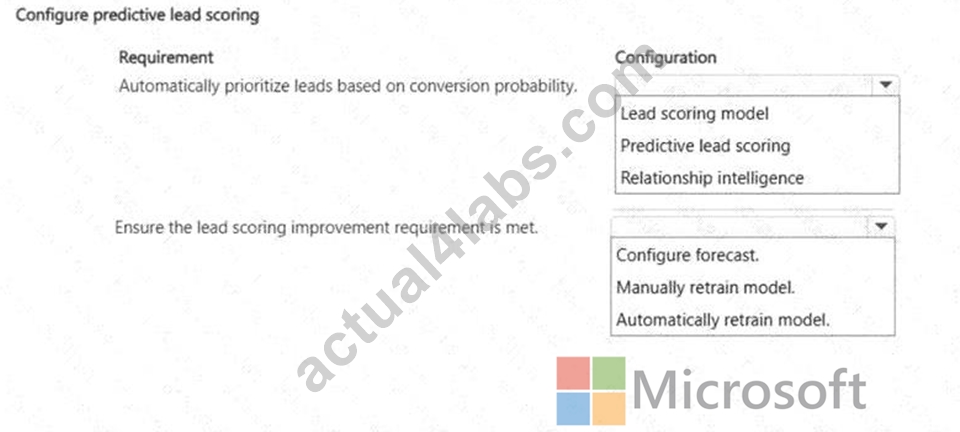
Answer:
Explanation: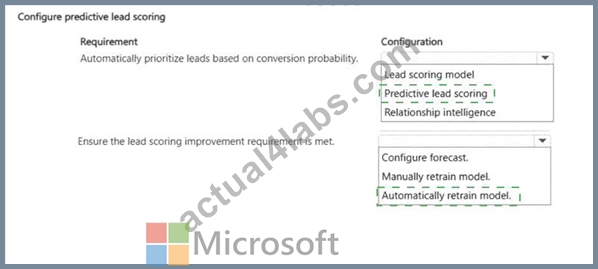
Explanation:
Requirement
Configuration
Automatically prioritize leads based on conversion probability
Predictive lead scoring
Ensure the lead scoring improvement requirement is met
Automatically retrain model
The correct capability for automatically prioritizing leads based on conversion probability is Predictive lead scoring . Dynamics 365 Sales predictive lead scoring assigns scores to leads so sellers can prioritize the leads most likely to qualify or convert. Microsoft's Sales documentation states that predictive lead scoring helps sales teams prioritize leads based on scores and improve lead qualification outcomes. This directly matches Contoso's requirement to guide sellers toward high-potential leads and reduce inconsistent manual prioritization across regions.
To meet the requirement that lead scoring must continuously improve based on historical sales outcomes, configure the model to automatically retrain . Microsoft's predictive lead scoring guidance explains that retraining uses the latest leads in the organization to improve model accuracy, and automatic retraining allows the application to retrain the model every 15 days. This is the correct option because Contoso wants the scoring model to improve continuously as more closed lead outcome data becomes available.
"Lead scoring model" is too generic; the AI capability required is specifically predictive lead scoring.
"Relationship intelligence" supports relationship analytics and engagement insights, but it does not score leads by conversion probability. "Configure forecast" applies to pipeline forecasting, not lead scoring accuracy.
References/topics: Predictive lead scoring; lead prioritization; scoring model accuracy; automatic model retraining; AI-driven lead qualification.
NEW QUESTION # 64
You are customizing Dynamics 365 Sales for a company.
Sales representatives need several enhancements to the opportunity form.
The enhancements must include the following:
Provide a guided interface to capture custom data during calls.
. Display revenue analytics directly within the opportunity record with the ability to ask questions.
. Automatically send a Microsoft Teams alert when an opportunity value exceeds a specific amount.
. Allow sellers to view product sales trends by region.
You need to determine which Microsoft Power Platform component should be implemented.
Which solution should you use for each requirement? To answer, move the appropriate solutions to the correct requirements. You may use each solution once, more than once, or not at all. You may need to move the split bar between panes or scroll to view content.
NOTE: Each correct selection is worth one point.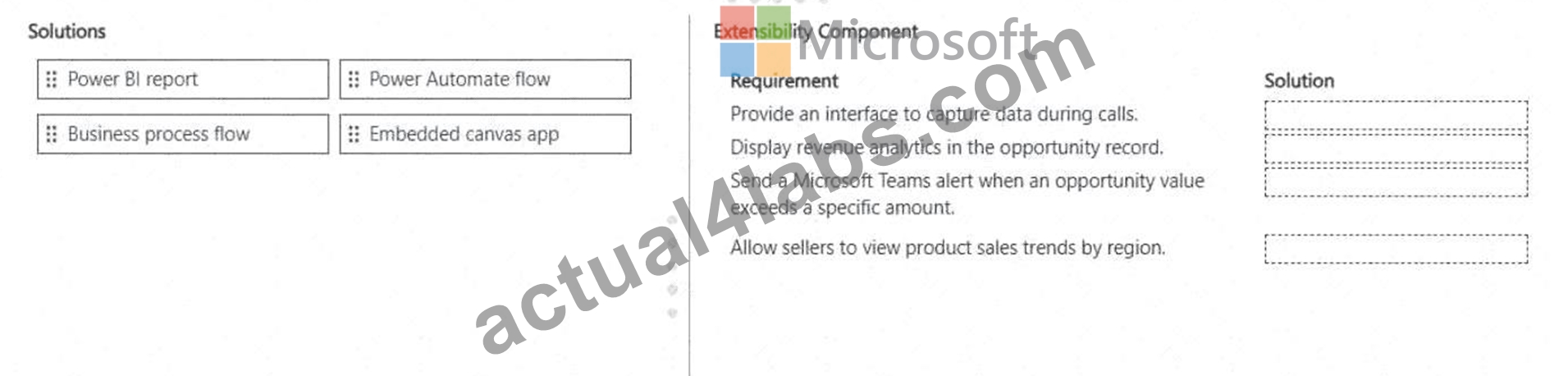
Answer:
Explanation: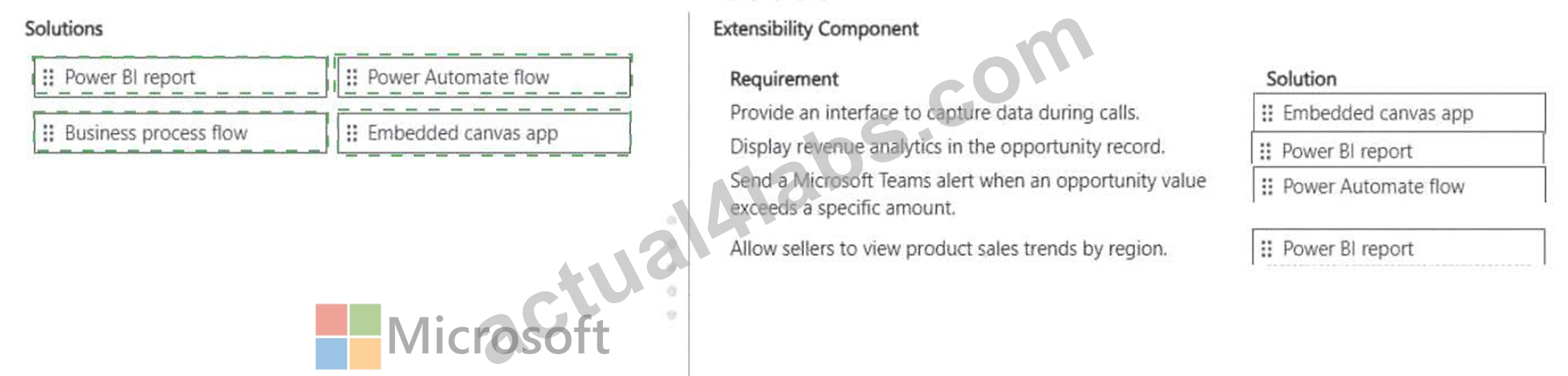
Explanation:
Requirement
Solution
Provide an interface to capture data during calls
Embedded canvas app
Display revenue analytics in the opportunity record
Power BI report
Send a Microsoft Teams alert when an opportunity value exceeds a specific amount Power Automate flow Allow sellers to view product sales trends by region Power BI report An embedded canvas app is the correct component for capturing custom data during calls because canvas apps are used to design tailored interfaces and can be embedded inside model-driven app forms. This gives sellers a purpose-built call capture experience directly on the Opportunity form instead of forcing them to use only standard fields or a rigid stage process. A Business process flow guides users through stages, but it is not the best fit for a custom call-data capture interface. Microsoft describes business process flows as guided process bars that lead users through defined stages and steps, not as custom UI components for call forms.
A Power BI report is required for both revenue analytics inside the opportunity record and product sales trends by region. Microsoft states that Power BI reports can be embedded in model-driven app main forms to bring rich reporting and analytics directly into record context, and Power BI Q & A allows users to ask natural language questions over report data.
A Power Automate flow is the correct solution for sending a Teams alert when opportunity value exceeds a threshold. A Dataverse-triggered cloud flow can run when an opportunity is created or updated, evaluate the value condition, and use the Microsoft Teams connector to post a message or card.
References/topics: Embedded canvas apps; Power BI embedded analytics; Power BI Q & A; Power Automate Dataverse triggers; Microsoft Teams connector; Dynamics 365 Sales extensibility.
NEW QUESTION # 65
A company generates leads from a webform. Salespeople manage leads by country/region. All salespeople are part of the same Dynamics 365 Sales team.
The sales manager requires the following functionality:
. Automate lead assignments.
. Ensure each seller can never have more than 20 open leads.
You create a country/region attribute for the process. You must simplify the process. You plan to use segments when possible.
You need to create a lead assignment rule for each country/region.
Which configurations should you use? To answer, select the appropriate options in the answer area.
NOTE: Each correct selection is worth one point.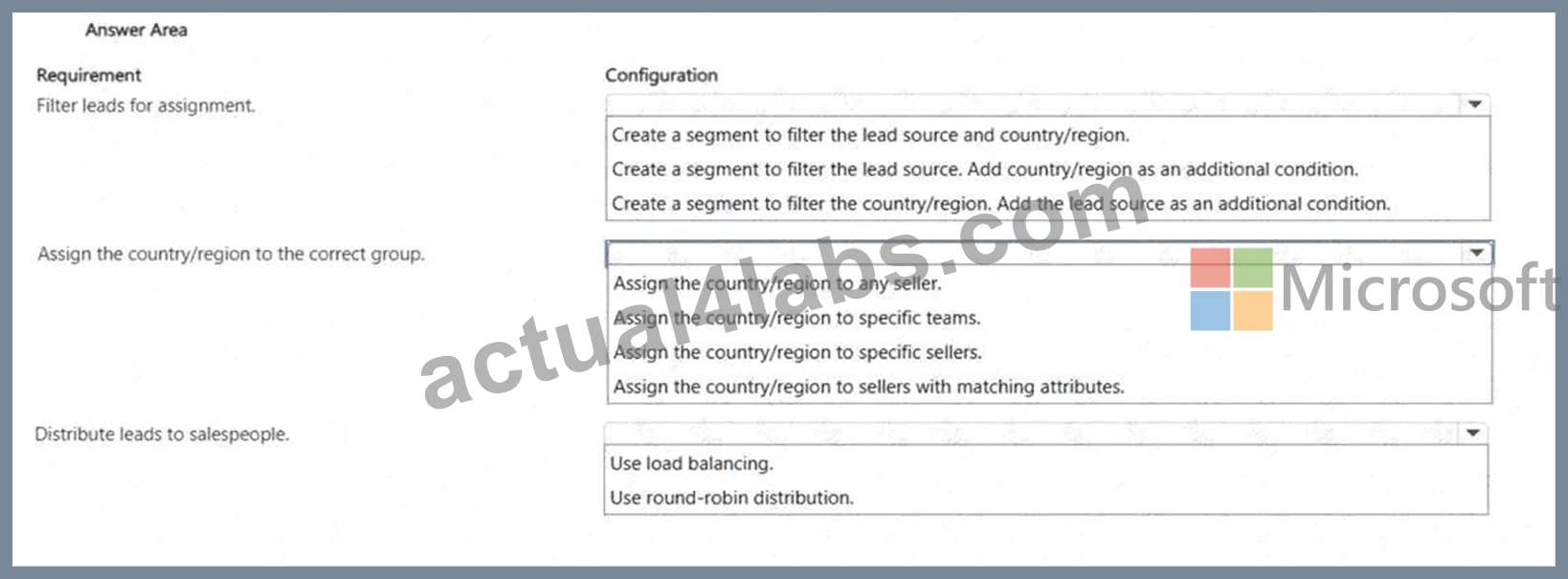
Answer:
Explanation: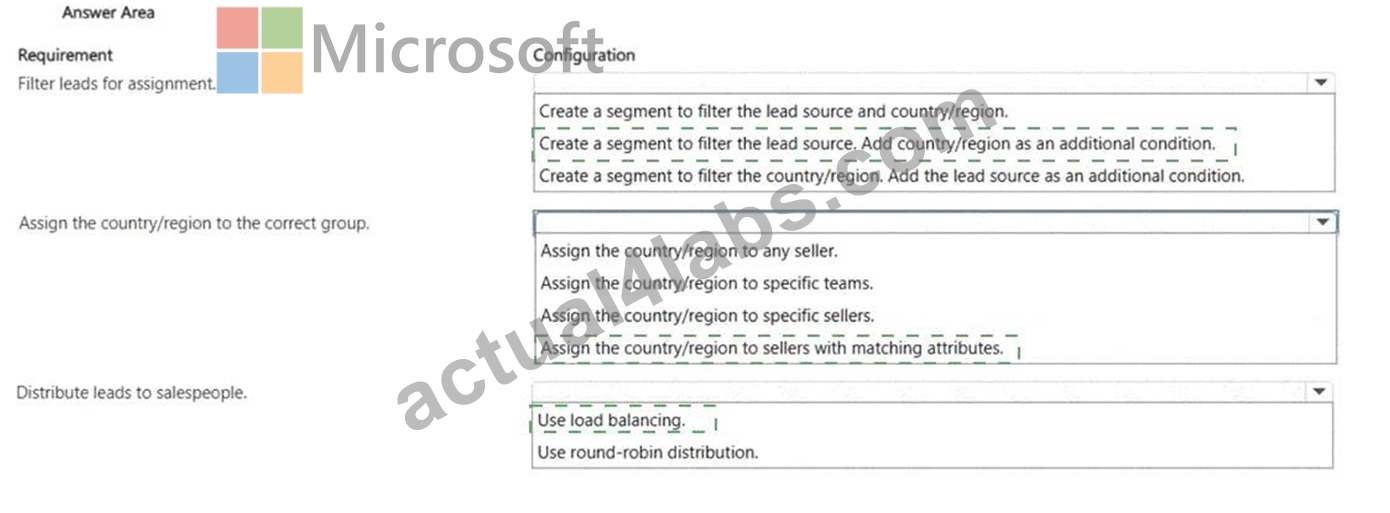
Explanation:
Requirement
Configuration
Filter leads for assignment
Create a segment to filter the lead source. Add country/region as an additional condition.
Assign the country/region to the correct group
Assign the country/region to sellers with matching attributes.
Distribute leads to salespeople
Use load balancing.
The clean configuration is to create one reusable segment for webform leads, then add the varying country
/region condition inside each country-specific assignment rule. Dynamics 365 Sales assignment rules are built by selecting the eligible segment first, then adding rule conditions to further filter records. Microsoft also recommends splitting conditions between segments and assignment rules to keep rules simpler and more efficient.
For routing to the correct sellers, use sellers with matching attributes . The scenario says salespeople manage leads by country/region and that a country/region attribute has been created. Assignment rules support assigning records to sellers who satisfy matching seller attributes or existing seller record fields, which avoids hardcoding individual sellers and is much easier to maintain as sellers change regions.
For distribution, use load balancing because the requirement is capacity-based: no seller should exceed 20 open leads. Dynamics 365 Sales load balancing distributes records based on seller workload/capacity, and seller capacity is calculated by subtracting active assigned records from the maximum configured capacity.
Round robin is weaker here because it primarily considers assignment order, not workload.
References/topics: Sales accelerator work assignment; segments; lead assignment rules; seller attributes; seller capacity; load balancing.
NEW QUESTION # 66
Sellers at a company require access to Dynamics 365 Sales from mobile devices.
Some sellers cannot access records after installing the sales mobile app.
You need to ensure that the sellers can use the mobile application.
Which two components should you configure? Each correct answer presents part of the solution. Choose two.
NOTE: Each correct selection is worth one point.
- A. Configure mobile security roles.
- B. Configure the mobile offline profile.
- C. Configure inbound and outbound profiles.
- D. Assign appropriate user licenses.
Answer: A,D
Explanation:
The correct components are mobile security roles and appropriate user licenses . Installing the mobile app alone does not grant access to Dynamics 365 Sales records. Microsoft's mobile setup guidance states that Dataverse security privileges control access to Dynamics 365 mobile apps, and the required mobile privilege is preconfigured for Sales roles but may need to be added to custom roles. It also states that the app must be shared with the security role assigned to the user, and users without the privilege can see an empty app list or an access error.
The license requirement is equally important. The Dynamics 365 Sales mobile experience exposes Sales Hub or Sales Professional according to the user's license, so sellers must have the correct Dynamics 365 Sales license assigned before they can access the appropriate Sales app and records. Mobile offline profiles are used for offline synchronization scenarios; they are not the base requirement for record access after app installation. Inbound and outbound profiles are unrelated to Sales mobile access and are not used to authorize sellers in the mobile application.
References/topics: Dynamics 365 Sales mobile app; Dataverse security roles; mobile access privilege; Sales Hub mobile access; Dynamics 365 Sales licensing.
NEW QUESTION # 67
You need to automate the quote approval process.
Which four actions should you perform in sequence? To answer, move the appropriate actions from the list of actions to the answer area and arrange them in the correct order.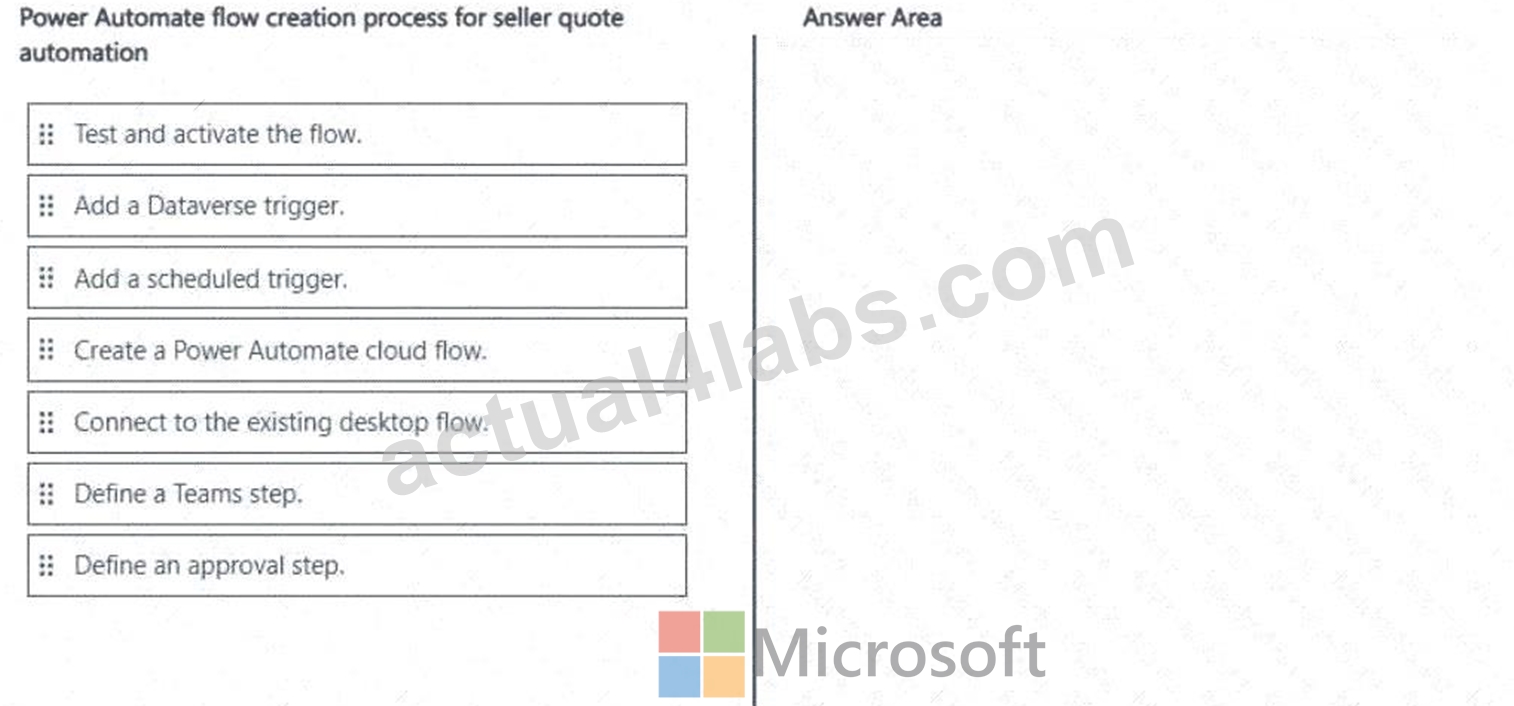
Answer:
Explanation: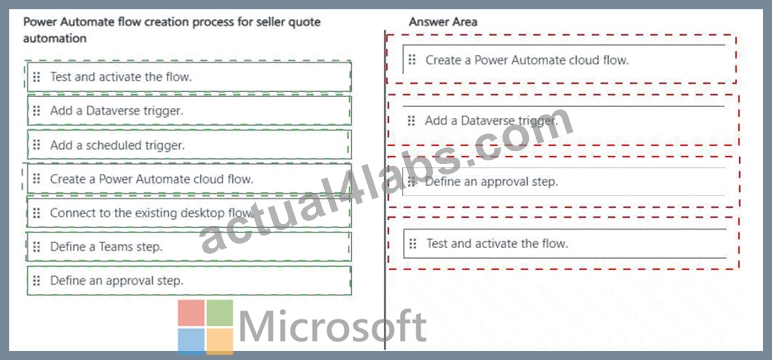
Explanation:
* Create a Power Automate cloud flow.
* Add a Dataverse trigger.
* Define an approval step.
* Test and activate the flow.
The correct automation pattern is an automated Power Automate cloud flow triggered by a Dataverse event.
The case study states that the process must notify the seller's manager when a draft quote is created and requires approval, and that approvals must use the Power Automate Approvals connector. Therefore, the flow should first be created as a cloud flow, then started by a Dataverse trigger such as when a row is added, modified, or deleted on the Quote table, filtered for the draft quote condition. Microsoft's Dataverse trigger guidance confirms that this trigger runs when a selected Dataverse table row is created, modified, or deleted.
After the trigger is defined, the flow must include an approval step using Power Automate approvals.
Microsoft's approval workflow guidance states that Power Automate can manage approvals across services including Dynamics 365 and Dataverse-based processes. The final action is to test and activate the flow so the quote approval automation is available to users. Do not use a scheduled trigger because the requirement is event-driven, not time-based. Do not connect to the existing desktop flow because that desktop flow processes partner orders for fulfillment, not draft quote approvals. A Teams step is optional collaboration, not the required approval mechanism.
References/topics: Power Automate cloud flows; Dataverse triggers; Approvals connector; Dynamics 365 Sales quote approval automation; sales platform extension.
NEW QUESTION # 68
A sales manager wants to set up goals for all salespeople. The goal measurement is based on the total outgoing calls finished each year. The goals for the fiscal year are based on a calendar year, January- December.
You need to create the rollup query for the goal metrics.
Which option should you select? To answer, select the appropriate options in the answer area.
NOTE: Each correct selection is worth one point.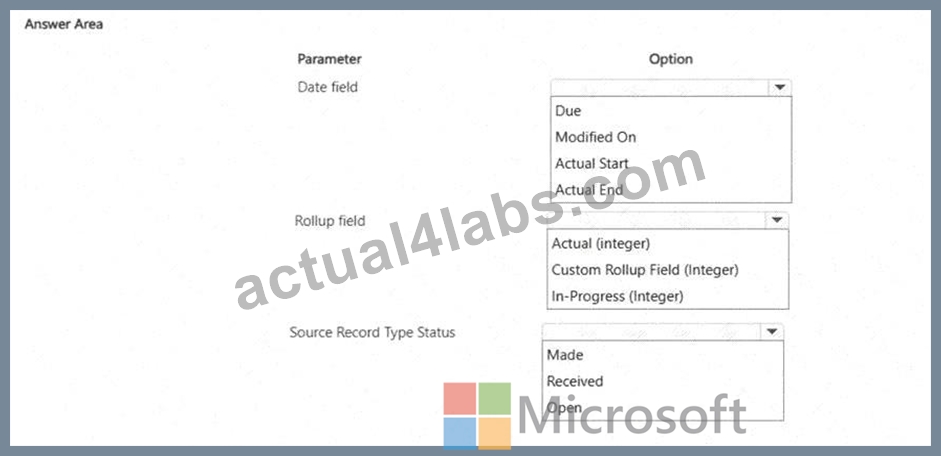
Answer:
Explanation: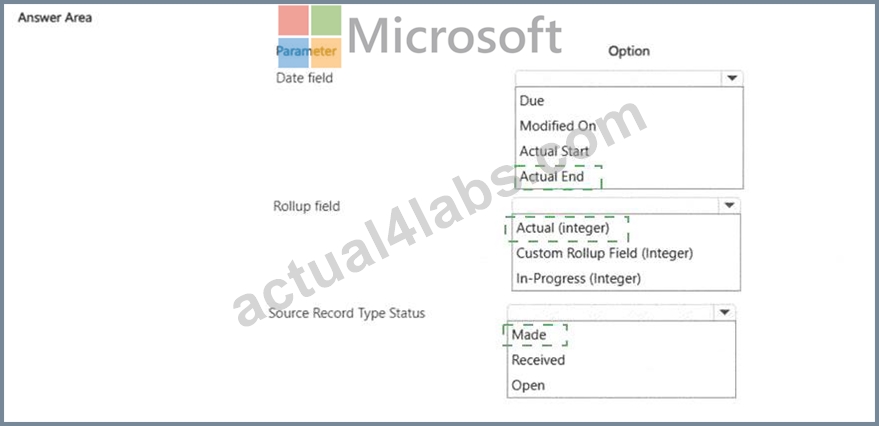
Explanation:
The correct date field is Actual End because the goal is based on calls that are finished during the calendar year. For the Phone Call table, Microsoft defines Actual End as the actual end date and time of the phone call, which is the proper date to evaluate whether the completed call falls within the January-December goal period.
The correct rollup field is Actual (Integer) because the goal measures the number of outgoing calls, not revenue or another money-based amount. Microsoft's goal metric guidance explains that goal metrics can use count/integer values, and specifically gives sales calls made by a salesperson as an example of an integer goal metric. The actual integer field represents the achieved count as of the latest rollup calculation.
The correct source record type status is Made because the requirement is for outgoing calls that were completed. Microsoft's Phone Call status reason options include Open , Made , Canceled , and Received ;
"Made" represents completed outgoing phone calls, while "Received" represents completed incoming calls.
Therefore, the rollup must count Phone Call records with status Made , using Actual End as the date boundary and Actual (Integer) as the accumulated value.
References/topics: Dynamics 365 Sales goals; goal metrics; rollup fields; phone call activity status; Actual End date; completed outgoing call tracking.
NEW QUESTION # 69
A company wants sellers to add products to opportunities and ensure the deal value is automatically calculated.
Sales managers report that when adding products from the product catalog to Opportunities, the Price Per Unit remains at zero. This results in incorrect total calculations.
You need to ensure the estimated revenue on opportunities is correct.
Which action should you perform?
- A. Create a discount list and attach it to the price list item.
- B. Select a valid price list on the opportunity and verify that the product has a matching price list item for the selected unit.
- C. Ensure the opportunity currency matches the currency used by the price list items for the products being added.
- D. Set the Opportunity Revenue to User Provided.
Answer: B
Explanation:
The correct action is to select a valid price list on the opportunity and verify that the product has a matching price list item for the selected unit. Dynamics 365 Sales calculates Price Per Unit from the price list item when an existing catalog product is added to an opportunity, quote, order, or invoice. Microsoft states that if an existing product is associated with a price list, the price per unit is calculated from the related price list item; otherwise, it is set to 0 .
The failure pattern described in the question is classic missing or mismatched price-list setup. Price calculation will not occur when no price list is selected, when the selected price list does not contain the product, or when the required price list item is missing. Microsoft also notes that price lists tie the product, unit, and pricing details together. Option A is incomplete because matching currency alone does not create the product/unit price list item. Option B is wrong because User Provided revenue bypasses system calculation.
Option D handles discounts only; it does not fix a zero base unit price.
References/topics: Opportunity products; price lists; price list items; Price Per Unit calculation; system- calculated opportunity revenue.
NEW QUESTION # 70
An organization wants Copilot to reduce time spent searching customer information before sales calls. Which capability best addresses this requirement?
- A. Product inventory synchronization
- B. Duplicate contact merging
- C. Context-aware record summarization
- D. Territory reassignment
Answer: C
Explanation:
Context-aware summarization allows Copilot to consolidate relevant CRM information, communications, activities, and opportunity details into a concise overview. Sellers spend less time navigating records and more time preparing for meaningful customer conversations.
NEW QUESTION # 71
Drag and Drop Question
You are customizing Dynamics 365 Sales for a company.
Sales representatives need several enhancements to the opportunity form.
The enhancements must include the following:
- Provide a guided interface to capture custom data during calls.
- Display revenue analytics directly within the opportunity record with the ability to ask questions.
- Automatically send a Microsoft Teams alert when an opportunity value
exceeds a specific amount.
- Allow sellers to view product sales trends by region.
You need to determine which Microsoft Power Platform component should be implemented.
Which solution should you use for each requirement? To answer, move the appropriate solutions to the correct requirements. You may use each solution once, more than once, or not at all. You may need to move the split bar between panes or scroll to view content.
NOTE: Each correct selection is worth one point.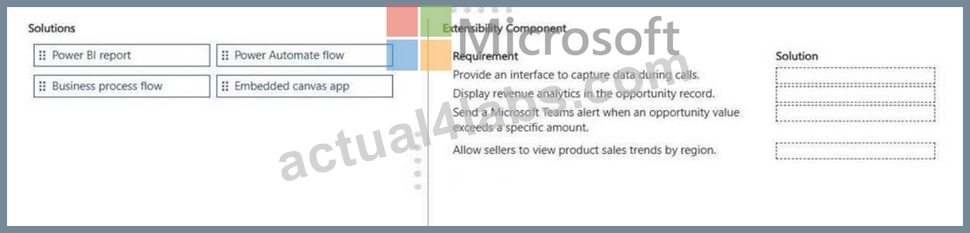
Answer:
Explanation: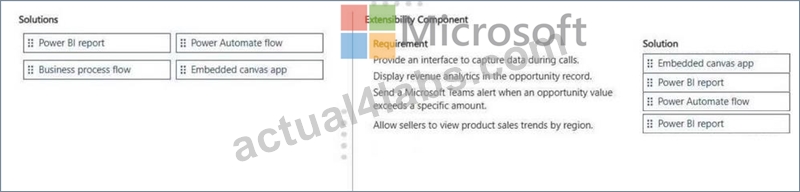
Explanation:
An embedded canvas app is the correct component for capturing custom data during calls because canvas apps are used to design tailored interfaces and can be embedded inside model- driven app forms. This gives sellers a purpose-built call capture experience directly on the Opportunity form instead of forcing them to use only standard fields or a rigid stage process. A Business process flow guides users through stages, but it is not the best fit for a custom call-data capture interface. Microsoft describes business process flows as guided process bars that lead users through defined stages and steps, not as custom UI components for call forms.
A Power BI report is required for both revenue analytics inside the opportunity record and product sales trends by region. Microsoft states that Power BI reports can be embedded in model-driven app main forms to bring rich reporting and analytics directly into record context, and Power BI Q&A allows users to ask natural language questions over report data.
A Power Automate flow is the correct solution for sending a Teams alert when opportunity value exceeds a threshold. A Dataverse-triggered cloud flow can run when an opportunity is created or updated, evaluate the value condition, and use the Microsoft Teams connector to post a message or card.
NEW QUESTION # 72
Note: This question is part of a series of questions that present the same scenario. Each question in the series contains a unique solution that might meet the stated goals. Some question sets might have more than one correct solution, while others might not have a correct solution.
After you answer a question in this section, you will NOT be able to return to it. As a result, these questions will not appear on the review screen.
A company is evaluating AI agent capabilities for opportunity management.
Sales managers require insights about deals. You must ensure that the system does not perform automatic outreach to buyers.
You need to determine whether proposed solutions meet the requirements.
Solution: Use Research mode and allow sellers to review insights manually.
Does the solution meet the goal?
- A. Yes
- B. No
Answer: A
Explanation:
Yes, the solution meets the goal. The requirement has two parts: sales managers need deal insights, and the system must not automatically perform outreach to buyers. Sales Close Agent in Research mode is the correct fit because it researches opportunities, calculates importance and risk, generates summaries, and provides actionable recommendations for sellers to review manually. Microsoft states that the opportunity research experience shows a summary and a See full research page with complete opportunity insights and recommendations.
Research mode is intentionally different from Engage mode. Engage mode is the autonomous customer-interaction mode; Microsoft describes Sales Close Agent Engage as managing customer interactions and driving sales for high-velocity deals. By contrast, Research mode focuses on research, opportunity insights, risks, and seller guidance. Microsoft's configuration guidance for Sales Close Agent Research describes selecting opportunities to research, configuring refresh frequency, and providing company context so the agent can curate research insights. Therefore, using Research mode while requiring sellers to manually review the insights satisfies both requirements: the organization receives AI-generated deal intelligence, but buyer outreach remains under human seller control.
NEW QUESTION # 73
A company uses Dynamics 365 Sales to manage opportunities using a custom form.
Sellers spend significant time manually reviewing information about opportunities before contacting customers.
You need to reduce the time required for reviewing opportunities.
What should you add to the form?
- A. Predictive opportunity scoring
- B. Timeline highlights
- C. Opportunity summary
- D. Health score
- E. Up next
Answer: C
Explanation:
The correct answer is Opportunity summary . The requirement is not to score the opportunity, show the next activity, or display health indicators; it is to reduce the seller's manual review effort before contacting the customer. Microsoft's Copilot capability for Dynamics 365 Sales provides AI-generated summaries for opportunity records so sellers can quickly understand key deal context, related activities, emails, and important history without reading the full timeline manually. Microsoft specifically states that Copilot record summarization generates concise summaries of key information from sales records such as opportunities, leads, and accounts.
Because the company uses a custom opportunity form , the opportunity summary widget must be added to that form. Microsoft's implementation guidance explicitly flags custom opportunity forms and asks whether the opportunity summary widget has been added, and the Copilot summary documentation notes that the opportunity summary widget is available by default on the standard form but must be added to custom forms.
Up next guides sellers to the next activity, Health score and Predictive opportunity scoring evaluate opportunity risk or likelihood, and Timeline highlights is narrower than the full AI-generated opportunity overview.
References/topics: Copilot opportunity summary; custom opportunity forms; AI-generated sales record summaries; seller productivity in Dynamics 365 Sales.
NEW QUESTION # 74
A company is using AI agents in Dynamics 365 Sales.
The company requires that the agent must do the following:
- Research incoming leads and generate initial outreach email.
- Autonomously contact leads, follow up, and evaluate qualification
during the process.
You need to identify which AI agent in Sales supports these requirements.
Which agent type should you use?
- A. Sales Close Agent: Research
- B. Sales Qualification Agent: Research-only
- C. Sales Qualification Agent: Research and engage
- D. Sales Close Agent: Engage
Answer: C
Explanation:
The correct agent type is Sales Qualification Agent: Research and engage. The requirement is specifically about inbound lead processing: researching incoming leads, generating outreach, autonomously contacting leads, following up, and evaluating qualification during the engagement process. Microsoft defines Sales Qualification Agent as the AI agent used to automate lead qualification in Dynamics 365 Sales, especially for high-volume inbound leads from sources such as websites, events, and webinars. In Research and engage mode, the agent researches the lead, evaluates fit using target customer profile and BANT criteria, sends personalized outreach emails, engages based on responses, sends follow-up emails, detects positive intent, and then hands promising leads to sellers.
Research-only mode is not enough because it generates a draft outreach email for seller review but does not send outreach emails or detect positive intent from responses. Microsoft's mode comparison explicitly shows that BANT checking, sending outreach, detecting positive intent, and follow-up emails are available in Research and engage mode, not Research-only mode. Sales Close Agent options are wrong because they apply to opportunity/deal execution, not initial lead qualification.
NEW QUESTION # 75
......
AB-210 Dumps PDF and Test Engine Exam Questions: https://www.actual4labs.com/Microsoft/AB-210-actual-exam-dumps.html