

[Mar-2026] BCS TM3 Dumps - Secret To Pass in First Attempt
BCS TM3 Exam Dumps [2026] Practice Valid Exam Dumps Question
BCS TM3 Exam Syllabus Topics:
| Topic | Details |
|---|---|
| Topic 1 |
|
| Topic 2 |
|
| Topic 3 |
|
NEW QUESTION # 11
You have been contracted to manage the user acceptance testing of a new reservation system for a travel agency. The reservation system is being developed by a third party. Detailed specifications are available, and an estimate of the total development effort exists. The system will be delivered in four agreed increments.
Which of the following estimation techniques would be most appropriate to use in this context?
- A. Estimation based on ratios
- B. Wide-band Delphi
- C. Planning poker
- D. Extrapolation
Answer: A
Explanation:
Comprehensive and Detailed Explanation From Exact Extract of ISTQB Certified Tester Advanced Level - Test Manager v3.0 syllabus:
The syllabus describesratio-based estimation(e.g., estimating test effort as a proportion of known or estimated development effort) as appropriate when reliable development-effort data or estimates and clear scope are available. Here, detailed specifications exist, overall development effort is estimated, and increments are defined-conditions well-suited to ratio-based estimation.
Extrapolationrequires comparable historical test data for this context.
Wide-band Delphiis useful when data is scarce and expert consensus is needed.
Planning pokeris typically used by Agile development teams to size user stories, not for contracting UAT with a third party.
NEW QUESTION # 12
Which of the following is not a key decision when defining a project test strategy?
- A. Selection of test types
- B. Selection of test tools
- C. Selection of test levels
- D. Selection of test techniques
Answer: B
Explanation:
Comprehensive and Detailed Explanation From Exact Extract of ISTQB Certified Tester Advanced Level - Test Manager v3.0 syllabus:
In the AL Test Manager syllabus, defining the project test strategy/approach focuses onwhatto test andhowto test at a high level, which explicitly includes decisions such asthe selection of test levels,the selection of test types, andthe selection of test design techniquesas part of the approach definition and planning. Tool decisions are addressed undertest tools and automation planningand are not listed among the core strategy- defining decisions.
References: ISTQB CTAL-TM v3.0 Syllabus-Chapter 2 (Test Management in the Organization: policy
/strategy alignment and strategy content), Chapter 3 (Test Planning: test approach content including levels, types, techniques), and Chapter 6 (Test Tool and Automation: tool strategy and selection).
NEW QUESTION # 13
During which test planning task are the test design techniques to be applied during the project, identified and selected?
- A. Identify risk treatment approaches
- B. Define test approach, and estimate and allocate resources
- C. Establish test plan
- D. Understand the context and organise test planning
Answer: B
Explanation:
Comprehensive and Detailed Explanation From Exact Extract of ISTQB Certified Tester Advanced Level - Test Manager v3.0 syllabus:
In theTest Planningactivities of the CTAL-TM v3.0 syllabus (Chapter 3), the selection oftest design techniquesis part of defining thetest approach. The syllabus describes that when thetest manager defines the test approach, they determinehowtesting will be performed, including thetest design techniquesto be used, and align resources and estimates accordingly.
The earlier tasks in planning set the stage (understanding context and organization) and address risk treatment choices, while theestablish test plantask documents and baselines the already chosen approach and decisions.
Why the other options are incorrect:
A). Understand the context and organise test planning- This task focuses on analyzing the test context, stakeholders, constraints, and organizational aspects to prepare for planning; it does not yet select specifictest design techniques.
B). Identify risk treatment approaches- This task deals with how risks will be addressed (e.g., through mitigation, contingency, or targeted testing focus); it informs priorities but does not itself selecttest design techniques.
D). Establish test plan- This task records and baselines the plan (including approach and techniques already chosen). The selection of techniques has already occurred when defining the approach.
References (ISTQB Certified Tester Advanced Level - Test Manager v3.0 syllabus):
Chapter 3:Test Planning, Monitoring, and Control- subsection describingtest planning tasksand the activity todefine the test approach(which includes selectingtest design techniques), followed by estimation/resource allocation and subsequent establishment of thetest plan.
NEW QUESTION # 14
Test control uses the information from test monitoring to provide guidance and take corrective action when required.
Which of the following is not a possible test control action?
- A. Adding new resources
- B. Re-prioritisation of test cases
- C. Adjusting the test schedule
- D. Checking the fulfilment of the exit criteria
Answer: D
Explanation:
Comprehensive and Detailed Explanation From Exact Extract of ISTQB Certified Tester Advanced Level - Test Manager v3.0 syllabus:
The syllabus distinguishestest monitoring(collecting/assessing status information, e.g., progress vs plan, exit criteria status) fromtest control(takingcorrective actionsbased on monitoring).Control actionsincludere- prioritising tests,adjusting schedules, andadding resourcesto address variances and risks.Checking the fulfilment of exit criteriaismonitoringactivity (status assessment), not a control action.
(Reference: CTAL-TM v3.0 -Test Planning, Monitoring, and Control: differences between monitoring (status, metrics, exit criteria checks) and control (reprioritisation, rescheduling, resource adjustments, scope changes).)
NEW QUESTION # 15
The following defect management process is in use at a company... What is the most important recommendation you would make for the defect report template in this process?
- A. Automate the incident numbering
- B. Add a lifecycle phase field to document when the defect is found
- C. Add a classification field for the type of incident
- D. Add a priority field to show how quickly it needs fixing
Answer: D
Explanation:
Comprehensive and Detailed Explanation From Exact Extract of ISTQB Certified Tester Advanced Level - Test Manager v3.0 syllabus:
For effectivedefect management and control, the report needs information that supportsprioritization and scheduling of fixes. The syllabus emphasizes fields such aspriority/severity, status, environment, and reproducibility to supportplanning, monitoring, and controldecisions. In the described process, addingpriorityis most critical to drivetimely assignment and fixing order(Chapter 5: Test Monitoring, Control, and Reporting - defect reporting to support control; Chapter 3: Test Planning - using priorities to allocate effort).
NEW QUESTION # 16
The diagram below shows an incomplete defect management process, where three states (states X, Y and Z) have yet to be named appropriately.
Which of the following labels would correctly complete the process?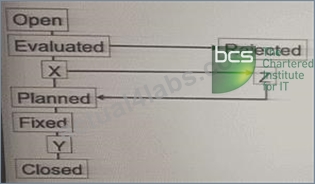
- A. X: Accepted, Y: Tested, Z: Deferred.
- B. X: In Progress, Y: Verified, Z: Terminated.
- C. X: Approved, Y: Reviewed, Z: Deferred.
- D. X: Accepted, Y: Reviewed, Z: Duplicate.
Answer: A
Explanation:
According to theISTQB Certified Tester Advanced Level - Test Manager v3.0 syllabus (Chapter 2: Test Management in the Organization), thedefect management processdefines how defects are handled from discovery to closure, ensuring traceability and communication between testing and development.
"The defect management process defines the states a defect may have during its lifetime, including identification, evaluation, correction, re-testing (confirmation testing), and closure." (ISTQB CTAL-TM v3.0 Syllabus, Chapter 2 - Defect Management Process) In the standard ISTQB defect workflow:
Afterevaluation, a defect can either be:
Rejected(e.g., not a defect, duplicate, or out of scope), or
Accepted(X) - meaning it is confirmed as a valid defect and will be corrected.
Once accepted, the defect isplannedfor correction andfixedby development.
After being fixed, it must betested (Y)- also referred to asconfirmation testingorretesting.
Some evaluated defects may bedeferred (Z)- postponed for future releases.
Thus, the correct states are:
X = Accepted(defect confirmed as valid and correction planned)
Y = Tested(confirmation testing after the fix)
Z = Deferred(postponed correction)
This sequence aligns directly with the ISTQB-defineddefect management lifecycle, which includes transitions betweenopen,evaluated,accepted (planned/fixed/tested), andclosed, as well as possiblerejectedordeferredbranches.
References (from ISTQB Certified Tester Advanced Level - Test Manager v3.0 Syllabus):
Chapter 2: Test Management in the Organization
Section:Defect Management Process
Describes thedefect states, includingopen, evaluated, accepted, planned, fixed, tested (retested), closed, and alternate states such asrejectedordeferred.
NEW QUESTION # 17
You are a test manager in charge of integration, system, and user acceptance testing for a bank. You are working on a project to upgrade an existing ATM to allow customers to obtain cash advances from supported credit cards.
The system should allow cash advances from €20 to €500 (both inclusive) for all supported credit cards. The supported credit cards are American Express, VISA, Eurocard, and Mastercard. The system should be easy to use for all users, including new users. The organisation is currently in a transition to Agile and already well on its way.
In the test plan, the following items are listed under the heading"Items and features to be tested":
All supported credit cards
Language localisation
Valid and invalid advance
Usability
Response time
Which of the following topics would be most important for you to address in detail in the test plan?
- A. An approach to regression testing
- B. Detailed entry and exit criteria per test level
- C. A set of logical test cases
- D. A list of acceptance criteria for each of the user stories
Answer: B
Explanation:
Comprehensive and Detailed Explanation From Exact Extract of ISTQB Certified Tester Advanced Level - Test Manager v3.0 syllabus:
According to theISTQB CTAL-TM v3.0 Syllabus, Chapter 3 - Test Planning, Monitoring, and Control, one of the main tasks oftest planningis todefine and document test completion criteria and test level entry criteriaas part of the test plan.
"The test plan shall include the entry and exit criteria for each test level, including the conditions that must be met to start and finish testing activities at that level." (ISTQB CTAL-TM v3.0 Syllabus, Chapter 3: Test Planning activities) Thetest planprovides the structure for managing multiple test levels such as integration, system, and user acceptance tests. Since this question context explicitly mentions severaltest levels, the most critical aspect to document in detail isthe entry and exit criteria per test level, ensuring clarity on when each test level starts and completes, and what constitutes sufficient testing for release or transition.
Why the other options are incorrect:
A). An approach to regression testing- While important, regression strategy typically belongs to thetest approachsection, not the detailed planning of multi-level testing criteria.
B). A list of acceptance criteria for each of the user stories- This belongs toAgile acceptance testdocumentation, not the formaltest planfor multiple test levels (integration, system, UAT).
D). A set of logical test cases- Test cases are outputs oftest design, not part of thetest plandocument.
References:
ISTQB Certified Tester Advanced Level - Test Manager Syllabus v3.0
Chapter 3: Test Planning, Monitoring, and Control
Section:Test Planning Tasks
Subsection:Define test completion criteria (exit criteria) and entry criteria for each test level Table of contents and body text referring to"items and features to be tested","entry and exit criteria", and
"content of the test plan".
NEW QUESTION # 18
Analytical test improvement approaches identify problems based on data from the project or team.
Appropriate improvements can be derived from an analysis of the identified set of problems.
Which of the following is not an example of an analytical-based test process improvement approach?
- A. Quantitative TPI NEXT assessment
- B. Analysis using measures, metrics and indicators
- C. Root cause analysis
- D. The Goal Question Metric (GQM) approach
Answer: A
NEW QUESTION # 19
In an Agile context, defects are often fixed without writing a formal defect report. However, there are some conditions where it is good practice to write a defect report, even in an Agile context.
When is a defect report typically not written in an Agile context?
- A. A defect that is blocking other iteration activities and cannot be immediately solved
- B. A defect that cannot be solved in the same iteration
- C. A defect that is found for a high-priority user story
- D. A defect that must be resolved by or in co-operation with other teams
Answer: C
Explanation:
Comprehensive and Detailed Explanation From Exact Extract of ISTQB Certified Tester Advanced Level - Test Manager v3.0 syllabus:
Same rationale as Q35. In Agile,no formal defect reportis typically created when the team canfix the issue immediatelyand maintain flow (e.g., defect on a high-priority user story that is quickly addressed). Formal reports are encouraged whenblocking,spanning iterations, orrequiring cross-teamwork for visibility
/traceability. Refer to CTAL-TM v3.0, Chapter 5 on defect management and Agile reporting considerations.
NEW QUESTION # 20
In multi-team environments with hybrid software development approaches, there are various challenges in the context of defect management, such as:
i. Alignment of defect attributes to be used
ii. Prioritisation of defects
iii. Alignment of the approach for defect fixes
Solutions to the above-mentioned challenges include:
- A. Transparency of plans by sharing them between teams via dashboardsWhich solution is related to which challenge?
- B. A = i, B = ii, C = iii
- C. The product owner should be involved in the defect management meetings
- D. A = i, B = ii, C = i
- E. Synchronisation between the defect management tools
- F. A = ii, B = i, C = iii
- G. A = i, B = iii, C = ii
Answer: A
Explanation:
Comprehensive and Detailed Explanation From Exact Extract of ISTQB Certified Tester Advanced Level - Test Manager v3.0 syllabus:
ii. Prioritisation of defects # A. Product owner involvement: The PO (or equivalent business authority) ensuresbusiness-value/risk-based prioritizationis consistent across teams.
i. Alignment of defect attributes # B. Tool synchronization: Toalign fields/attributes/statuses, teams synchronize or harmonize defect management tools and schemas.
iii. Alignment of approach for fixes # C. Transparent shared dashboards:Shared plans/dashboardssupport coordination onhow/whenfixes are implemented across teams, improving consistency and visibility.This mapping reflects the syllabus coverage oforganization-level test management, multi-team governance, tool alignment, and cross-team transparency practices in hybrid/Agile environments (CTAL-TM v3.0, Chapter 2:
Test Management in the Organization; Chapter 5: defect management coordination and reporting).
NEW QUESTION # 21
Analytical test improvement approaches identify problems based on data from the project or team.
Appropriate improvements can be derived from an analysis of the identified set of problems.
Which of the following is not an example of an analytical-based test process improvement approach?
- A. Quantitative TPI NEXT assessment
- B. Analysis using measures, metrics and indicators
- C. Root cause analysis
- D. The Goal Question Metric (GQM) approach
Answer: A
Explanation:
Comprehensive and Detailed Explanation From Exact Extract of ISTQB Certified Tester Advanced Level - Test Manager v3.0 syllabus:
The syllabus classifies improvement approaches includinganalytical approaches(e.g.,root cause analysis, GQM, andanalysis of measures/metrics/indicators) that derive improvements byanalysing project/team data.
Model-basedapproaches (e.g.,TMMi,TPI NEXT) are a distinct category that evaluate practicesagainst a reference modelrather than primarily deriving improvements from project data analysis.
Hence,B (Quantitative TPI NEXT assessment)ismodel-based, not ananalyticalapproach;A, C, and Dare analytical.
(References: CTAL-TM v3.0 Syllabus - Chapter 2 "Test Management in the Organization" - improvement approaches: analytical vs. model-based vs. other; examples provided for each category.)
NEW QUESTION # 22
Which of the following is not true regarding applying a model-based approach, e.g., TMMi, for improvements at project level?
- A. The assessment should include test engineering processes such as test design, test implementation and test execution
- B. The assessment should include test management processes such as test planning and test monitoring and control
- C. The assessment should include areas such as test policy and test organisation
- D. Practices at organisational level should be tailored appropriate to the project's context
Answer: C
Explanation:
Comprehensive and Detailed Explanation From Exact Extract of ISTQB Certified Tester Advanced Level - Test Manager v3.0 syllabus:
The syllabus distinguishesorganizational-levelprocess areas (e.g.,test policy, test organization) fromproject- levelprocess areas (e.g.,test planning, monitoring/control; test design, implementation, execution) when applyingmodel-based improvementssuch as TMMi at different scopes.
Atproject level, assessments focus onproject processes and practices;test policyandtest organizationareorganizationalconcerns, not a correct inclusion for a project-level assessment.
Therefore,C is not truefor a project-level model-based improvement focus.A and Bare correct inclusions at project scope, andDis consistent with the syllabus guidance totailor organizational practices to the project context.
(References: CTAL-TM v3.0 Syllabus - Chapter 2 "Test Management in the Organization" - improvement approaches and scopes; descriptions contrasting organizational vs. project-level process areas and the use of model-based frameworks such as TMMi.)
NEW QUESTION # 23
You are working as a test manager at a company that develops software applications for the mobile domain.
The organisation has recently been assessed against TMMi. This assessment showed that the company is a TMMi level 1 organisation. The projects use the V-model lifecycle and an independent test team exists. The test team consists of both experienced and novice testers. The team has not yet been formally trained in testing, but an ISTQB Foundation course is scheduled to take place in two months.
In your role as a test manager working in the independent test team, you have recently performed a risk assessment for a mobile software application to be developed. You want the features that have been identified as major risks to be tested more thoroughly.
Which test practice would you propose to mitigate the identified major product risks?
- A. Use test design techniques such as equivalence partitioning and decision table testing
- B. Start a test improvement project to achieve TMMi level 2
- C. Assign the most experienced testers to test the features with the highest risk levels
- D. Create pairs of developers and testers to test the features with the highest risk levels together
Answer: C
Explanation:
Comprehensive and Detailed Explanation From Exact Extract of ISTQB Certified Tester Advanced Level - Test Manager v3.0 syllabus:
The syllabus advises thatrisk mitigationincludes allocatingstronger capability and more efforttohigh-riskareas (e.g., by assigningmore experienced testersand more intensive testing to those features). In alow-maturity (TMMi level 1)context withnovice testers not yet trained, immediately deployingexperienced testersto high- risk items is the most practical and effective step to achievedeeper, more reliable testing.
Option B would be beneficial, but without formal training yet, immediate effectiveness is uncertain.
Option C is a longer-term improvement initiative, not a direct immediate mitigation for the current project risks.
Reference: ISTQB CTAL-TM v3.0 Syllabus, Chapter 4 (Risk-Based Testing) onallocating test effort and expertise according to product risk; Chapter 3 (Test Planning) onresourcing high-risk areasfirst.
NEW QUESTION # 24
Assume that you have calculated the following costs of quality:
Average cost of detection: €350
Average cost of internal failure: €250
Average cost of external failure: €4,500
The average costs of detection and internal failure are calculated using the number of defects found prior to release, while the average cost of external failure is calculated using the number of defects found after release.
What is the saving in cost of quality for each defect found in testing?
- A. €5,100
- B. €4,600
- C. €4,400
- D. €3,900
Answer: D
Explanation:
Comprehensive and Detailed Explanation From Exact Extract of ISTQB Certified Tester Advanced Level - Test Manager v3.0 syllabus:
The syllabus explains thecost of quality (CoQ)perspective for testing and distinguishes betweenpre-release costs(e.g., detection/appraisal andinternal failurecosts) andpost-release costs(external failurecosts). When a defect is foundduring testing, you incur detection and internal failure costs; if it escapes to production, you incur the (typically much higher) external failure cost. Thesaving per defect found in testingis calculated as:
External failure # (Detection + Internal failure)=€4,500 # (€350 + €250) = €4,500 # €600 = €3,900.
This aligns with the syllabus guidance to quantify testing's economic value by comparing avoided external failure costs with the costs of detecting and fixing defects before release (CoQ view).
NEW QUESTION # 25
A project has been running for a few months and the team does not seem to be making progress in their test approach. The team also lacks drive and enthusiasm and is sometimes seen to be performing their tasks too slowly. You have been asked to recruit an extra person into the team. In addition to introducing the new team member, you have decided to raise motivation.
Which of the actions listed below would most likely result in the opposite, a de-motivation of the team?
- A. Providing adequate rewards to the testers when they have done an outstanding job.
- B. Criticising testers only in private when they made a mistake during their test activities.
- C. Organising a meeting with senior management in which senior management addresses the importance of good testing for this project.
- D. Constantly prescribing overtime to the testers so that they will be accustomed to perform extra hours when necessary.
Answer: D
Explanation:
Comprehensive and Detailed Explanation From Exact Extract of ISTQB Certified Tester Advanced Level - Test Manager v3.0 syllabus:
The syllabus addressesmotivators and de-motivatorsin test teams. Sustainedmandatory overtimeis explicitly highlighted as ade-motivator, leading to burnout, reduced morale, and lower quality over time. In contrast, private, constructive feedback,recognition/reward, andvisible management supportare listed as practices that canimprove motivation. Hence,constantly prescribing overtime (B)is the option most likely tode-motivatethe team.
(ISTQB CTAL-TM v3.0 - Chapter "People Skills - Team Composition": motivation and de-motivation factors; effects of overwork, recognition, supportive leadership, and constructive feedback.)
NEW QUESTION # 26
Your company is considering purchasing a test tool suite from a respectable vendor. Your manager has searched the internet for comparable products, but none of them meet his specific requirements. A tool demonstration has been arranged for next week and your team has been invited to attend. The tool suite consists of a test management tool, test execution tool, and a requirements management tool. There is a possibility of adding a performance testing tool at a later stage.
You have decided to attend the demo but raise some issues beforehand regarding expectations.
Which two issues from the options provided below should at least be raised?
- A. Which project will be selected to perform the tool pilot?
- B. Do we have a set of tool requirements to validate the tool against?
- C. Is customized training available?
- D. How will the implementation be organised?
- E. What are the problems we are trying to address?
Answer: B,E
Explanation:
Comprehensive and Detailed Explanation From Exact Extract of ISTQB Certified Tester Advanced Level - Test Manager v3.0 syllabus:
The syllabus reminds test managers thattool introduction must be problem-drivenandrequirements-based.
Before (or alongside) demos, teams should clarify:
Athebusiness/testing problemsand improvement goals the tool is meant to address (e.g., traceability, automation scale, reporting).
Baclear set of tool requirements/selection criteriato objectivelyassess the toolduring a demo or evaluation.
These two are theminimum critical questionsto ground any evaluation. WhileC,D, andEare important for later stages (rollout planning, piloting, and training), ISTQB stresses thatsuccessful adoption starts with defined needs and evaluation criteria, ensuring the demo and subsequent selection are aligned to real objectives.
Relevant syllabus areas:Test Tool and Automation-Tool selection and introduction(identify problems
/opportunities, define requirements and success criteria, evaluate, then plan pilot/rollout/training).
NEW QUESTION # 27
Which of the following is a generic good practice in adopting and rolling out of a new test tool?
- A. Consider the pros and cons of the various licensing models
- B. Define guidelines for the use of the tool
- C. Identify opportunities for process improvement supported by the tool
- D. Understand how the tool can technically and organisationally be integrated into the software development lifecycle
Answer: B
Explanation:
Comprehensive and Detailed Explanation From Exact Extract of ISTQB Certified Tester Advanced Level - Test Manager v3.0 syllabus:
The syllabus onTest Tool and Automationlistsgood practices for tool adoption and rollout, including establishingusage guidelines/standardsso teams apply the tool consistently, effectively, and in alignment with the defined process and objectives. WhileBandCare also sensible activities in a broader adoption plan, thegeneric, universally applicable good practiceemphasized in ISTQB materials is todefine and communicate clear guidelines for tool use(roles, workflows, conventions, quality gates), backed by training and a measured rollout.D(licensing considerations) is a procurement detail and not a core "generic" practice highlighted for successful rollout.
Relevant syllabus areas:Test Tool and Automation-Tool selection, introduction, and successful deployment practices(guidelines, training, pilot, measured rollout, integration with process).
NEW QUESTION # 28
Which of the following statements about test management activities for an iterative development model is false?
- A. Roles are integrated; facilitator or coach typically replace the traditional test manager.
- B. With testware the focus is on acceptance criteria and definition of done. The level of documentation is minimal.
- C. The test approach is embedded within iterations, with a focus on adaptability and feedback.
- D. Reporting is done at project milestones.
Answer: D
Explanation:
Comprehensive and Detailed Explanation From Exact Extract of ISTQB Certified Tester Advanced Level - Test Manager v3.0 syllabus:
In iterative/Agile contexts (Chapter:Test Management in the Organization), the syllabus emphasizes:
A: Testware tends to be lean; focus is onacceptance criteriaand theDefinition of Done; documentation is oftenminimalbut sufficient.
B: Thetest approach is integrated within iterations, emphasizingadaptability,continuous feedback, and close collaboration.
D: Traditional, centralized "test manager" roles are oftenevolved or distributed; responsibilities may be shared across the team, with afacilitator/coach (e.g., Scrum Master/Agile coach)supporting quality practices.
Cisfalsebecause in iterative modelsreporting is continuous and occurs every iteration (e.g., sprint reviews, daily information radiators), not only at traditionalproject milestonestypical of sequential models.(Reference:
CTAL-TM v3.0 Syllabus - Chapter "Test Management in the Organization", sections on Agile/iterative test management, roles, minimal documentation, and iterative reporting.)
NEW QUESTION # 29
To which category of cost of quality does "fixing a defect found during testing" belong?
- A. Internal failure costs
- B. Defect prevention costs
- C. Appraisal costs
- D. External failure costs
Answer: A
Explanation:
Comprehensive and Detailed Explanation From Exact Extract of ISTQB Certified Tester Advanced Level - Test Manager v3.0 syllabus:
The syllabus differentiatescost of qualityinto:
Prevention(to avoid defects),
Appraisal(to evaluate products, e.g., reviews, testing),
Internal failure(defectsfound before release, including the cost to fix during testing), and External failure(defects foundafter release)."Fixing a defect found during testing" is aninternal failure cost, because the failure is detected and corrected prior to delivery (CTAL-TM v3.0, Organizational Test Management - economics of testing and cost of quality categories).
NEW QUESTION # 30
You have recently been employed as a test manager for a software company producing Human Resource (HR) systems... You have been asked to write a test strategy for the project and have chosen to implement a flexible and change-relatedreactive test strategy.
Which of the following would be an essential part of your test approach?
- A. Using decision table testing, equivalence partitioning and boundary value analysis
- B. Using defect-based attacks and exploratory testing
- C. Performing a detailed product risk analysis
- D. Implementing ISO/IEC 29119 as a testing framework
Answer: B
Explanation:
Comprehensive and Detailed Explanation From Exact Extract of ISTQB Certified Tester Advanced Level - Test Manager v3.0 syllabus:
In areactive(change-driven) test strategy-appropriate when requirements are evolving and flexibility is essential-the syllabus highlightsexploratory testinganddefect/experience-based techniques (defect-based attacks)as key elements because they adapt rapidly to change and emerging information.
A(product risk analysis) is central torisk-based/analyticalstrategies.
B(standard-compliant framework) aligns withstandard/process-compliantstrategies.
References: ISTQB CTAL-TM v3.0 Syllabus-Chapter 4 (Approaches for test prioritization and effort allocation: strategy/approach types including reactive strategies; emphasis on exploratory and defect-based approaches under change-driven contexts).
NEW QUESTION # 31
During a test process improvement initiative, defect information is gathered to perform defect cluster analysis.
Which aspect is most likely being targeted for improvement?
- A. To minimise the costs associated with defects.
- B. To improve the defect removal efficiency.
- C. To better understand risk and focus testing, as part of risk-based testing.
- D. To reduce the total number of defects.
Answer: C
Explanation:
Comprehensive and Detailed Explanation From Exact Extract of ISTQB Certified Tester Advanced Level - Test Manager v3.0 syllabus:
Defect clustering (e.g., Pareto-style concentration of defects in certain components) is used to informrisk- based testingso that testing can beprioritized and focused on the riskiest areasof the product. In the CTAL-TM v3 syllabus, the test manager uses defect data and trends toprioritize test effort, allocate test depth/techniques where risk is higher, and provide traceable justification in planning and control (Chapter 4: Risk-Based Testing and effort allocation; Chapter 3: Test Planning - using historical/defect data to shape the approach and focus).
NEW QUESTION # 32
......
TM3 Exam Dumps PDF Guaranteed Success with Accurate & Updated Questions: https://www.actual4labs.com/BCS/TM3-actual-exam-dumps.html
TM3 Dumps - Grab Out For [NEW-2026] BCS Exam: https://drive.google.com/open?id=1Z0YEQHd5qIuyx6hEwcRmtvhBfZtpkvR8