

AZ-600 Dumps Special Discount for limited time Try FOR FREE
AZ-600 Dumps for success in Actual Exam Oct-2023]
NEW QUESTION # 79
You have two Azure subscriptions named sub1 and sub2. The subscriptions are linked to an Azure AD tenant named contoso.com.
You deploy on Azure Stack Hub integrated system and register the system with sub1.
You open a new PowerShell session and connect to sub1.
You need to register the Azure Stack Hub integrated system with sub2.
Which three PowerShell cmdlets should you run in sequence? To answer, move the appropriate cmdlets from the list of cmdlets to the answer area and arrange them in the correct order.
Answer:
Explanation:
Explanation
NEW QUESTION # 80
You have an Azure Stack Hub integrated system that connects to the Internet. The integrated system uses an Azure Active Directory (Azure AD) identity provider.
You need to update the Azure App Service resource provider.
Which two actions should you perform? Each correct answer presents part of the solution.
NOTE: Each correct selection is worth one point.
- A. From the Updates blade of the administrator portal, select the Resource providers section
- B. From the Updates blade of the administrator portal, select the infrastructure section
- C. Run appservice.exe as a local administrator
- D. From the administrator portal, select the update, download the update, and then install the update
- E. Download the App Service installer to a computer that can connect to the Azure Stack Hub endpoints
Answer: C,E
Explanation:
Reference:
https://docs.microsoft.com/en-us/azure-stack/operator/azure-stack-app-service-update?view=azs-2008&pivots=state-connected
NEW QUESTION # 81
You have an Azure Stack Hub integrated system that uses an Azure Active Directory (Azure AD) identity provider.
You have a group named AppGroup1.
You need to provide an application with the ability to access Azure Stack Hub resources by using AppGroup1.
Which four actions should you perform in sequence? To answer, move the appropriate actions from the list of actions to the answer area and arrange them in the correct order.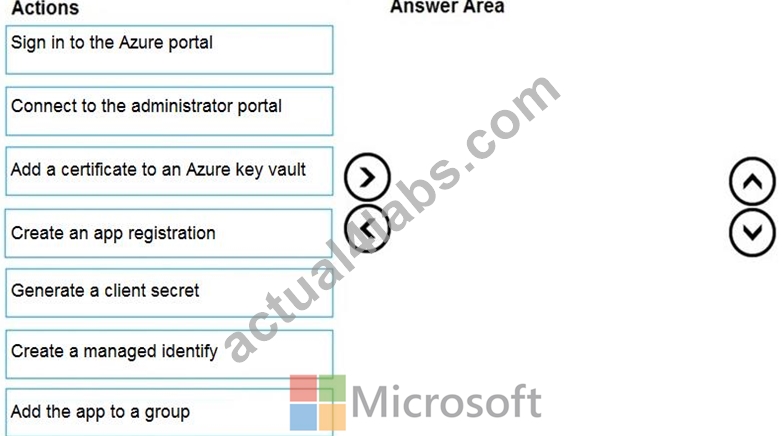
Answer:
Explanation: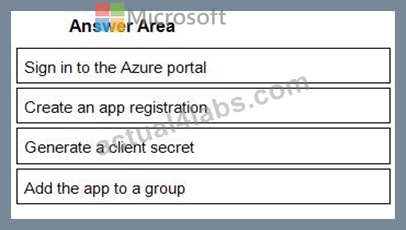
1 - Sign in to the Azure portal
2 - Create an app registration
3 - Generate a client secret
4 - Add the app to a group
Reference:
https://docs.microsoft.com/en-us/azure-stack/operator/azure-stack-create-service-principals?view=azs-2008&tabs=az1%2Caz2&pivots=state-connected
NEW QUESTION # 82
You have an Azure Stack Hub integrated system that connects to the Internet.
You attempt to download an image as shown in the Add from Azure exhibit. (Click the Add from Azure tab.)
The Marketplace item blade for [smalldisk] Windows Server 2019 Datacenter-Pay as you go is shown in the item exhibit. (Click the Item tab.)
The marketplace items are shown in the Marketplace Items exhibit. (Click the Marketplace Items tab.)
For each of the following statements, select Yes if the statement is true. Otherwise, select No.
NOTE: Each correct selection is worth one point.
Answer:
Explanation:
Explanation
Graphical user interface, text, application, email Description automatically generated
Reference:
https://docs.microsoft.com/en-us/azure-stack/operator/azure-stack-windows-server-faq?view=azs-2102&tabs=az
NEW QUESTION # 83
You have an Azure Stack Hub integrated system that has 10 user subscriptions. Each subscription contains approximately 50 virtual machines.
You are planning a backup and restore strategy for the integrated system.
You need to identify which type of backup to use to back up specific resources.
What should you identify for each resource? To answer, select the appropriate options in the answer area.
NOTE: Each correct selection is worth one point.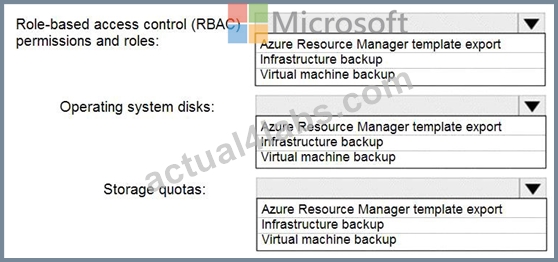
Answer:
Explanation: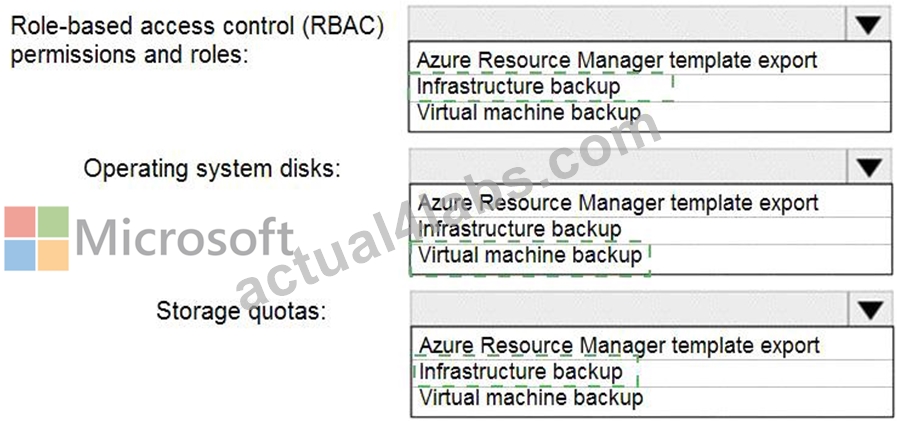
Explanation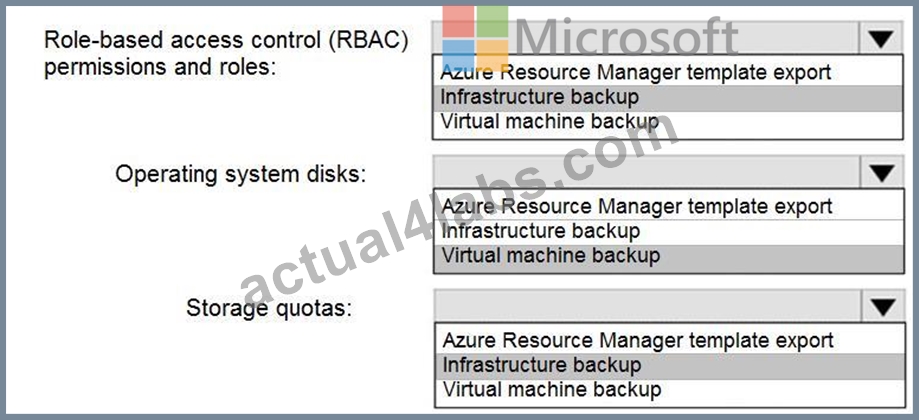
Reference:
https://docs.microsoft.com/en-us/azure-stack/operator/azure-stack-backup-enable-backup-console?view=azs-200
NEW QUESTION # 84
You need to create the Linux virtual machine image. The solution must support the planned changes.
Which three actions should you perform in sequence? To answer, move the appropriate actions from the list of actions to the answer area and arrange them in the correct order.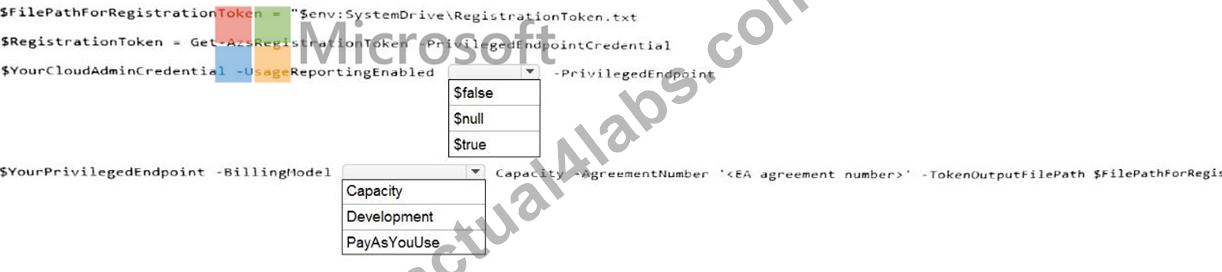
Answer:
Explanation: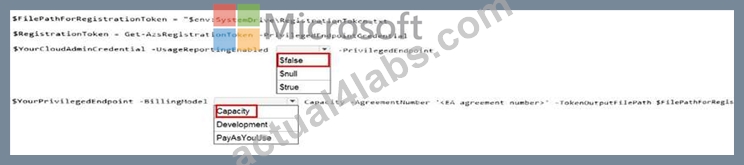
Explanation
Step 1: Create a config.file and save the file as Sloud-init.txt file.
Publish a custom cloud-init built image of a Linux virtual machine to Azure Stack Hub Marketplace on the integrated system.
Add Linux images to the Azure Stack Hub Marketplace
1: Create a cloud-init.txt file with your cloud-config
Step 2: Upload the file to Azure Stack Hub storage account.
2: Reference cloud-init.txt during the Linux VM deployment
Upload the file to an Azure storage account, Azure Stack Hub storage account, or GitHub repository reachable by your Azure Stack Hub Linux VM.
Step 3: Provision on Azure Stack Hub virtual machine by using Az PowerShell moduel.
You can create an Ubuntu Server 16.04 LTS virtual machine (VM) by using Azure Stack Hub PowerShell.
Make sure to reference the cloud-init.txt as a part of the -CustomData flag:
$VirtualMachine =Set-AzVMOperatingSystem -VM $VirtualMachine `
-Linux `
-ComputerName "MainComputer" `
-Credential $cred -CustomData "#include https://cloudinitstrg.blob.core.windows.net/strg/cloud-init.txt" Reference:
https://learn.microsoft.com/en-us/azure-stack/operator/azure-stack-linux?
NEW QUESTION # 85
You have an Azure Stack Hub integrated system. The current VIP pool uses a subnet of 192.168.203.0/24 and has routing configured to use BGP.
In the administrator portal, you receive an alert that the public IP addresses are at 95 percent utilization.
You need to add 192.168.204.0/24 to the public IP address pool.
Which three actions should you perform in sequence? To answer, move the appropriate actions from the list of actions to the answer area and arrange them in the correct order.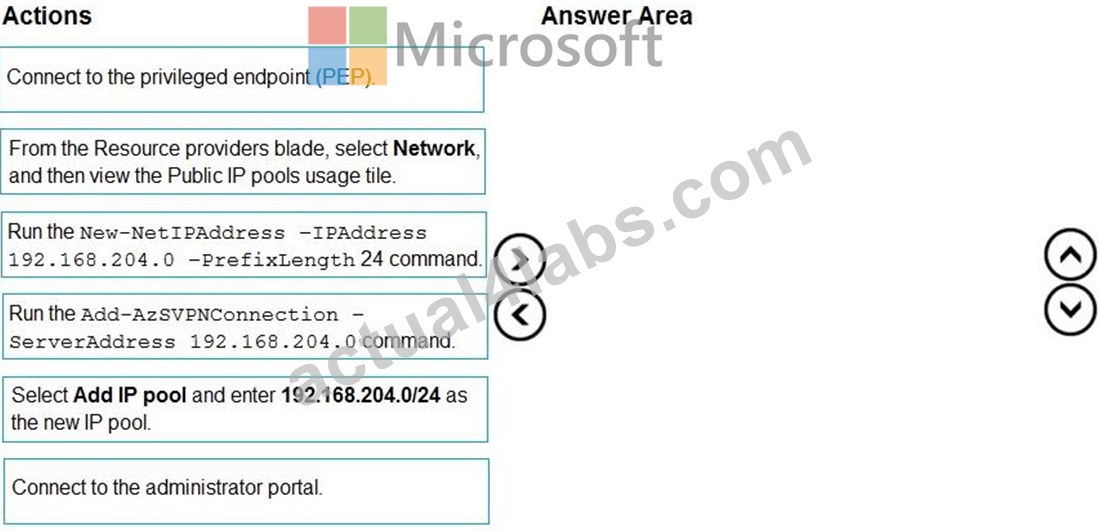
Answer:
Explanation: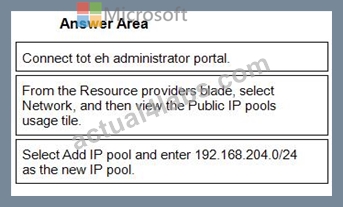
1 - Connect tot eh administrator portal.
2 - From the Resource providers blade, select Network, and then view the Public IP pools usage tile.
3 - Select Add IP pool and enter 192.168.204.0/24 as the new IP pool.
Reference:
https://learn.microsoft.com/en-us/azure-stack/operator/azure-stack-add-ips
NEW QUESTION # 86
You have an Azure Stack Hub integrated system that has the following configurations:
* A deployment prefix of AzS
* A physical prefix of AzP
You need to renew the certificates for the integrated system.
To which virtual machine should you establish a PowerShell session?
- A. AzP-S1-N01
- B. AzS-WAS01
- C. AzS-ERCS02
- D. AzS-CA01
Answer: C
Explanation:
Explanation
https://docs.microsoft.com/en-gb/learn/modules/manage-azure-stack-hub-use-privileged-endpoints/2-connect-pri
NEW QUESTION # 87
You have an Azure Stack Hub integrated system.
You unlock the privileged endpoint (PEP).
How long will the PEP session remain unlocked?
- A. 24 hours
- B. eight hours
- C. one hour
- D. 30 minutes
Answer: B
Explanation:
Unlocking the privileged endpoint for support scenarios
During a support scenario, the Microsoft support engineer might need to elevate the privileged endpoint PowerShell session to access the internals of the Azure Stack Hub infrastructure. This process is sometimes informally referred to as "break the glass" or "unlock the PEP".
An elevated PEP session has a validity of 8 hours, after which, if not terminated, the elevated PEP session will automatically lock back to a regular PEP session.
NEW QUESTION # 88
You need to identify the authentication and authorization process for the integrated system in Chicago. The solution must meet the technical requirements.
What should you include in the solution? To answer, select the appropriate options in the answer area.
NOTE: Each correct selection is worth one point.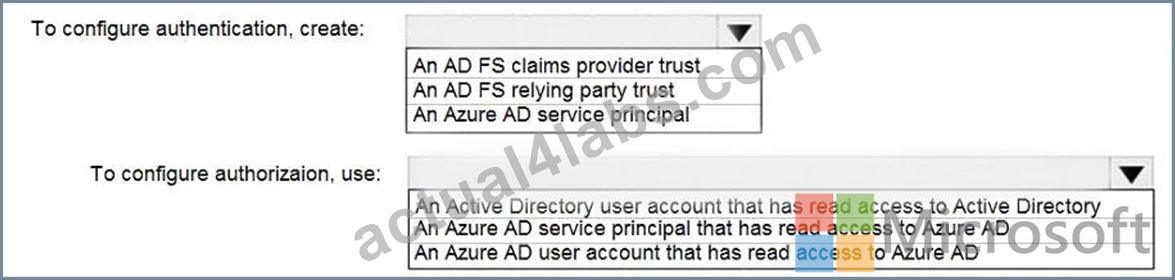
Answer:
Explanation: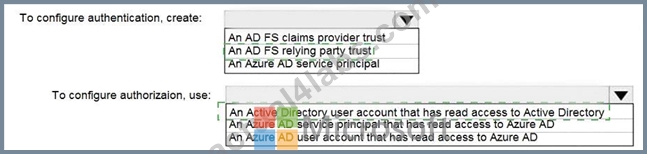
Explanation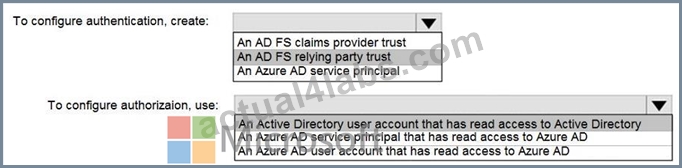
Reference:
https://docs.microsoft.com/en-us/azure-stack/operator/azure-stack-integrate-identity?view=azs-2008
NEW QUESTION # 89
You have a Windows Server-based certification authority (CA) and a disconnected Azure Stack Hub integrated system.
You need to issue a certificate that will be used to authenticate a service principal when the service principal accesses Azure Stack Hub resources.
How should you configure the certificate? To answer, select the appropriate options in the answer area.
NOTE: Each correct selection is worth one point.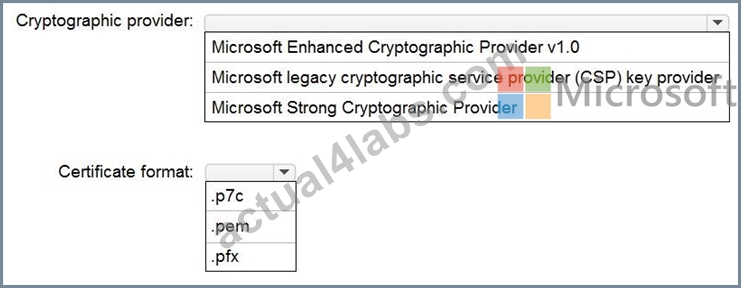
Answer:
Explanation: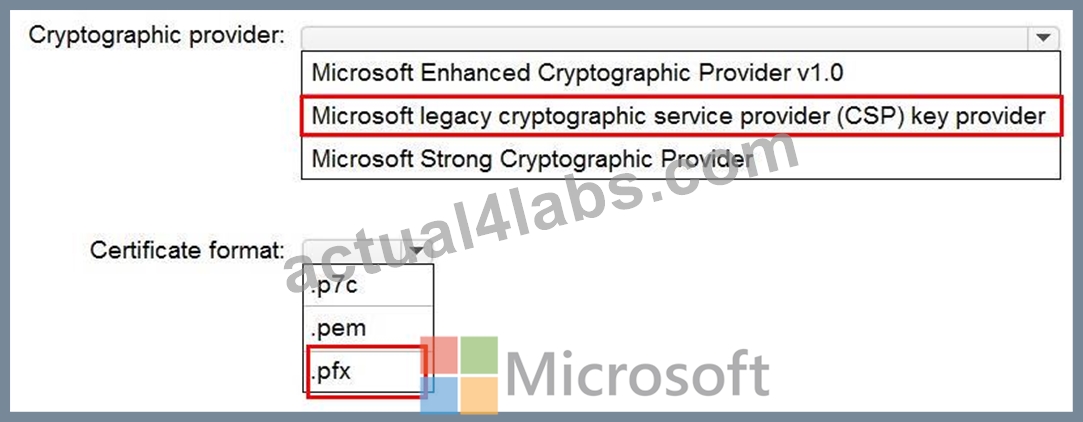
NEW QUESTION # 90
You have an Azure Stack Hub integrated system that is disconnected from the Internet.
You need to make a new image available in Azure Stack Hub Marketplace in the disconnected environment.
From a computer that has Internet access, you download all the required tools.
Which four actions should you perform in sequence next? To answer, move the appropriate actions from the list of actions to the answer area and arrange them in the correct order.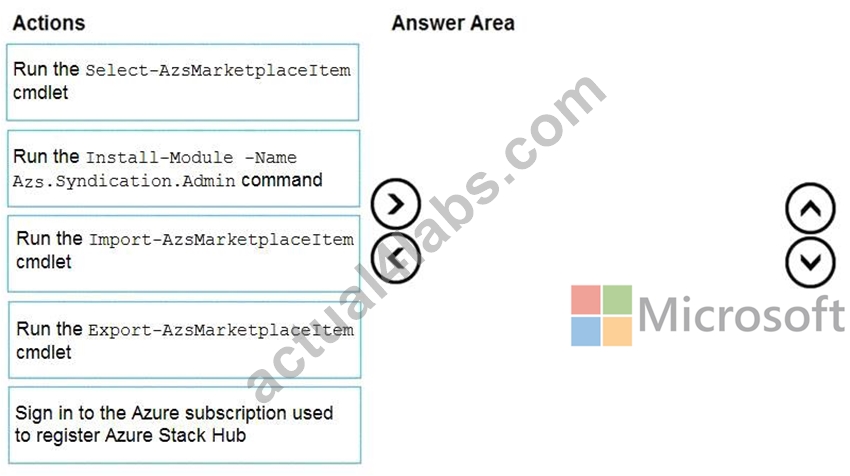
Answer:
Explanation: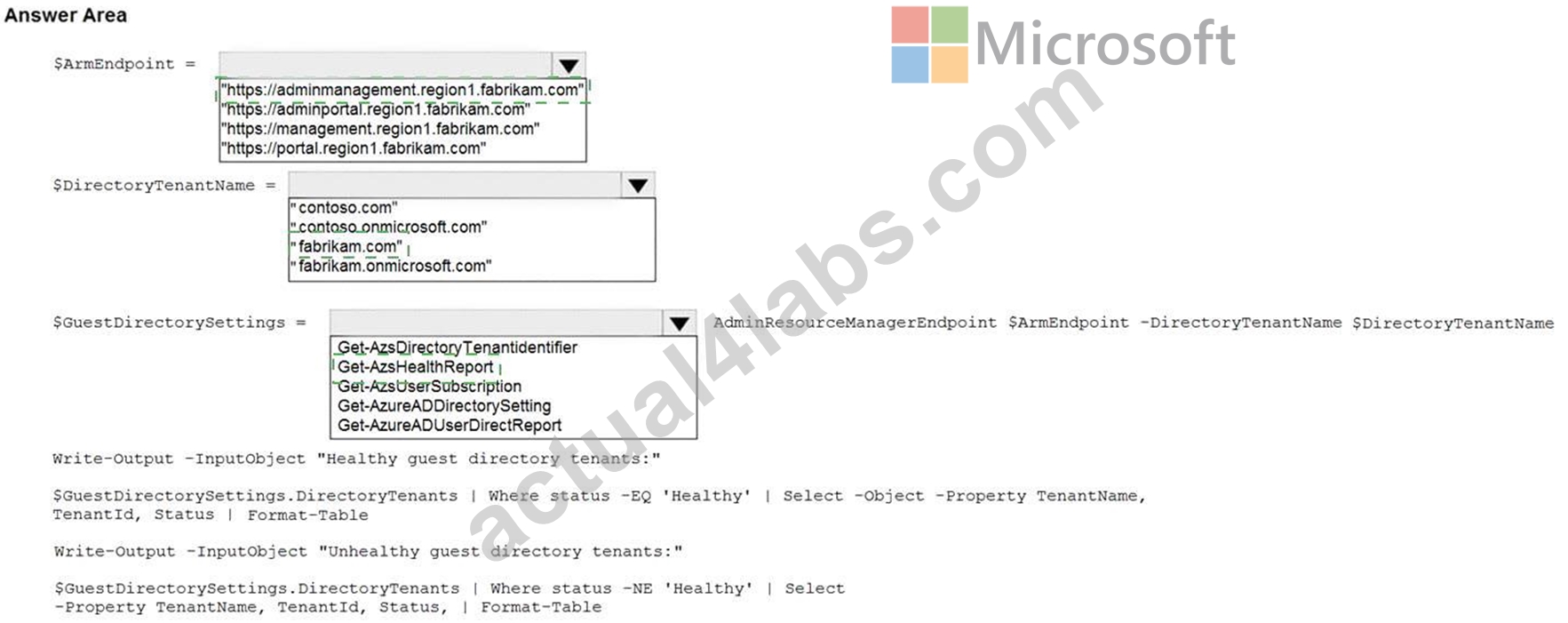
Explanation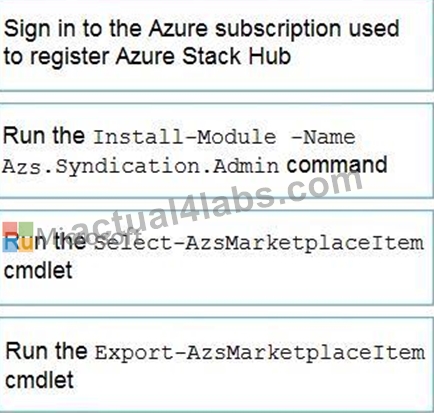
Reference:
https://docs.microsoft.com/en-us/azure-stack/operator/azure-stack-download-azure-marketplace-item?view=azs-
NEW QUESTION # 91
You have an Azure Stack Hub integrated system that has several Azure Active Directory (Azure AD) tenants onboarded for various departments at your company. Each department uses a specific tag for every resource it creates.
You need to generate a report to help the finance department perform a chargeback to each department.
Which three actions should you perform in sequence? To answer, move the appropriate actions from the list of actions to the answer area and arrange them in the correct order.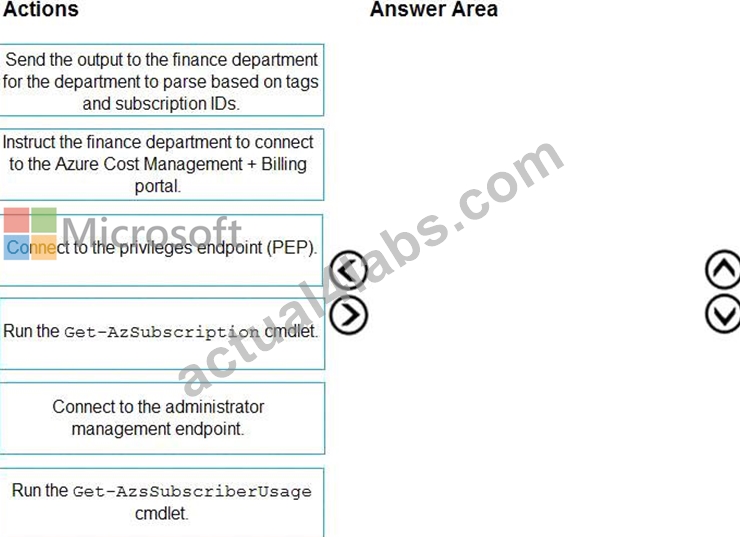
Answer:
Explanation: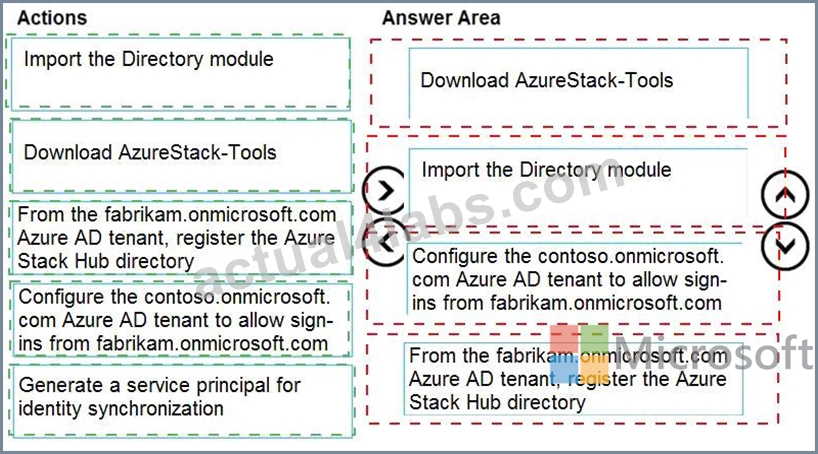
Explanation
Graphical user interface, text, application Description automatically generated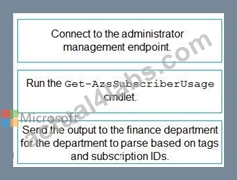
Reference:
https://docs.microsoft.com/en-us/azure-stack/mdc/operator/analyze-usage-tzl?tabs=az1
NEW QUESTION # 92
You have an Azure Stack Hub integrated system that is configured as shown in the following table.
You need to generate certificate signing requests (CSRs) for certificate renewal.
How should you complete the PowerShell script? To answer, select the appropriate options in the answer area.
NOTE: Each correct selection is worth one point.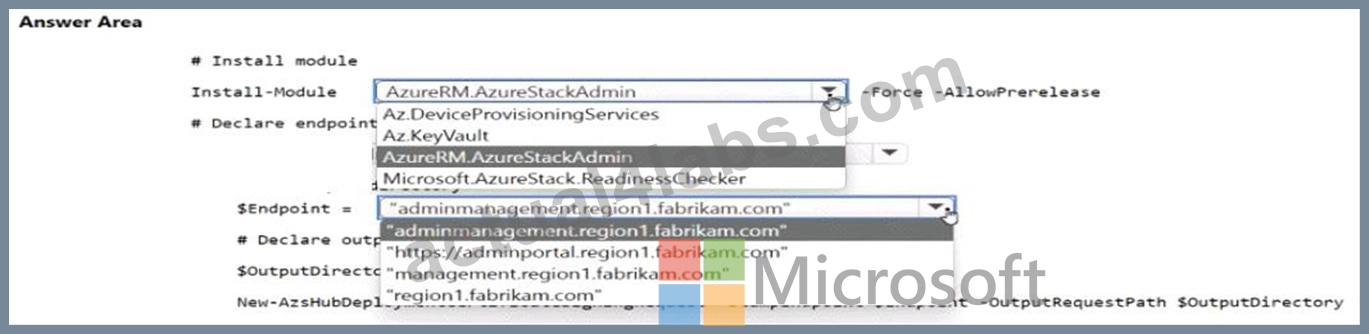
Answer:
Explanation: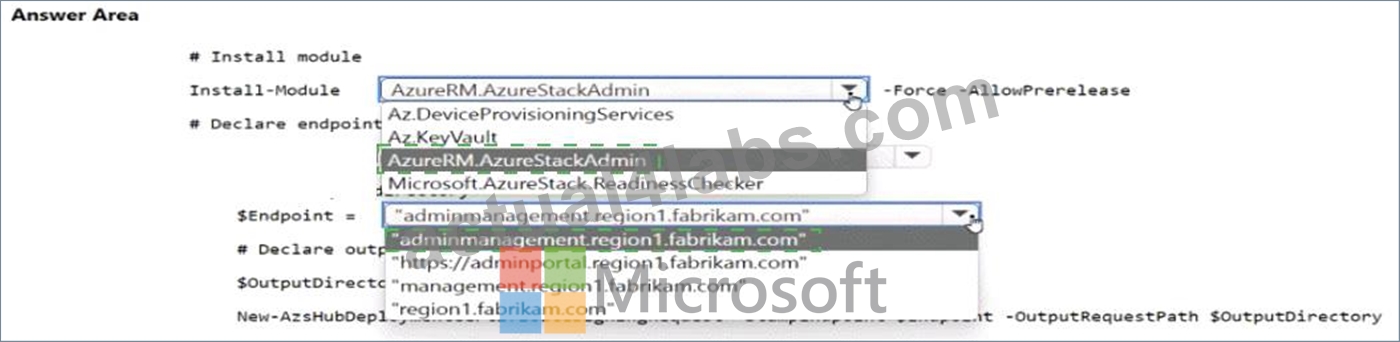
Explanation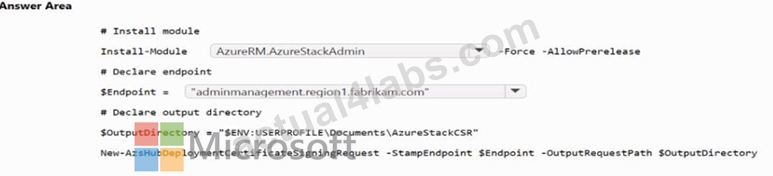
NEW QUESTION # 93
You have an Azure Stack Hub integrated system. That uses the Azure App Service resource provider.
You plan to rotate the App Service certificates. The new certificates are stored in a folder named c:\certificates\Appservices.
You need to validate the new certificates.
How should you complete the script? To answer, select the appropriate options in the answer area.
NOTE Each correct selection is worth one point.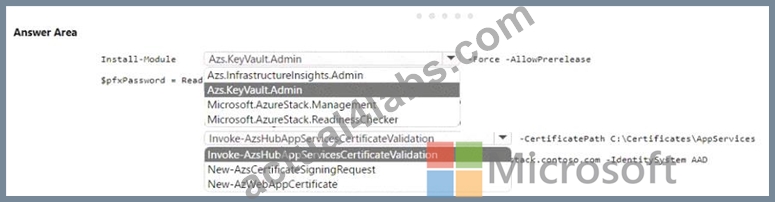
Answer:
Explanation: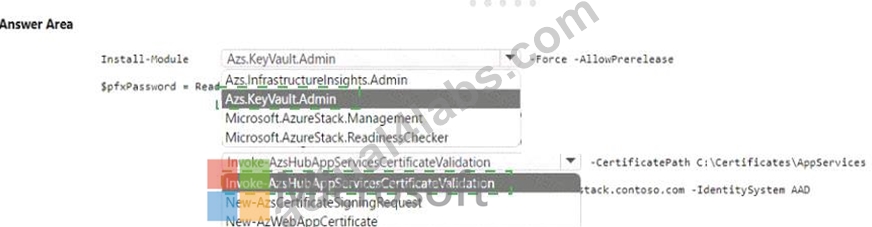
Explanation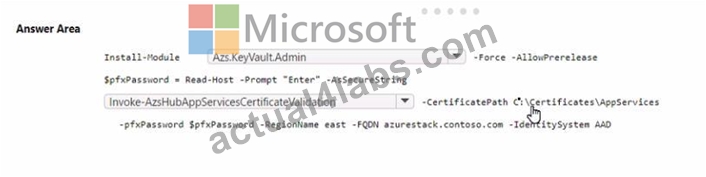
NEW QUESTION # 94
Which three components are required to configure an Azure Stack Hub infrastructure backup? Each correct answer presents part of the solution.
NOTE: Each correct selection is worth one point.
- A. an SMB file share in the trusted network perimeter
- B. an Azure Blob storage account
- C. an SMB file share in Azure
- D. an encryption certificate
- E. credentials that have write access to storage
Answer: A,D,E
NEW QUESTION # 95
You have an Azure Stack Hub integrated system that uses an Azure Active Directory (Azure AD) tenant named contoso.com as an identity provider.
You need to create a certificate file named AzSIBCCert for infrastructure backup.
How should you complete the PowerShell script? To answer, select the appropriate options in the answer area.
NOTE: Each correct selection is worth one point.
Answer:
Explanation:
Explanation
NEW QUESTION # 96
You have an Azure Stack Hub integrated system that connects to the Internet.
You attempt to download an image as shown in the Add from Azure exhibit. (Click the Add from Azure tab.)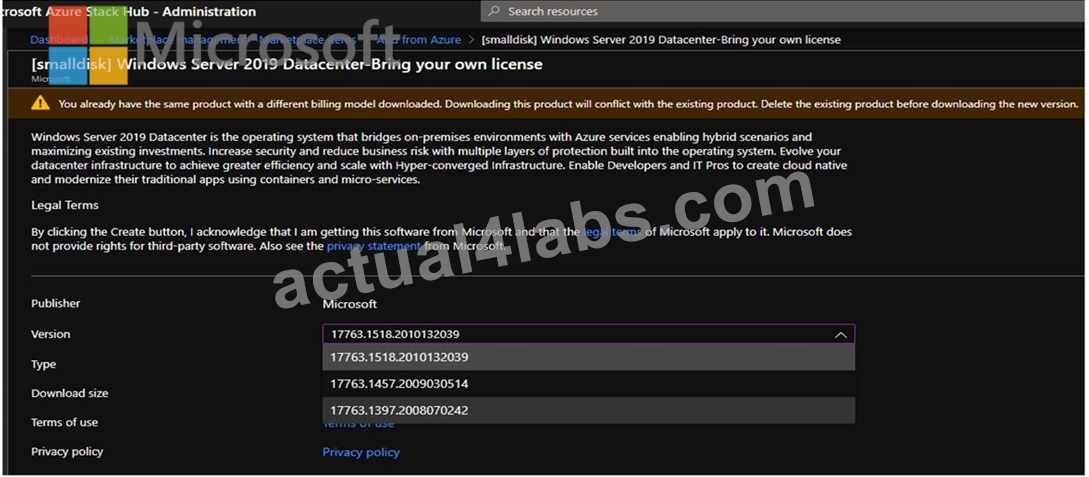
The Marketplace item blade for [smalldisk] Windows Server 2019 Datacenter-Pay as you go is shown in the item exhibit. (Click the Item tab.)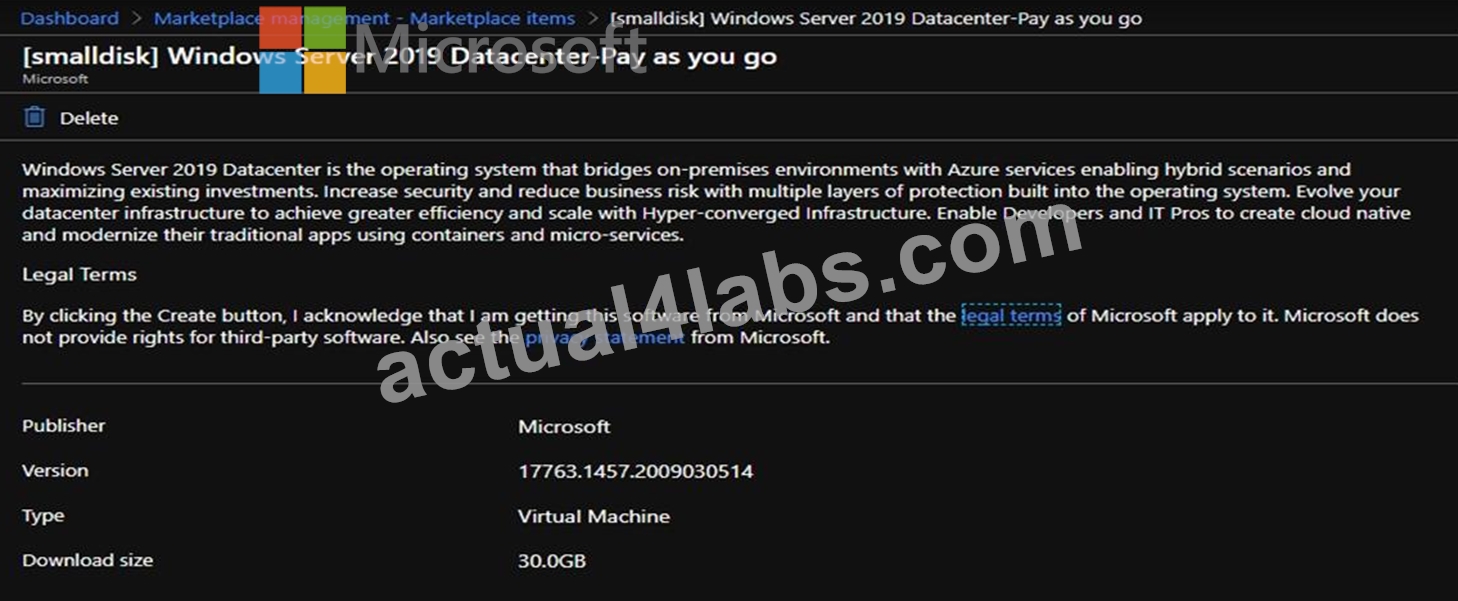
The marketplace items are shown in the Marketplace Items exhibit. (Click the Marketplace Items tab.)
For each of the following statements, select Yes if the statement is true. Otherwise, select No.
NOTE: Each correct selection is worth one point.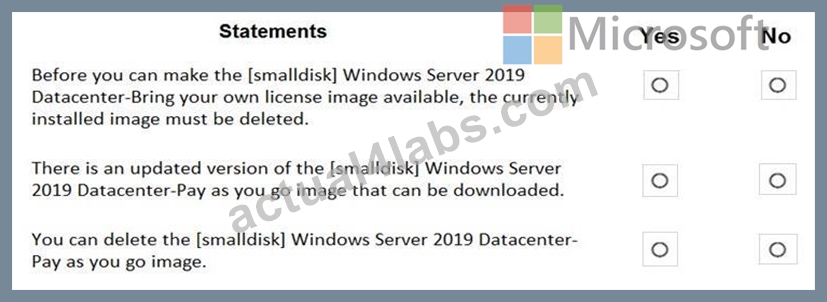
Answer:
Explanation:
Explanation
Graphical user interface, text, application, email Description automatically generated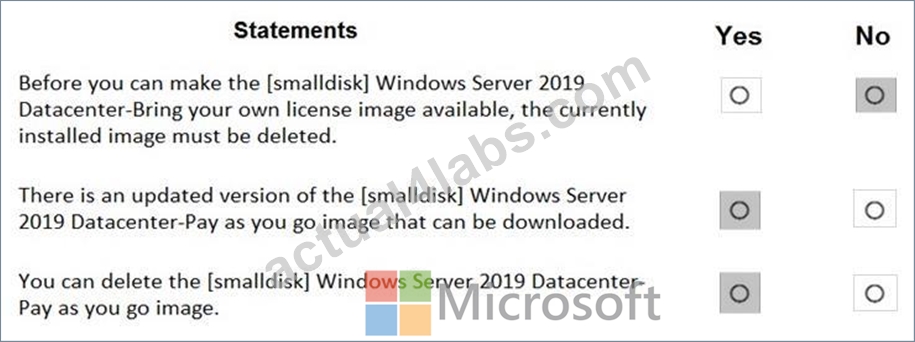
Reference:
https://docs.microsoft.com/en-us/azure-stack/operator/azure-stack-windows-server-faq?view=azs-2102&tabs=az
NEW QUESTION # 97
You start the update of an Azure Stack Hub integrated system. The Update run details are shown in the following exhibit.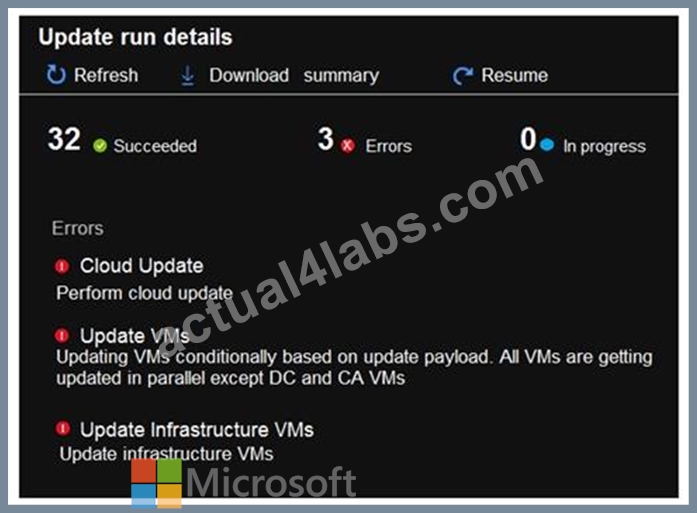
Use the drop-down menus to select the answer choice that completes each statement based on the information presented in the graphic.
NOTE: Each correct selection is worth one point.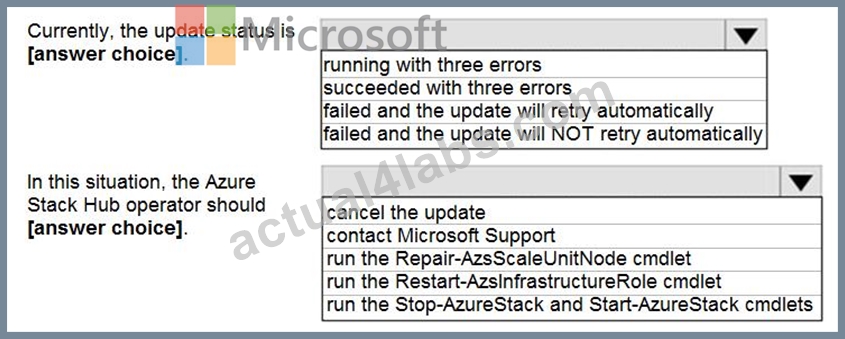
Answer:
Explanation: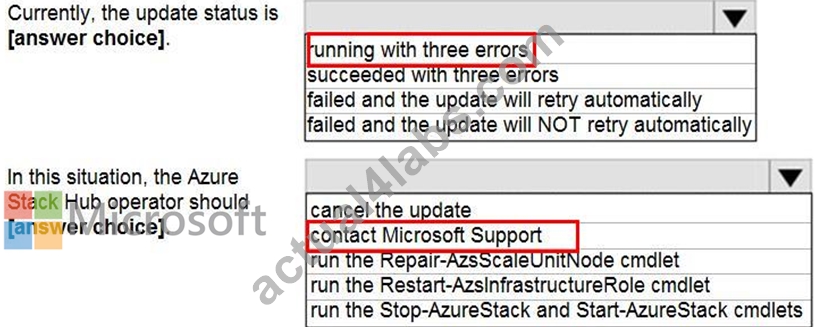
Reference:
https://docs.microsoft.com/en-us/azure-stack/operator/azure-stack-apply-updates?view=azs-2008
NEW QUESTION # 98
You plan to deploy an Azure Stack Hub integrated system that will be disconnected from the internet. The integrated system region name is region1, and the external domain is name is contoso.local.
You need to ensure that the generated certificate signing request (CSR) has the correct subjects and subject alternative names (SAN).
Which name must you include in the CSR?
- A. *.hosting.region1.azurestack.local
- B. graph.local.azurestack.external
- C. *.adminhosting.region 1.azurestack.local
- D. graph.region1.contoso.local
Answer: C
Explanation:
Explanation
You can deploy and use Azure Stack Hub without a connection to the internet. However, with a disconnected deployment, you're limited to an Active Directory Federation Services (AD FS) identity store and the capacity-based billing model. Because multitenancy requires the use of Azure Active Directory (Azure AD), multitenancy isn't supported for disconnected deployments.
The implementation of Extension Host requires two wild card SSL certificates, one for the Admin portal and one for the Tenant portal.
Note: Certificate requirements
The extension host implements two new domain namespaces to guarantee unique host entries for each portal extension. The new domain namespaces require two additional wildcard certificates to ensure secure communication.
The table shows the new namespaces and the associated certificates:
Table Description automatically generated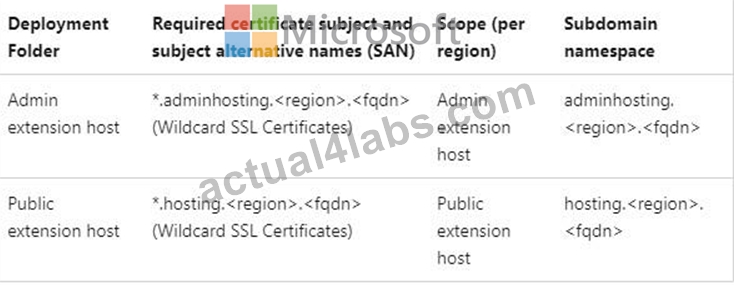
Example:
$regionName = 'east' # The region name for your Azure Stack Hub deployment
$externalFQDN = 'azurestack.contoso.com' # The external FQDN for your Azure Stack Hub deployment Starting Certificate Request Process for Deployment CSR generating for following SAN(s):
*.adminhosting.east.azurestack.contoso.com,*.adminvault.east.azurestack.contoso.com,*.blob.east.azurestack.co Present this CSR to your Certificate Authority for Certificate Generation:
https://learn.microsoft.com/en-us/azure-stack/operator/azure-stack-disconnected-deployment
https://learn.microsoft.com/en-us/azure-stack/operator/azure-stack-extension-host-prepare
https://learn.microsoft.com/en-us/azure-stack/operator/azure-stack-get-pki-certs
NEW QUESTION # 99
You have a disconnected Azure Stack Hub integrated system that will be used in production.
You need to obtain a token to register the integrated system.
How should you complete the PowerShell script? To answer, select the appropriate options in the answer area NOTE: Each correct selection is worth one point.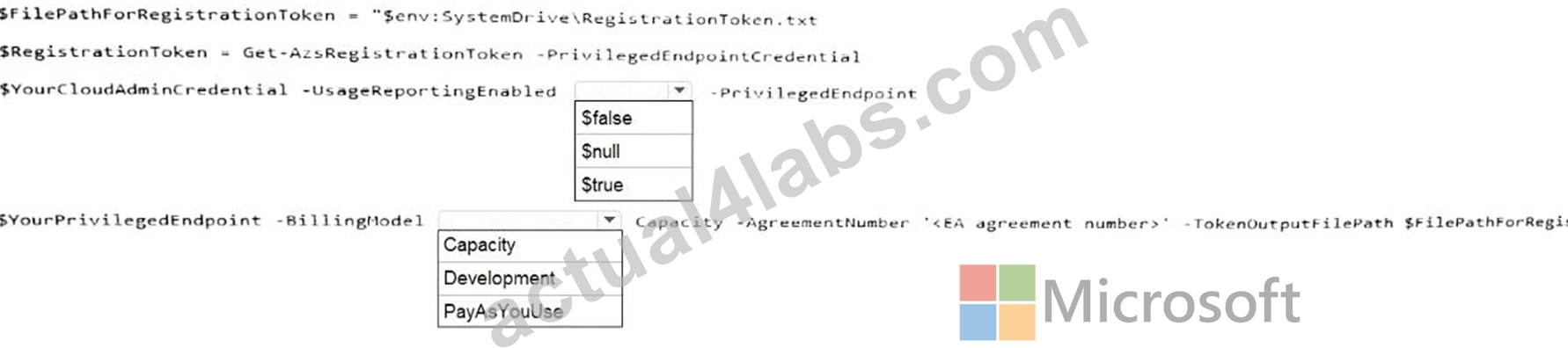
Answer:
Explanation: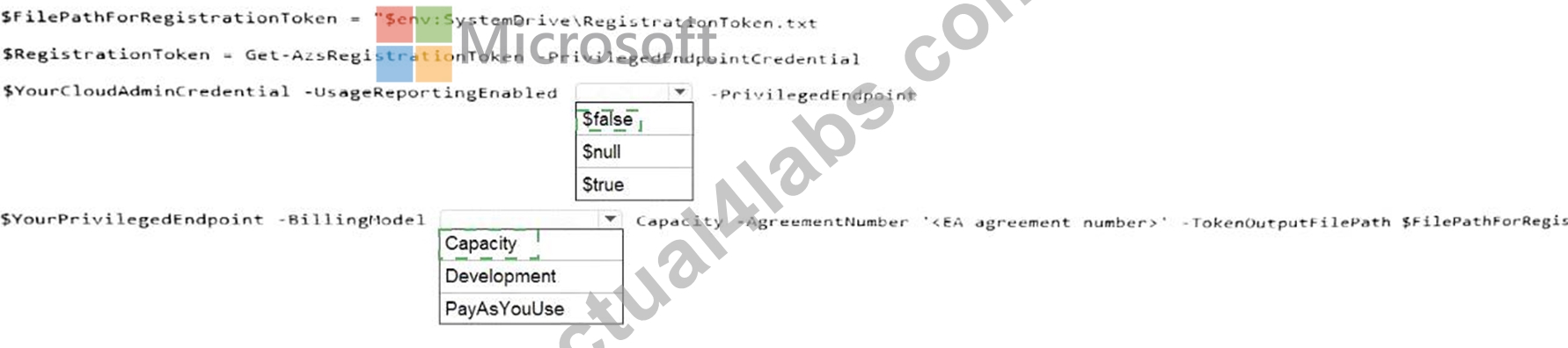
Explanation
Box 1: $false
Get-AzsRegistrationToken generates a registration token from the input parameters.
Parameter: UsageReportingEnabled True/False
Azure Stack Hub reports usage metrics by default. Operators with capacity uses or supporting a disconnected environment need to turn off usage reporting. Allowed values for this parameter are: True, False.
Box 2: Capacity
BillingModel String
The billing model that your subscription uses. Allowed values for this parameter are: Capacity, PayAsYouUse, and Development.
With a disconnected deployment, you're limited to an Active Directory Federation Services (AD FS) identity store and the capacity-based billing model.
Reference: https://learn.microsoft.com/en-us/azure-stack/operator/azure-stack-registration
https://learn.microsoft.com/en-us/azure-stack/operator/azure-stack-disconnected-deployment
NEW QUESTION # 100
You need to resolve the performance issue reported by the users in the priv1 region.
What should you do?
- A. Install the AMD drivers on the virtual machines
- B. Add an additional scale unit node
- C. Redeploy the virtual machines to a new Azure Stack Hub node
- D. Install the NVIDIA drivers on the virtual machines
Answer: A
Explanation:
Reference:
https://docs.microsoft.com/en-us/azure/virtual-machines/windows/n-series-amd-driver-setup
Topic 2, Litware Office
Case study
This is a case study. Case studies are not timed separately. You can use as much exam time as you would like to complete each case. However, there may be additional case studies and sections on this exam. You must manage your time to ensure that you are able to complete all questions included on this exam in the time provided.
To answer the questions included in a case study, you will need to reference information that is provided in the case study. Case studies might contain exhibits and other resources that provide more information about the scenario that is described in the case study. Each question is independent of the other questions in this case study.
At the end of this case study, a review screen will appear. This screen allows you to review your answers and to make changes before you move to the next section of the exam. After you begin a new section, you cannot return to this section.
To start the case study
To display the first question in this case study, click the Next button. Use the buttons in the left pane to explore the content of the case study before you answer the questions. Clicking these buttons displays information such as business requirements, existing environment, and problem statements. If the case study has an All Information tab, note that the information displayed is identical to the information displayed on the subsequent tabs. When you are ready to answer a question, click the Question button to return to the question.
Overview
Existing Environment
Network Environment
The Litware offices and the Fabrikam office connect by using a private circuit. Each office connects directly to the Internet.
Identity Environment
The Litware network contains an Active Directory forest named litwareinc.com. The forest and an Azure Active Directory (Azure AD) tenant named litwareinc.com are integrated by using Active Directory Federation Services (AD FS). Litware has an enterprise certification authority (CA).
The Azure subscriptions of Litware are associated to the litwareic.com Azure AD tenant.
Fabrikam also has an Azure AD tenant.
Azure Stack Hub Environment
Litware has the following two Azure Stack Hub integrated systems:
* A fully operational integrated system in Boston that connects to the Internet and has the following configurations:
- Is managed by using an administrator management endpoint of:
https://adminportal.eastus.litwareinc.com
- Has an Azure App Service deployment that has two dedicated, large web workers
- Currently uses version 2005 of Azure Stack Hub
* A newly delivered integrated system in Chicago that is disconnected from the Internet and will be managed by using an administrator management endpoint of:
https://adminportal.northcentralus.litwareinc.com
Datacenter Environment
The Chicago datacenter of Litware contains the infrastructure shown in the following table.
Current Problems
During heavy usage, requests to App Service in Boston fail despite low utilization of the web workers.
Requirements
Planned Changes
Litware plans to implement the following changes:
* Deploy an Event Hubs resource provider to the integrated system in Boston.
* Make Azure Functions available to Azure Stack Hub users in Boston.
* Prepare the integrated system in Chicago to be production-ready.
Technical Requirements
Litware identifies the following technical requirements:
* Implement an infrastructure to support Azure Functions on the integrated system in Boston.
* Provision the certificates required to deploy the Event Hubs resource provider to the integrated system in Boston.
* Configure an identity provider for the integrated system in Chicago.
* Locate the IP address of the privileged endpoint (PEP) of the integrated system in Chicago.
* Ensure that only operators have control over the creation of subscriptions on the integrated system in Chicago.
* Provision a certificate to provide access to the Azure Resource Manager endpoint of the integrated system in Chicago.
* Identify which PowerShell setting on CLIENT1 and CLIENT2 must be modified to register the integrated system in Chicago.
* Implement a management app that will use Azure Resource Manager to inventory the resources of the integrated system in Chicago.
Security and Compliance Requirements
Litware has the following security and compliance requirements:
* All infrastructure software must run the latest version, including hotfixes.
* Litware must have control over certificate revocations.
Business Requirements
Litware wants to ensure that the users at Fabrikam have secure access to the workloads on the integrated system in Boston.
Updates and Hotfixes
The current hotfixes and updates available for Azure Stack Hub are:
* 2005
* 2005 hotfix 1
* 2005 hotfix 2
* 2005 hotfix 3
* 2008
* 2008 hotfix 1
* 2008 hotfix 2
* 2011 (latest version)
NEW QUESTION # 101
......
Microsoft AZ-600 certification exam is a must-have for any professional looking to demonstrate expertise in configuring and operating a hybrid cloud with Microsoft Azure Stack Hub. AZ-600 exam is designed to test the candidate's knowledge and skills in managing and deploying Azure Stack Hub, as well as integrating it with the Azure cloud.
Accurate AZ-600 Answers 365 Days Free Updates: https://www.actual4labs.com/Microsoft/AZ-600-actual-exam-dumps.html
Realistic AZ-600 100% Pass Guaranteed Download Exam Q&A: https://drive.google.com/open?id=1Iq1-YF3ZXAuxUcMJnR31fkUtf9Rgw6ig