

Ultimate Guide to Prepare AZ-600 Certification Exam for Azure Stack Hub Operator Associate in 2023
Use Real AZ-600 Dumps - Microsoft Correct Answers updated on 2023
Microsoft AZ-600 exam is a certification exam that validates the candidate's knowledge and skills in configuring and operating a hybrid cloud using Microsoft Azure Stack Hub. Professionals who pass AZ-600 exam can demonstrate their expertise in managing Azure services on-premises or in a hybrid environment, making them valuable assets to any organization that uses Azure services.
Microsoft AZ-600 exam is designed for IT professionals who want to demonstrate their expertise in configuring and operating a hybrid cloud with Microsoft Azure Stack Hub. AZ-600 exam measures the candidate's ability to manage Azure services, configure Azure Stack Hub, and implement hybrid scenarios. AZ-600 exam also covers topics such as deploying and managing Azure Stack Hub infrastructure, configuring Azure Stack Hub services, and implementing Azure Stack Hub security. Passing AZ-600 exam indicates that the candidate has the skills and knowledge required to deploy and manage hybrid cloud infrastructure using Microsoft Azure Stack Hub.
NEW QUESTION # 11
You have an Azure Slack Hub integrated system that uses the latest version.
You discover an alert for an external certificate that will expire. You obtain new certificates.
You need to validate that all the components required to change the certificates are in a healthy state, and then renew the certificates.
Which three actions should you perform? Each correct answer presents part of the solution.
NOTE: Each correct selection is worth one point.
- A. Copy the certificates to an SMB file share that is accessible from the privilege endpoint (PEP).
- B. Run Start-SecretRotation cmdlet and Specify the Internal parameter.
- C. Run the Start -Sec ret Rot at Ion and specify the PfxFilePath parameter.
- D. Run the Test-AzureStaek cmdlet and Specify the -Group SecretRotationReadiness parameter.
- E. Copy the certificates to Azure Blob storage.
- F. Run the Test-AzureStack cmdlet and Specify the -Group UpdateReadiness parameter.
Answer: A,B,D
Explanation:
Reference: https://learn.microsoft.com/en-us/azure-stack/operator/azure-stack-rotate-secrets
NEW QUESTION # 12
You have an Azure Stack Hub integrated system that contains a user named User1.
You have a JSON file that contains the definition of the Reader role.
You need to create a custom role to enable User1 to manage updates for the integrated system.
Which four actions should you perform in sequence? To answer, move the appropriate actions from the list of actions to the answer area and arrange them in the correct order.
Answer:
Explanation:
Explanation
Step 1: Modify the permissions section of the JSON file
Step 2: Modify the assignableScopes section of the JSON file.
Replace <SubscriptionID> with your Azure subscription ID.
Sample JSON file:
{
"Name": "Azure Stack Hub registration role",
"Id": null,
"IsCustom": true,
"Description": "Allows access to register Azure Stack Hub",
"Actions": [
"Microsoft.Resources/subscriptions/resourceGroups/write",
"Microsoft.Resources/subscriptions/resourceGroups/read",
"Microsoft.AzureStack/registrations/*",
"Microsoft.AzureStack/register/action",
"Microsoft.Authorization/roleAssignments/read",
"Microsoft.Authorization/roleAssignments/write",
"Microsoft.Authorization/roleAssignments/delete",
"Microsoft.Authorization/permissions/read",
"Microsoft.Authorization/locks/read",
"Microsoft.Authorization/locks/write"
],
"NotActions": [
],
"AssignableScopes": [
"/subscriptions/<SubscriptionID>"
]
}
Step 3: Connect to the administrator Azure Resource Manager (ARM) endpoint.
In PowerShell, connect to Azure to use Azure Resource Manager. When prompted, authenticate using an account with sufficient permissions such as Owner or User Access Administrator.
Connect-AzAccount
Step 4: Run the New-AzRoleDefinition cmdlet.
To create the custom role, use New-AzRoleDefinition specifying the JSON template file.
New-AzRoleDefinition -InputFile "C:\CustomRoles\registrationrole.json
Reference: https://learn.microsoft.com/en-us/azure-stack/operator/azure-stack-registration-role
NEW QUESTION # 13
You have an Azure Stack Hub integrated system that has several Azure Active Directory (Azure AD) tenants onboarded for various departments at your company. Each department uses a specific tag for every resource it creates.
You need to generate a report to help the finance department perform a chargeback to each department.
Which three actions should you perform in sequence? To answer, move the appropriate actions from the list of actions to the answer area and arrange them in the correct order.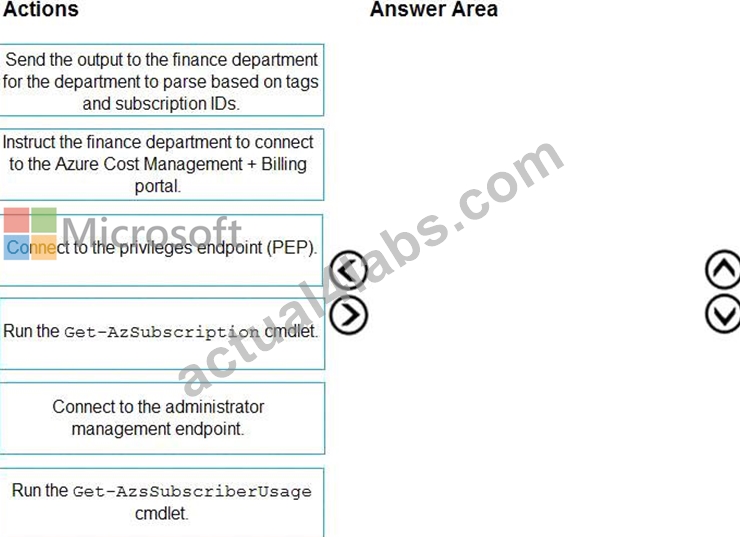
Answer:
Explanation: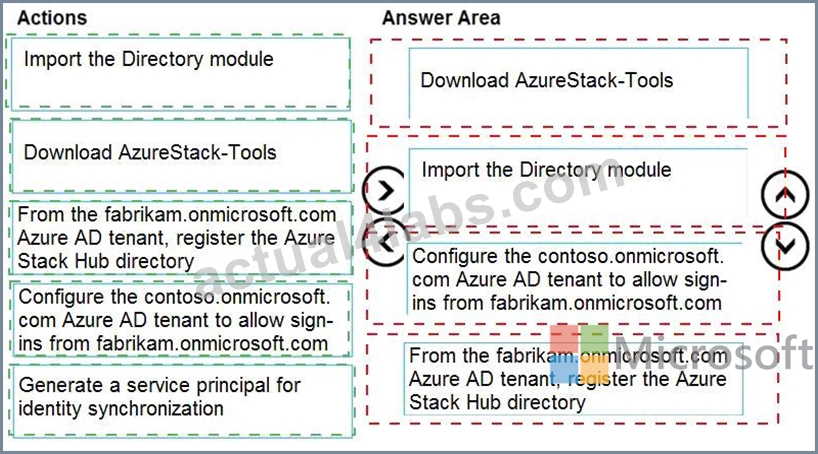
Explanation
Graphical user interface, text, application Description automatically generated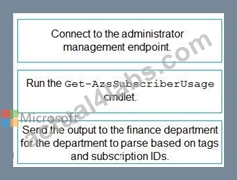
Reference:
https://docs.microsoft.com/en-us/azure-stack/mdc/operator/analyze-usage-tzl?tabs=az1
NEW QUESTION # 14
You have an Azure Stack Hub integrated system.
You need to delegate the management of offers to a user named User1.
Which three actions should you perform in a sequence? To answer, move the appropriate actions from the list of actions to the answer area and arrange them in the correct order.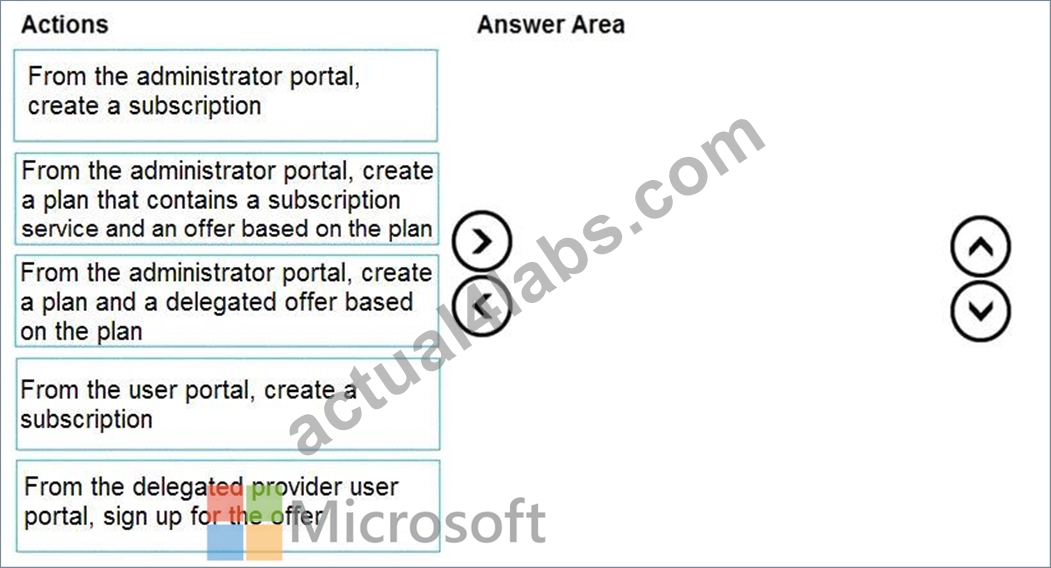
Answer:
Explanation: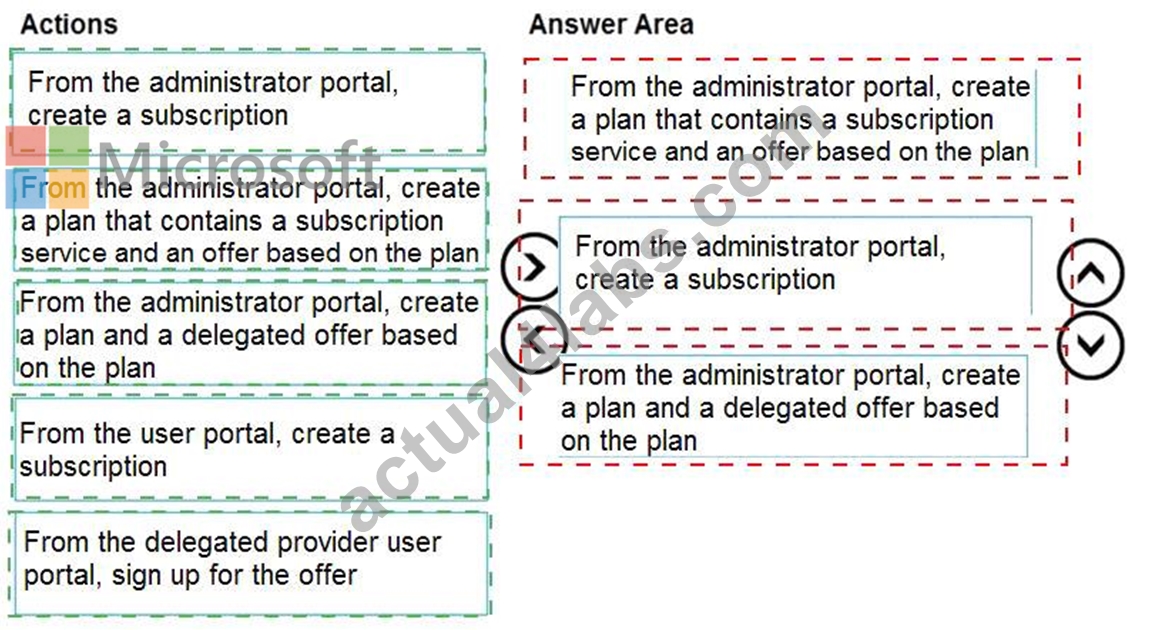
Explanation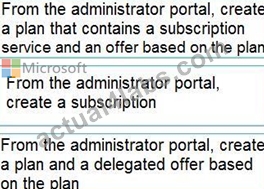
Reference:
https://docs.microsoft.com/en-us/azure-stack/operator/azure-stack-delegated-provider?view=azs-2008
NEW QUESTION # 15
You have a Windows Server-based certification authority (CA) and a disconnected Azure Stack Hub integrated system.
You need to issue a certificate that will be used to authenticate a service principal when the service principal accesses Azure Stack Hub resources.
How should you configure the certificate? To answer, select the appropriate options in the answer area.
NOTE: Each correct selection is worth one point.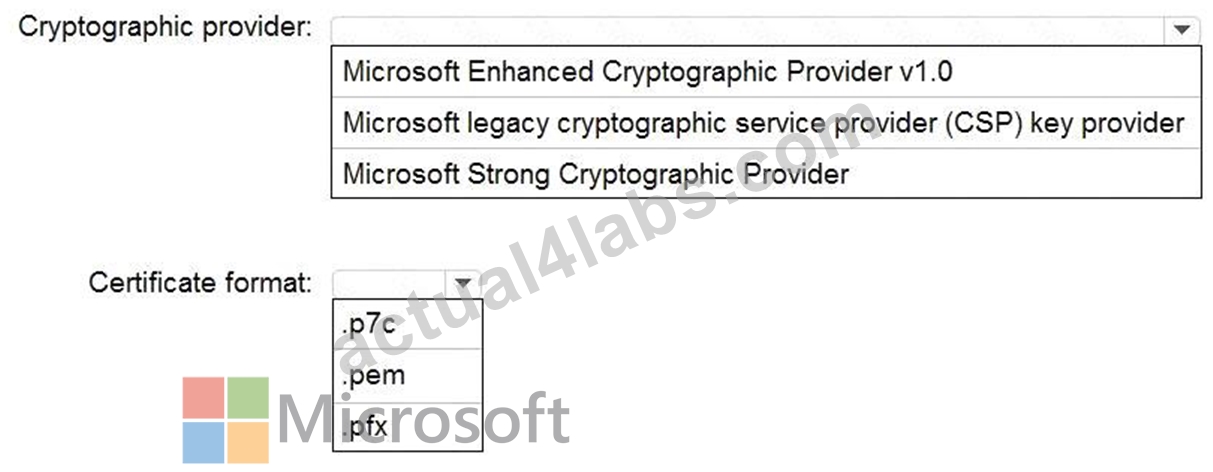
Answer:
Explanation: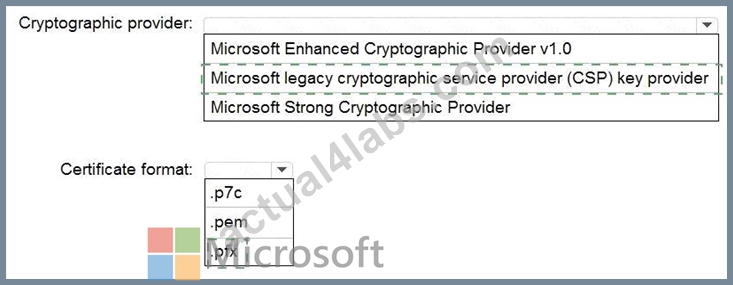
Explanation
Box 1: Microsoft legacy Cryptographic Service Provider (CSP) key provider Give an app access to Azure Stack Hub resources An application that deploys or configures resources through Azure Resource Manager must be represented by its own identity, known as a security principal. Just as a user is represented by a user principal, an app is represented by a service principal.
Create an app registration that uses a certificate credential
When creating a certificate credential, the following requirements must be met:
* The cryptographic provider must be specified as a Microsoft legacy Cryptographic Service Provider (CSP) key provider.
* The certificate format must be in PFX file, as both the public and private keys are required. Windows servers use .pfx files that contain the public key file (TLS/SSL certificate file) and the associated private key file.
* Etc.
Box 2: .pfx
Reference: https://learn.microsoft.com/en-us/azure-stack/operator/give-app-access-to-resources
NEW QUESTION # 16
You have an Azure Stack Hub integrated system that is disconnected from the Internet.
You need to collect diagnostic logs, but do not have access to an SMB share.
Which four actions should you perform in sequence? To answer, move the appropriate actions from the list of actions to the answer area and arrange them in the correct order.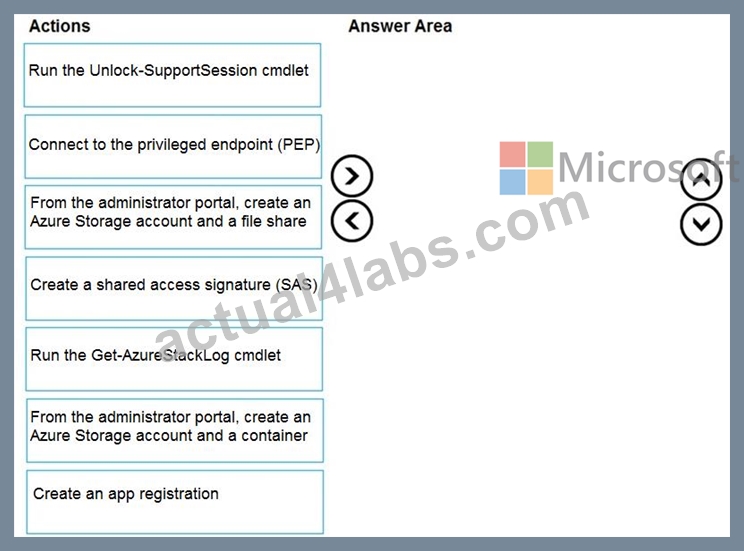
Answer:
Explanation: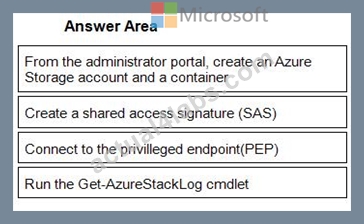
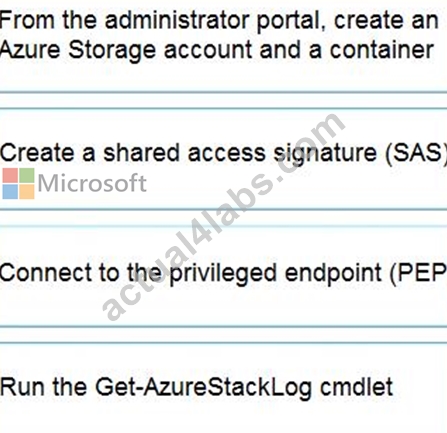
1 - From the administrator portal, create an Azure Storage account and a container
2 - Create a shared access signature (SAS)
3 - Connect to the privilleged endpoint(PEP)
4 - Run the Get-AzureStackLog cmdlet
Reference:
https://docs.microsoft.com/en-us/azure-stack/operator/azure-stack-get-azurestacklog?view=azs-2008
NEW QUESTION # 17
You have an Azure Stack Hub integrated system that is enabled for mufti-tenancy. The integrated system is configured as shown in the following table.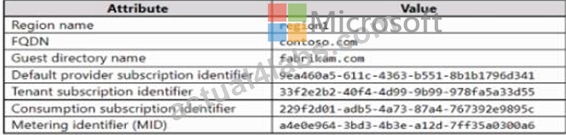
You need lo onboard fabrikam.com as a guest Azure AD tenant to the integrated system.
How should you complete the Power Shell script? To answer, drag the appropriate values to the correct targets. Each value may be used once, more than once, or not at all. You may need to drag the split bar between panes or scroll to view content.
NOTE: Each correct selection is worth one point.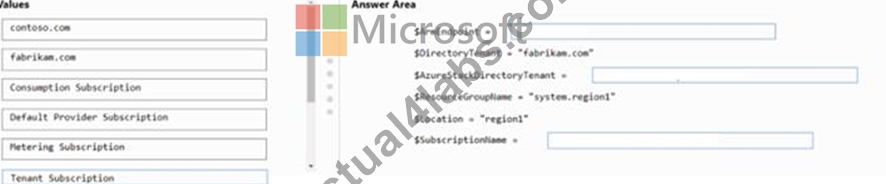
Answer:
Explanation: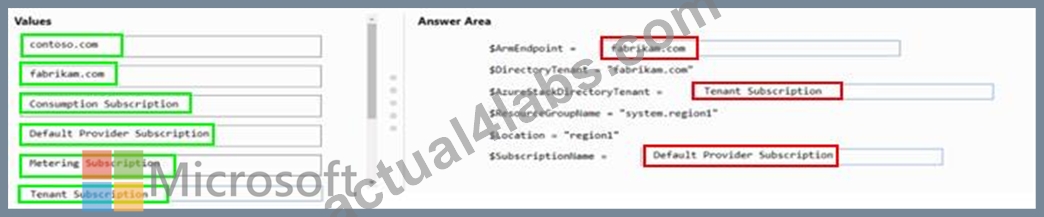
NEW QUESTION # 18
You have an Azure Stack Hub integrated system that contains a user named User1.
You have a JSON file that contains the definition of the Reader role.
You need to create a custom role to enable User1 to manage updates for the integrated system.
Which four actions should you perform in sequence? To answer, move the appropriate actions from the list of actions to the answer area and arrange them in the correct order.
Answer:
Explanation:
Explanation
Step 1: Modify the permissions section of the JSON file
Step 2: Modify the assignableScopes section of the JSON file.
Replace <SubscriptionID> with your Azure subscription ID.
Sample JSON file:
{
"Name": "Azure Stack Hub registration role",
"Id": null,
"IsCustom": true,
"Description": "Allows access to register Azure Stack Hub",
"Actions": [
"Microsoft.Resources/subscriptions/resourceGroups/write",
"Microsoft.Resources/subscriptions/resourceGroups/read",
"Microsoft.AzureStack/registrations/*",
"Microsoft.AzureStack/register/action",
"Microsoft.Authorization/roleAssignments/read",
"Microsoft.Authorization/roleAssignments/write",
"Microsoft.Authorization/roleAssignments/delete",
"Microsoft.Authorization/permissions/read",
"Microsoft.Authorization/locks/read",
"Microsoft.Authorization/locks/write"
],
"NotActions": [
],
"AssignableScopes": [
"/subscriptions/<SubscriptionID>"
]
}
Step 3: Connect to the administrator Azure Resource Manager (ARM) endpoint.
In PowerShell, connect to Azure to use Azure Resource Manager. When prompted, authenticate using an account with sufficient permissions such as Owner or User Access Administrator.
Connect-AzAccount
Step 4: Run the New-AzRoleDefinition cmdlet.
To create the custom role, use New-AzRoleDefinition specifying the JSON template file.
New-AzRoleDefinition -InputFile "C:\CustomRoles\registrationrole.json
Reference: https://learn.microsoft.com/en-us/azure-stack/operator/azure-stack-registration-role
NEW QUESTION # 19
You have an Azure Stack Hub integrated system that has the following configurations:
* A deployment prefix of AzS
* A physical prefix of AzP
You need to renew the certificates for the integrated system.
To which virtual machine should you establish a PowerShell session?
- A. AzS-CA01
- B. AzS-ERCS02
- C. AzP-S1-N01
- D. AzS-WAS01
Answer: B
NEW QUESTION # 20
You need to identify the PEP information for the integrated system in Chicago. The solution must meet the technical requirements.
What should you use?
- A. the Help + support blade of the administrator portal
- B. the HLH configuration file
- C. Properties on the Region management blade of the administrator portal
- D. the Get-AzsRegistrationToken cmdlet
Answer: C
Explanation:
Reference:
https://docs.microsoft.com/en-us/azure-stack/operator/azure-stack-privileged-endpoint?view=azs-2008
NEW QUESTION # 21
You have a connected Azure Stack Hub integrated system.
You need to identify which users can access the privileged endpoint (PEP).
Which cmdlet should you run?
- A. Get-AzContext
- B. Get-AzureADUser
- C. Get-Mosluser
- D. Get-Cloudadminuserlist
Answer: A
NEW QUESTION # 22
You have an Azure Stack Hub integrated system.
You unlock the privileged endpoint (PEP).
How long will the PEP session remain unlocked?
- A. one hour
- B. eight hours
- C. 30 minutes
- D. 24 hours
Answer: B
Explanation:
Unlocking the privileged endpoint for support scenarios
During a support scenario, the Microsoft support engineer might need to elevate the privileged endpoint PowerShell session to access the internals of the Azure Stack Hub infrastructure. This process is sometimes informally referred to as "break the glass" or "unlock the PEP".
An elevated PEP session has a validity of 8 hours, after which, if not terminated, the elevated PEP session will automatically lock back to a regular PEP session.
NEW QUESTION # 23
You have an Azure Stack Hub integrated system.
You need to ensure that you can recover managed and unmanaged disks that are deleted from user subscriptions.
Which three actions should you perform in sequence? To answer, move the appropriate actions from the list of actions to the answer area and arrange them in the correct order.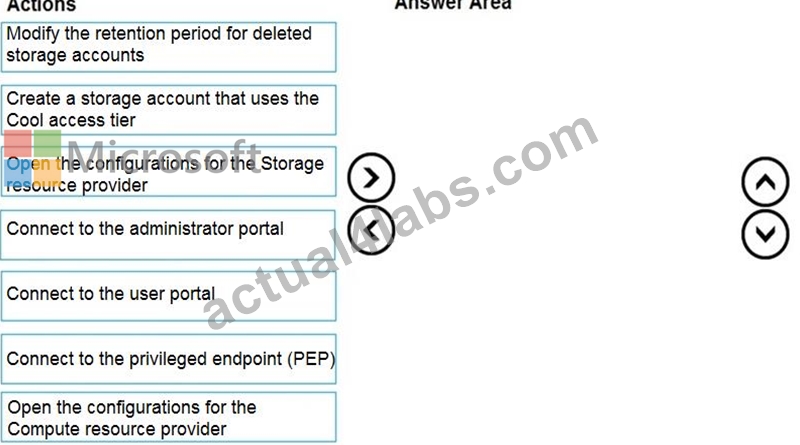
Answer:
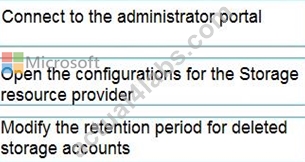
Explanation: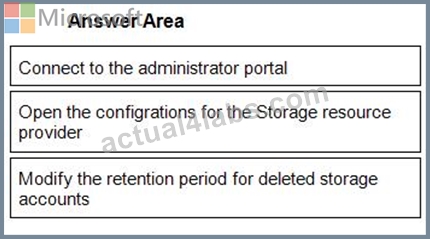
1 - Connect to the administrator portal
2 - Open the configrations for the Storage resource provider
3 - Modify the retention period for deleted storage accounts
Reference:
https://docs.microsoft.com/en-us/azure-stack/operator/azure-stack-manage-storage-accounts?view=azs-2008
NEW QUESTION # 24
You have an Azure Stack Hub integrated system that is disconnected from the Internet. The integrated system is registered to an Azure Active Directory (Azure AD) tenant named contoso.com.
You need to download the latest Ubuntu image for Azure Stack Hub Marketplace.
How should you complete the PowerShell script? To answer, drag the appropriate cmdlets to the correct targets. Each cmdlet may be used once, more than once, or not at all. You may need to drag and split the bar between panes to scroll to view content.
NOTE: Each correct selection is worth one point.
Answer:
Explanation:
Explanation
Reference:
https://docs.microsoft.com/en-us/azure-stack/operator/azure-stack-download-azure-marketplace-item?view=azs-
NEW QUESTION # 25
You need to configure the Azure Stack Hub infrastructure backups. The solution must meet the Azure Stack Hub requirements.
What should you do in the Azure Stack Hub administrator portal? To answer, select the appropriate options in the answer area.
NOTE: Each correct selection is worth one point.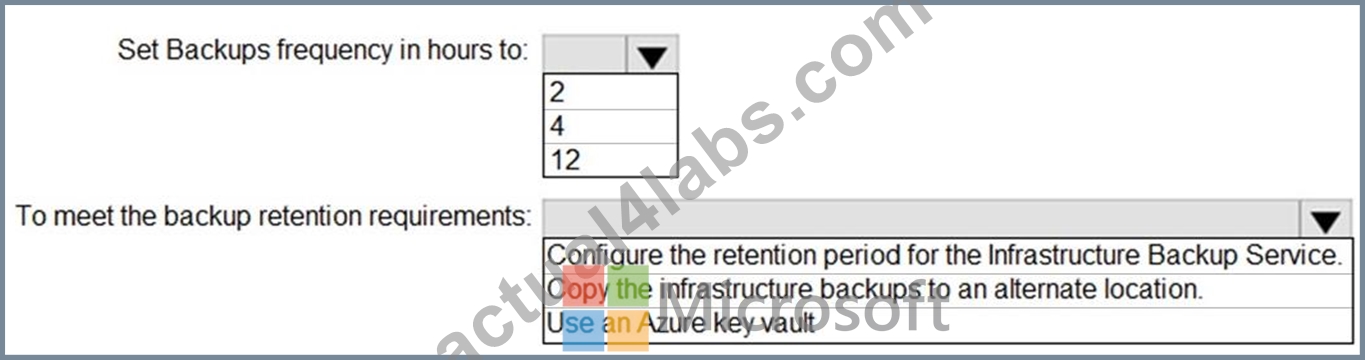
Answer:
Explanation: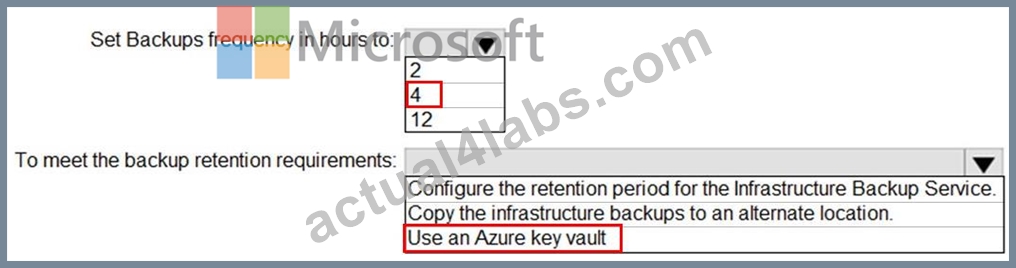
Reference:
https://learn.microsoft.com/en-us/azure-stack/operator/azure-stack-backup-enable-backup-console
https://learn.microsoft.com/en-us/azure/architecture/hybrid/azure-stack-backup
NEW QUESTION # 26
You have an Azure Stack Hub Integrated system that has the following configurations:
* Deployment virtual machine (DVM) IP address: 10.30.1.253
* First host IP address: 10.30.1.193
* Last host IP address: 10.30.1.254
* Subnet mask: 255.255.255.192
* BMC network: 10.30.1.192/26
* Default gateway: 10.30.1.193
* NTP: 10.31.1.2
* DNS: 8.8.8.8
You need to deploy an Operator Access Workstation (OAW) to the Hardware Lifecycle Host (HLH) and configure the network settings for the OAW.
How should you complete the script? To answer, select the appropriate options in the answer area.
NOTE: Each correct selection is worth one point.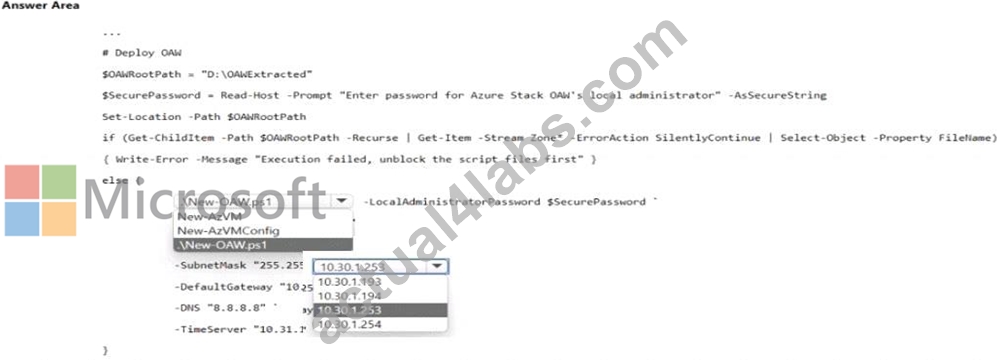
Answer:
Explanation: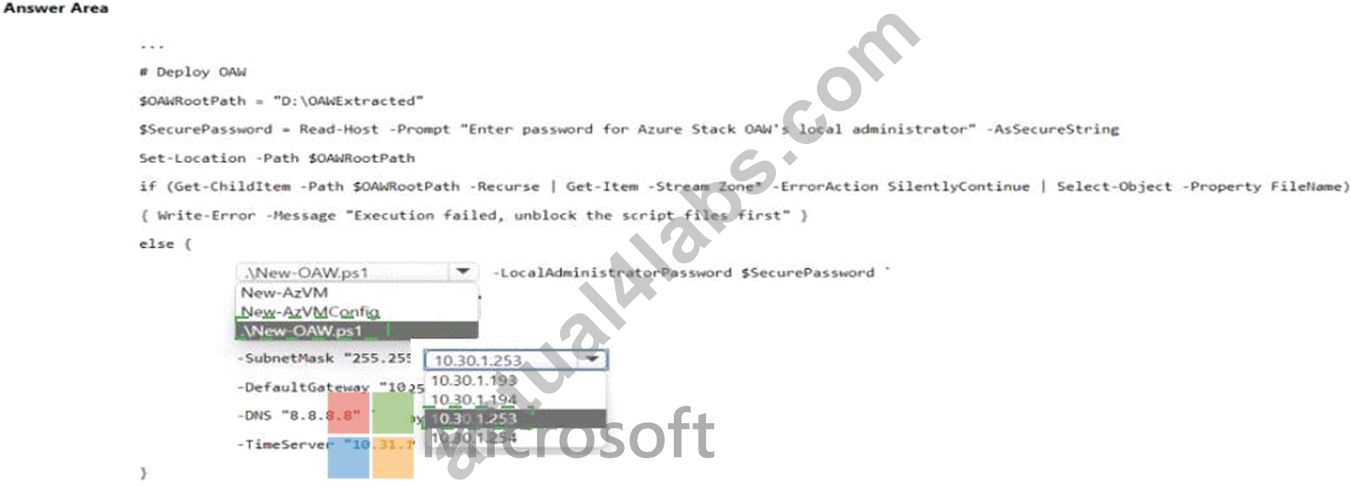
Explanation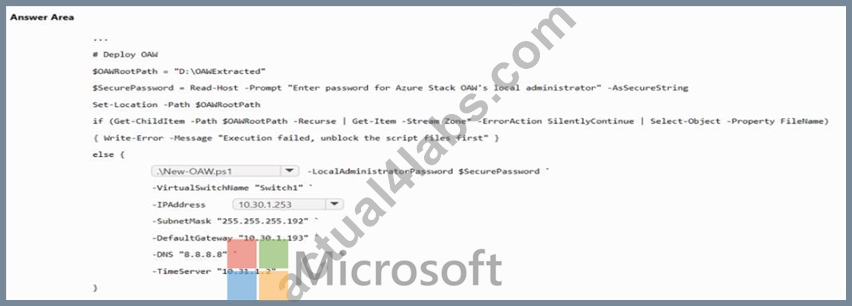
Box 1: .\New-OAW.ps1
Create the OAW VM using a script
The following script prepares the virtual machine as the Operator Access Workstation (OAW), which is used to access Microsoft Azure Stack Hub.
Sign in to the HLH with your credentials.
Download OAW.zip and extract the files.
Open an elevated PowerShell session.
Navigate to the extracted contents of the OAW.zip file.
Run the New-OAW.ps1 script.
Example: Example: Deploy on HLH using a Microsoft Image
$oawRootPath = "D:\oawtest"
$securePassword = Read-Host -Prompt "Enter password for Azure Stack OAW's local administrator"
-AsSecureString
if (Get-ChildItem -Path $oawRootPath -Recurse | Get-Item -Stream Zone* -ErrorAction SilentlyContinue | Select-Object FileName)
{ Write-Host "Execution failed, unblock the script files first" }
else { .\New-OAW.ps1 -LocalAdministratorPassword $securePassword }
Syntax:
New-OAW
-LocalAdministratorPassword <Security.SecureString> `
-IPAddress <String> `
-SubnetMask <String> `
-DefaultGateway <String> `
-DNS <String[]> `
-TimeServer<String> `
[-AzureStackCertificatePath <String>] `
[-AzSStampInfoFilePath <String>] `
[-CertificatePassword <Security.SecureString>] `
[-ERCSVMIP <String[]>] `
[-ImageFilePath <String>] `
[-VirtualMachineName <String>] `
[-VirtualMachineMemory <int64>] `
[-VirtualProcessorCount <int>] `
[-VirtualMachineDiffDiskPath <String>] `
[-PhysicalAdapterMACAddress <String>] `
[-VirtualSwitchName <String>] `
[-ReCreate] `
[-AsJob] `
[-Passthru] `
[-WhatIf] `
[-Confirm] `
[<CommonParameters>]
Box 2: 10.30.1.253
Deployment virtual machine (DVM) IP address: 10.30.1.253
Note:
Parameter:
IPAddress (Required)
The static IPv4 address to configure TCP/IP on the virtual machine.
Reference: https://learn.microsoft.com/en-us/azure-stack/operator/operator-access-workstation
NEW QUESTION # 27
You open the Resource providers blade for a user subscription as shown in the following exhibit.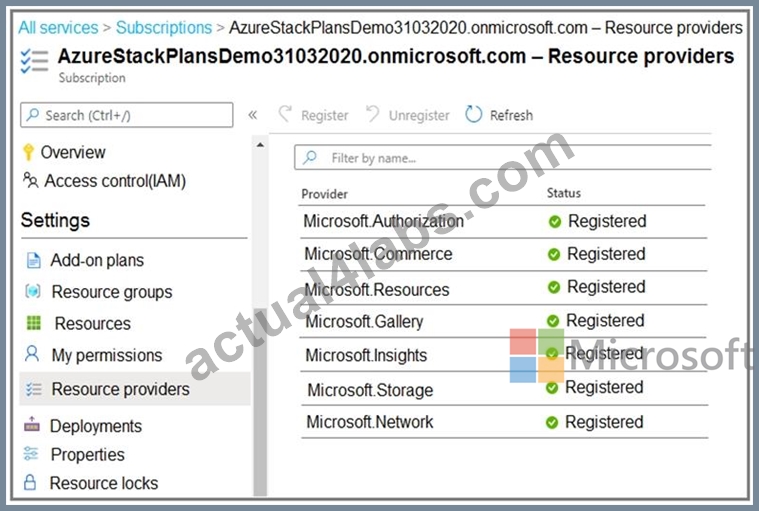
Use the drop-down menus to select the answer choice that completes each statement based on the information presented in the graphic.
NOTE: Each correct selection is worth one point.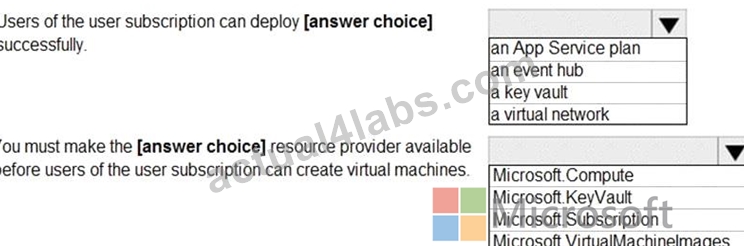
Answer:
Explanation: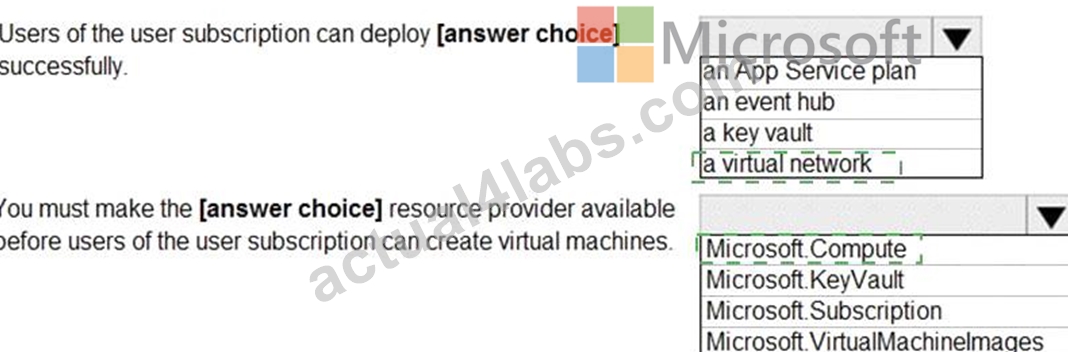
Explanation
Graphical user interface, text, application, email Description automatically generated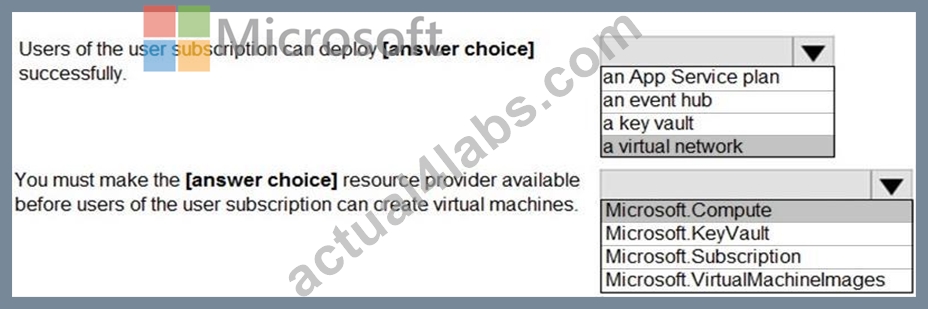
Reference:
https://docs.microsoft.com/en-us/azure/azure-resource-manager/management/azure-services-resource-providers
NEW QUESTION # 28
You have an Azure Stack Hub integrated system.
The Volumes list for the integrated system is shown in the following exhibit.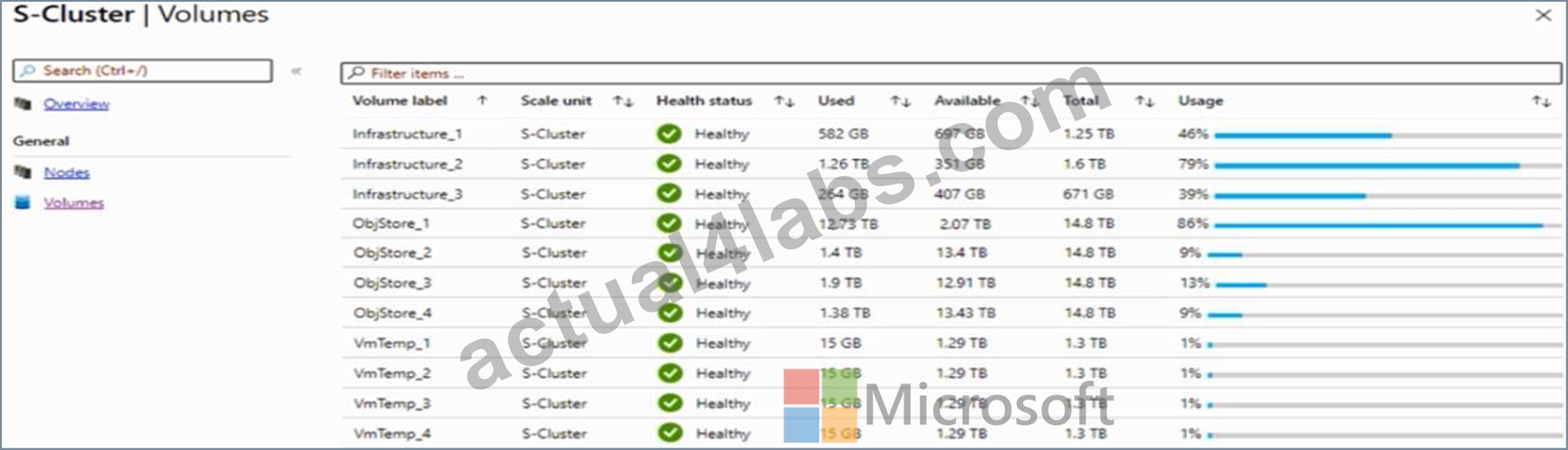
Use the drop-down menus to select the answer choice that completes each statement based on the information presented in the graphic.
NOTE: Each correct selection is worth one point.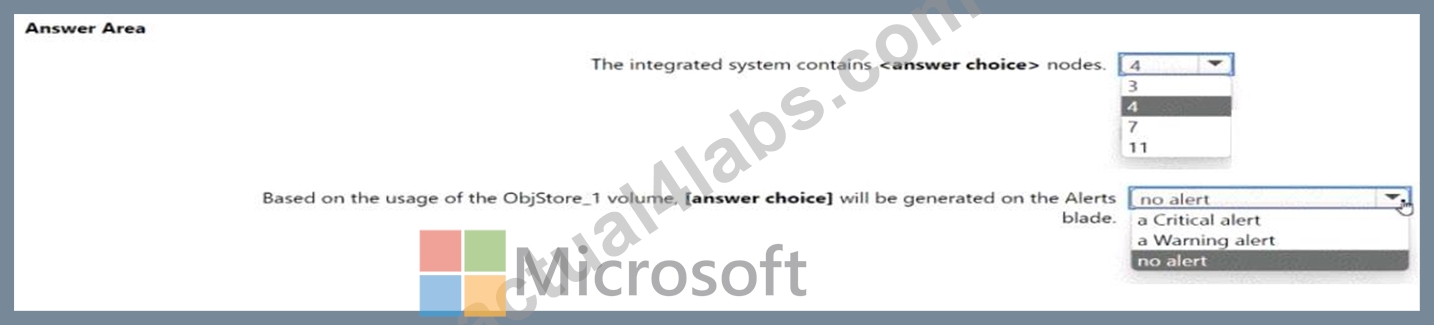
Answer:
Explanation: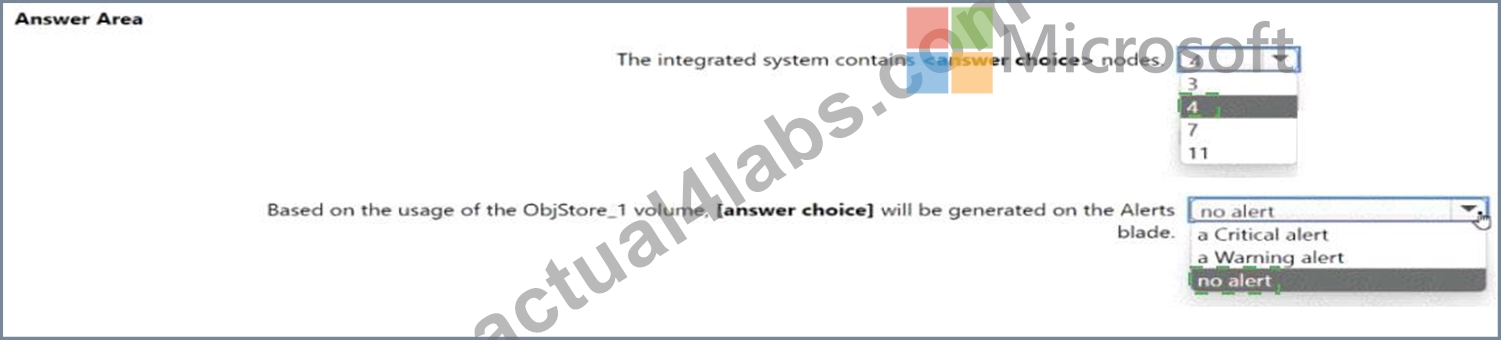
Explanation
NEW QUESTION # 29
You have an Azure Stack Hub integrated system that uses an Azure Active Directory (Azure AD) tenant named fabrikam.com as an identity provider. The integrated system region name is region1, and the external domain name is fabrikam.com.
The integrated system has the following domains enabled for multitenancy:
fabrikam.onmicrosoft.com
contoso.onmicrosoft.com
fabrikam.com
contoso.com
You need to disable multitenancy for contoso.com.
How should you complete the PowerShell script? To answer, select the appropriate options in the answer area.
NOTE: Each correct selection is worth one point.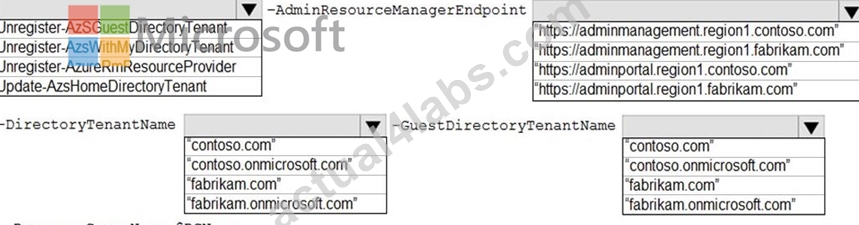
Answer:
Explanation: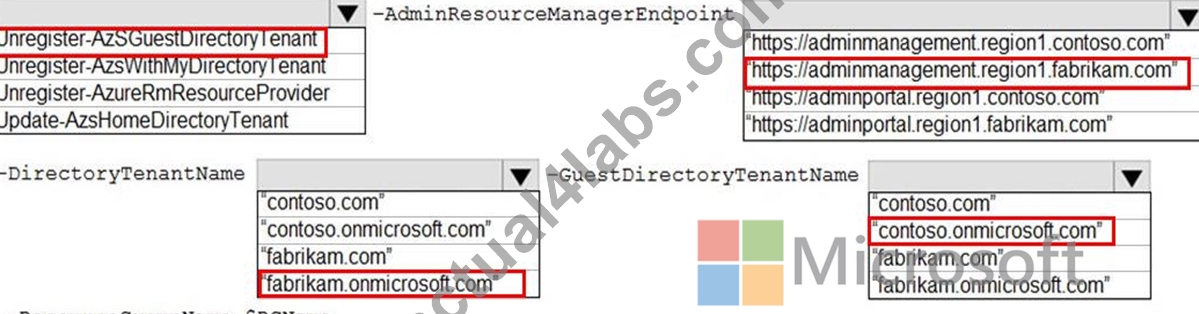
Reference:
https://docs.microsoft.com/en-us/azure-stack/operator/azure-stack-enable-multitenancy?view=azs-2008
NEW QUESTION # 30
You have an Azure Stack Hub integrated system that is disconnected from the Internet.
You need to collect diagnostic logs, but do not have access to an SMB share.
Which four actions should you perform in sequence? To answer, move the appropriate actions from the list of actions to the answer area and arrange them in the correct order.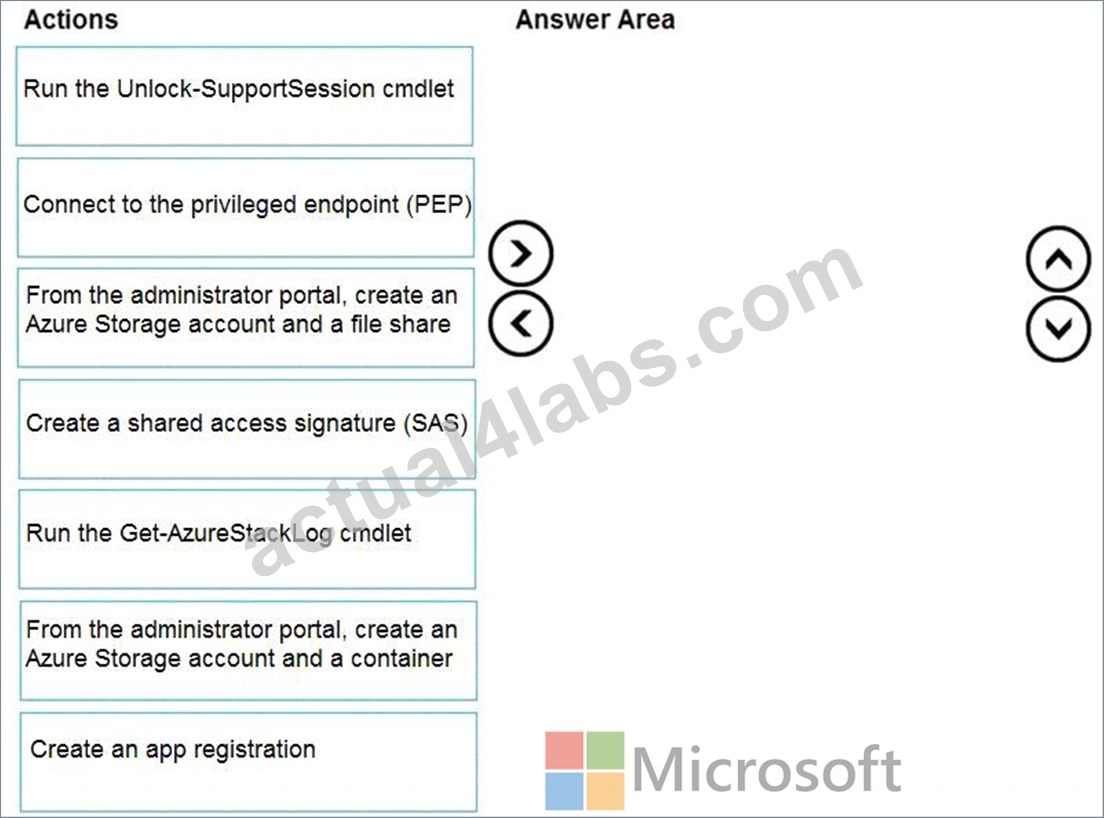
Answer:
Explanation: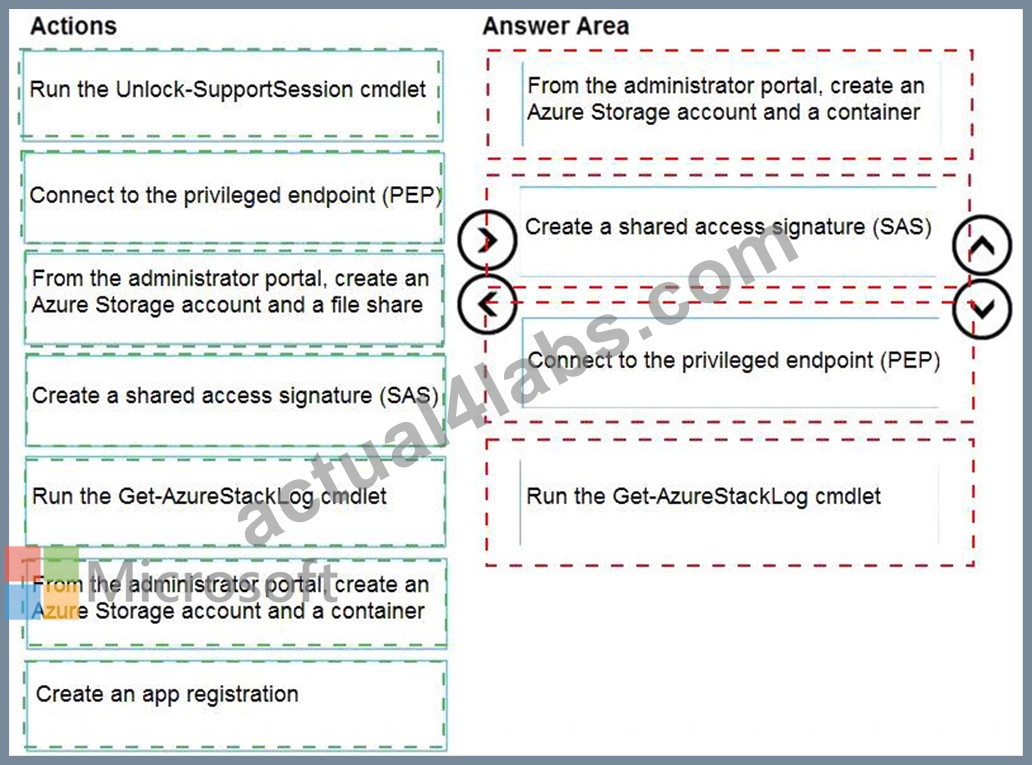
Explanation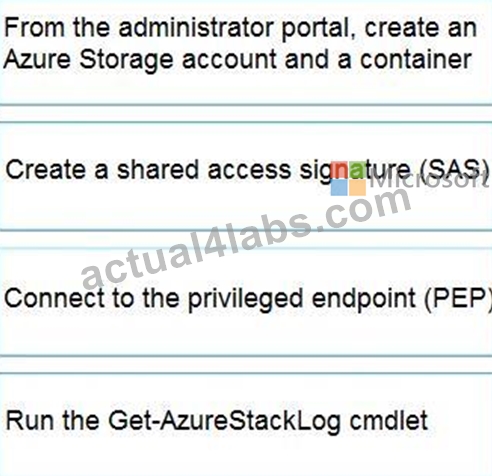
Reference:
https://docs.microsoft.com/en-us/azure-stack/operator/azure-stack-get-azurestacklog?view=azs-2008
NEW QUESTION # 31
You have an Azure Stack Hub integrated system.
You need to ensure that you can recover managed and unmanaged disks that are deleted from user subscriptions.
Which three actions should you perform in sequence? To answer, move the appropriate actions from the list of actions to the answer area and arrange them in the correct order.
Answer:
Explanation: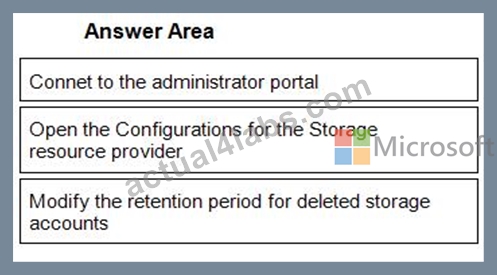
1 - Connet to the administrator portal
2 - Open the Configurations for the Storage resource provider
3 - Modify the retention period for deleted storage accounts
Reference:
https://docs.microsoft.com/en-us/azure-stack/operator/azure-stack-manage-storage-accounts?view=azs-2008
NEW QUESTION # 32
......
Microsoft AZ-600 certification exam is a valuable credential for IT professionals who want to demonstrate their expertise in configuring and operating a hybrid cloud environment with Microsoft Azure Stack Hub. It is a challenging exam that requires a deep understanding of Azure Stack Hub architecture, deployment, configuration, management, and troubleshooting. By earning this certification, candidates can enhance their career prospects and demonstrate their skills and expertise to potential employers.
Azure Stack Hub Operator Associate -AZ-600 Exam-Practice-Dumps: https://www.actual4labs.com/Microsoft/AZ-600-actual-exam-dumps.html
AZ-600 Premium Files Test pdf - Free Dumps Collection: https://drive.google.com/open?id=1Iq1-YF3ZXAuxUcMJnR31fkUtf9Rgw6ig